
Blogs 09 2016 - 07 2017
Laura gives a researcher's perspective on what it's like to attend the largest medieval studies conference of its kind in Europe.

from www.leeds.ac.uk
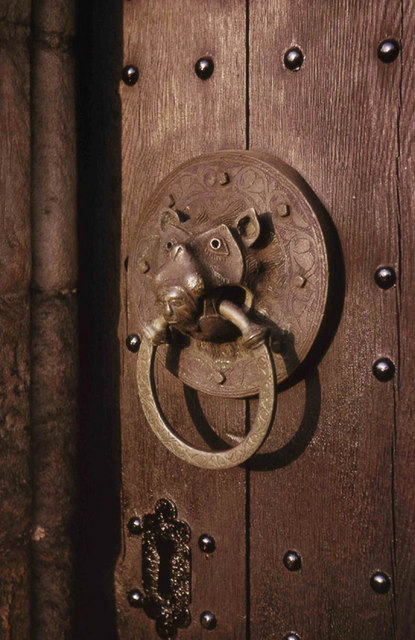
From 3rd-6th July, I attended the 24th International Medieval Congress at the University of Leeds. I have been attending the Leeds IMC for several years now. The conference used to be held at a now-demolished block of university residences and classrooms towards the north of Leeds, in Adel. A colleague liked to call it ‘medieval boarding school’, but there was an interesting 1150-1170 parish church to go and visit whenever you started getting cabin fever.
Norman door ring from nearby Adel parish church - John Wray
Since moving to the city centre, Leeds has only got bigger - more talks, more delegates and more round tables, events and field trips. These days, the final day of the conference is marked by a celebration of all things medieval.
So what keeps me coming back year after year? I find Leeds is a great way to keep in touch with the range and variety of work being done in the different areas of my research interests. In sessions sponsored by research networks and societies such as the Society for Fourteenth-Century Studies, I can meet PhD students and early career researchers, and find out about unpublished work that is still-in-progress. I can also meet archivists and scholars working outside universities, in places such as the London Inns of Court or the History of Parliament Trust.
The internationalism of Leeds is also a major draw. Research projects from across the globe come to sponsor panels and sessions and present on their work at the IMC. In just a few days in the same place, I can find out about interesting research projects that I might never hear about otherwise.
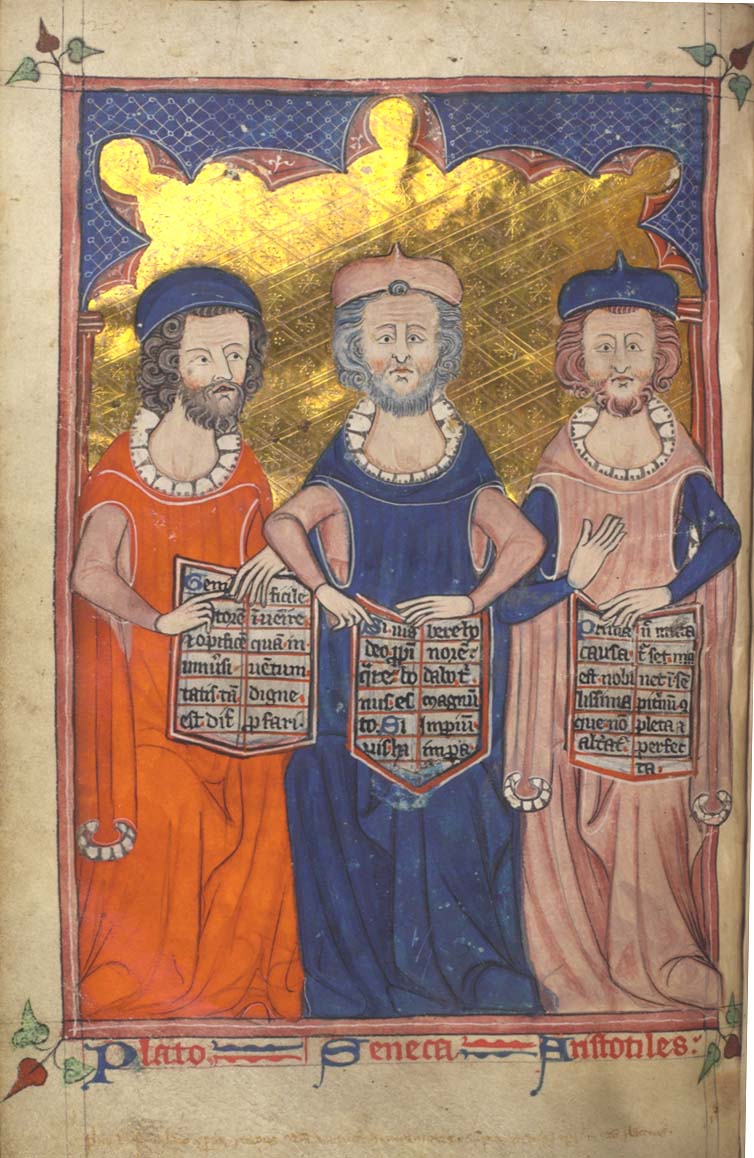
Plato, Seneca, Aristotle. 14th Century (MS Hunter 231)
A longer-term benefit of going to Leeds is the improved ‘general knowledge’ of medieval studies you gradually acquire.
Dropping in on interesting-sounding sessions that are completely outside your research area, and listening to papers on Carolingian clerics or medieval Ethiopia, is a great way to keep your intellectual horizons open. Some of the specialist insights and approaches found in these papers can be applied to your own work, or they may inspire something new.I also get to appreciate the breadth of medieval scholarship as a whole. Turning to a random page in the conference programme, there is a choice between papers on ‘Byzantines and Seljuks on the Roads of Central Anatolia’, ‘Arabic Love Poetry at the Norman Court of Palermo’ and ‘Middle English Hippiatric Treatises'.
They also enrich your teaching, for academics never teach only on the subjects that they research and write about. A paper heard at Leeds on very specific details of pilgrimage to Rome, for example, may suddenly come in useful if you are asked to teach an introduction to the medieval cult of saints and relics. It also means that your students will get taught the latest research and thinking on a topic, even if they might not realise it. They are more likely to think what a strange person you are for knowing such obscure facts…
In the second part of his blog set on political infighting in ecclesiastical courts, David Murray discusses factions, revenge, and nepotism.
Lucan famously wrote in his Pharsalia ‘Exeat aula qui volt esse pius; virtus et summa potestas non coeunt’ (‘Leave the court if you want to be virtuous, for virtue and great power do not go together’). Quoted in the twelfth-century philosopher and churchman John of Salisbury’s Polycraticus, this advice clearly struck a chord in the medieval world. Court criticism certainly colours much of the literature of the time and beyond. Think of the digs, sly and otherwise, that are so often made about King Arthur’s court in romances from the dawn of the genre in the twelfth century all the way up to Mark Twain’s A Connecticut Yankee in King Arthur’s Court.
‘Leave the court if you want to be virtuous,
for virtue and great power do not go together’
An institution that ‘hangs’ around one person, and where preferment depends on seeking the favour and presence of that one person will inevitably give rise to in-fighting. And ecclesiastical courts are no different.
As I mentioned in my last post, the election of Gregor Schenk von Osterwitz as the provost in Salzburg in 1386 is a perfect example of revenge being a dish best served cold. It came to the rage of Ortolf von Ovenstetten who expected to succeed his own brother, the previous incumbent. The Archbishop of the time, Pilgrim von Puecheim, had been waiting for two decades to side-line the Ovenstetten brothers and their friends—his enemies—in Bavaria. This, however, is to look at the affair only from the side of the Bavarian faction. Seen from the other side of the divide, it was merely Gregor Schenk von Osterwitz’s reward for long service. He had, after all, spent a decade as scholaster from 1371-1382, after arriving in Salzburg from the college of canons at Arnsdorf near Dresden.
The rewards (just desserts or otherwise) did not end there; Gregor was elected Prince-Archbishop on Pilgrim’s death in April 1396. This was certainly not surprising, though may well have raised eyebrows (or, more likely, hollow laughs) among the locals in the Getreidegasse. This is because, the year before, a Papal order commanded Pilgrim to investigate Gregor for falsely imprisoning two men, Dietling Pellendorf and Rudolf Turs. Pilgrim, always a loyal servant of the pope (in this case Boniface IX), appointed an investigator. By an extraordinary coincidence the investigator happened also to be his nephew—what are the chances of that? So perhaps Gregor’s rise was not so resistible. Gregor was certainly not forgiving about the episode: when he was elected Archbishop, the canon who delivered the papal letter, Friedrich von Pernegg, was sent on extended gardening leave at the universities of Vienna and Prague.
Given that, in my own field of literary studies at least, much of our perception of the court comes from the secular world, one is often tempted to think things might be rather different at an ecclesiastical court. The machinations of the canons at Salzburg rapidly disabuse of the reality that this was far from the case. This all leaves us asking more questions: what exactly is it (if anything at all) that makes the ecclesiastical court different?
Even if the ruler did not inherit his position from his father, there is still evidently a place for heredity—just think about Ortolf von Ovenstetten’s expectations of succeeding his brother—as well as nepotism. Pilgrim the Prince-Archbishop had a particular flair for this, and managed to place two of his nephews (not the one who investigated his successor, though) as suffragan bishops in Chiemsee and Seckau. Perhaps the long view is important here: where a king can dismiss lackeys with relative ease, a bishop, abbot or other churchman is part of a fixed hierarchy, where there is always a higher instance, normally Rome. Sometimes, in more political affairs, local rulers and the Empire too. Then, of course, there’s God too…
In our latest 'Meet the Researchers' slot, resident art historian Laura talks source material, 'women's history', and the space between power struggles.
You’re the art historian on the project, so what sort of questions are you asking of the source material?
The American painter Edward Hopper supposedly said: ‘If you could say it in words, there would be no reason to paint’. I think it’s always a useful starting point to ask: what can this image suggest, or explain, or reveal, that a textual document cannot? For my project on Queen Philippa, we can look at official records of her property transactions and her gifts to servants and petitioners. But there are very few surviving household accounts that tell us what the queen actually did all day, or what she enjoyed on a cultural and intellectual level. Looking at the manuscripts she owned can give us an insight into Philippa’s wider interests, and a window into her more ‘private’, devotional and emotional world. We can consider Philippa as a thinking and feeling human being, as well assessing her on a public and political level as a queen of England, a wealthy and powerful landowner and a member of a pan-European aristocratic elite. The images found in Philippa’s manuscripts are not simply ‘illustrations’, but a unique form of historical evidence.
The role of women in history had quite a renaissance in different historical disciplines a while back. Do you think this trend is continuing?
‘Women’s history’ (formerly put in inverted commas) may have been a new and fashionable historical subject in the seventies, and it clearly developed alongside what was seen then as new and radical feminist theories.
If you don’t think that women matter, then of course, their histories won’t matter to you either.
But these histories (and many others), are still there to be explored
Decades later, the study of women is firmly established across the different disciplines that make up the arts and humanities. We cannot understand the past if we are only studying a small subsection of its population. This doesn’t only apply to women, of course. And privilege still matters. Philippa might do many similar things to other aristocrats, but as a queen, she is exceptional even in an elite context. And her life was very, very different to the lives of the vast majority of medieval women.
So how do you investigate Philippa's life?
Getting a more complete social picture of the past can be difficult due to the nature of the surviving source material. Philippa’s husband, Edward III, for example, seems to go around doing lots of things: signing letters, giving orders, waging war and travelling about.
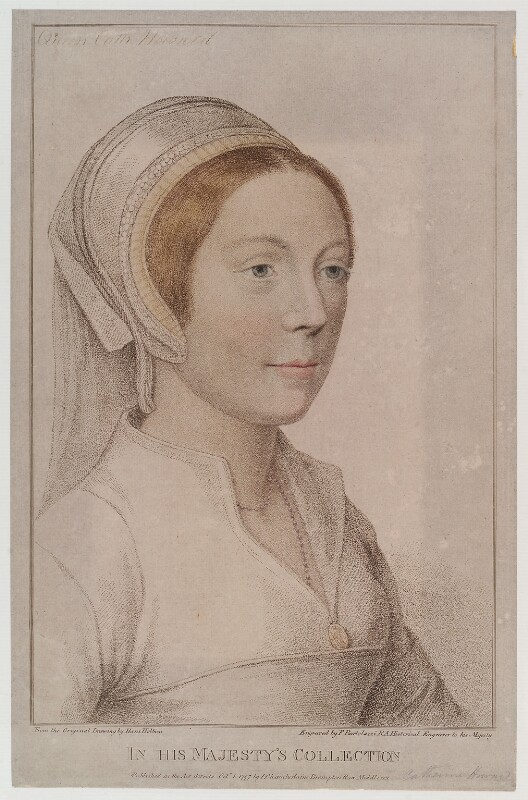
Unknown woman engraved as Catherine Howard (NPG D20279) © National Portrait Gallery, London
This leads to a lot more paperwork in his name, and a lot more historical sources to investigate. Similarly, just as journalists today are much more interested writing about the prime minister than an ordinary person, the historical chroniclers of the time were also focussed on what the king, rather than the queen, was doing. This can leave the impression that the queen was not really doing much at all, beyond having babies and perhaps making the occasional ceremonial appearance at court, giving out gifts and favours. Philippa was certainly doing things, but the vast majority of these activities were enacted, recorded and accounted for in her husband’s name. The result is that the only activities we seem to see Philippa doing are those distinctively female activities (such as childbirth) that cannot be credited to anyone else. So studying women’s history is in part a matter of looking at all the available historical sources from a different perspective- asking not just ‘what happened?’ but ‘whose viewpoint are we seeing here?’ And there remains a political aspect to it. If you don’t think that women matter, then of course, their histories won’t matter to you either. But these histories (and many others) are still there to be explored and investigated, even if the evidence for them may sometimes be more fragmentary than we’d like.
How would you explain the MALMECC project to interested members of the general public?
I would say that the MALMECC project is about exploring the world of medieval European courts as a whole.
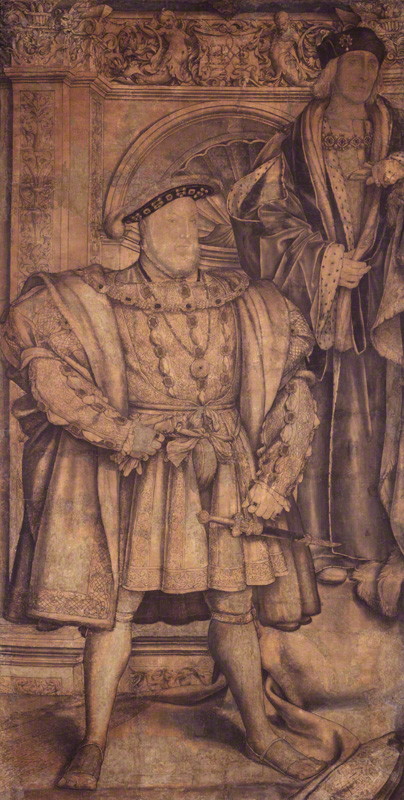
King Henry VIII by Hans Holbein the Younger (NPG 4027) © National Portrait Gallery, London
If we were thinking about ‘culture’ at court, and perhaps considering art, books and music in turn, before assessing the court as a political institution or social environment, as researchers we would be completely missing the point of ‘life at court’ in the Middle Ages and beyond, which is the interplay and interactions between all these different elements.
To take a later example. The fifth wife of Henry VIII of England, Catherine Howard, may have started a romance with Thomas Culpeper around 1540. They attended the same court functions, such as the May Day tournaments, or when she gave out gifts and favours on Maundy Thursday. And as Culpeper had been a gentleman of the Privy Chamber since 1537, in close personal attendance on the king, there were other opportunities for them to meet, and lots of plausible reasons for him to be passing in and out of the queen’s chamber, receiving letters from her, or dealing with her servants. So the social and cultural life of the Tudor court cannot be separated from the political upheavals and faction fights it fostered. And as Henry VIII aged, the fates of his friends, wives and ministers depended more and more on the king’s mood. If the king had been up late feasting the night before, and was now feeling tired and irritable, who knows what might happen? This is why court culture can matter so much- there is more to it than the space in between the power struggles.
What’s the most exciting thing about the project for you?
For me, the musical aspect of the project is particularly new and exciting. While I’m a very interdisciplinary medievalist, this is not an area I’ve engaged with before. It’s proving to be a very interesting learning curve! Because art historians usually view manuscripts and artefacts in the silence of a library reading room or museum collections room, I also think it can be too easy to ignore the sonic dimensions and performative aspects of these objects. MALMECC ensures that these elements are at the centre of our analysis.
The second exciting element of the MALMECC project is its transnationalism. It’s easy to focus on Philippa simply as ‘the queen of England’, but much more valuable to think of her as a transnational courtly figure. Philippa remained in close touch with her natal family, and her continuing links with the Low Countries were crucial to Edward III’s diplomatic efforts throughout the Hundred Years’ War. Philippa gave birth to two of her children in the Low Countries (Lionel of Antwerp and John of Gaunt, or Ghent) and travelled abroad regularly with her husband. Thinking about her cultural patronage from this transnational perspective is especially useful.
What are your interests outside of academia?
I enjoy yoga, going for walks in the countryside and now I’m getting more settled in Oxford, I’m hoping to start riding horses again.
In the latest MALMECC blogpost, our literature scholar David Murray talks about political wheezes and back-stabbing in the reign of Pilgrim von Puecheim. David is working on the subproject ‘The “Monk” and the Prince: Court Culture and Song in Late-Medieval Salzburg'
I recently heard a senior medievalist observe, ‘When I was a graduate student, we didn’t have the internet. We had Germans instead.’ The thought often comes to mind when flicking through vast series like the Monumenta or dictionaries like Friedrich von Wartburg’s Französisches Etymologisches Wörterbuch. At the other end of the scale sit smaller works of intellectual and technical intricacy. Indeed one of my most recent scholarly debts falls at this end of the chart. My gratitude is due to two Austrian scholars, now long dead, Hans Wagner and Herbert Klein who, in 1953, scraped together everything known about the members of Salzburg’s secular clergy. Put in such bald terms, it hardly sounds promising. However, an elaborate game of hide and seek in the civic archives leads one through several hundred years of political wheezes and back-stabbing. A particular highpoint for skulduggery seems to have been the reign of Pilgrim II von Puecheim (1365-96).
The 1321 font in Salzburg cathedral, resting on lions from c. 1180 is all that remains of the medieval building the Ovenstettens and Pilgrim knew, which was irreparably damaged by snow and rain after a fire in December 1598. See website for images www.salzburger-dom.at
The writing was, in a sense, on the wall from the start of his reign, when Pilgrim was imposed on the Domherren by the Pope in Avignon, to the considerable displeasure of two brothers, Eberhard and Ortolf von Ovenstetten. Eberhard, provost at the time, and a member of the community for the past three decades, had hoped that Ortolf would be elected as Prince-Archbishop. Add to this the fact that Pilgrim was allied with Clement VII in Avignon whereas the Ovenstettens’ Bavarian alliances led them to side with Urban VI in Rome, and it becomes more understandable why the next decades were so eventful. On top of all of this, when the young Pilgrim had been a student in Avignon, he had had to open legal proceedings to force Eberhard to pay him the income from his Salzburg benefice. Nothing worse than coming between a student and his beer money…
An uneasy peace was maintained for almost two decades (by 1377 Ortolf was a member of Pilgrim’s council) until the Salzburg
synod of 1380 when the Ovenstettens’ implacable devotion to Rome came to the surface again. (There was, incidentally, another Ovenstetten brother, Otto, who studied with Ortolf in Bologna. Nothing more is known of him, but one imagines him, rather like the third Attenborough brother, enjoying a quiet life and wondering why elder siblings are such a nuisance…)
Gold coin of Pilgrim II. The inscription refers to PILGRIMVS ARCHIEPISCOPVS - Archbishop Pilgrim. (Landesmuseum Württemberg)
Eberhard died in 1385, and Ortolf was duly elected, with a majority of 4-2, to succeed his brother. But in 1386, Gregor Schenk von Osterwitz was invested by the Prince-Archbishop as Provost, and the Salzburg Four fled to Bavaria. A series of begging letters from this Bavarian fraction bear witness to the uphill struggle to get back into Pilgrim’s good books. This was unsurprisingly hard work, since the figure-head of the faction, Friedrich, Duke of Bavaria, had taken Pilgrim prisoner in the Cistercian monastery at Raitenhaslach in 1387.
Ortolf seems to have made his peace with Pilgrim, and is recorded in Salzburg in 1390, where he died two years later.
Who needs House of Cards or The Thick of It when, thanks to Wagner and Klein, we have the Salzburg Domherren? In my next post, I’ll come back to the prodigal son, Gregor Schenk von Osterwitz, another ruthless politcal mover, and his inevitable rise.
On 27th-28th April 2017, the MALMECC project hosted its first workshop on: ‘Methodological Innovation in Late Medieval Studies’. Hosted by Wadham College, Oxford, a multidisciplinary group of medievalists from countries across Europe as well as North America joined us to debate new ways of approaching medieval sources and explore new methods of historical, art historical, literary and musicological investigation.
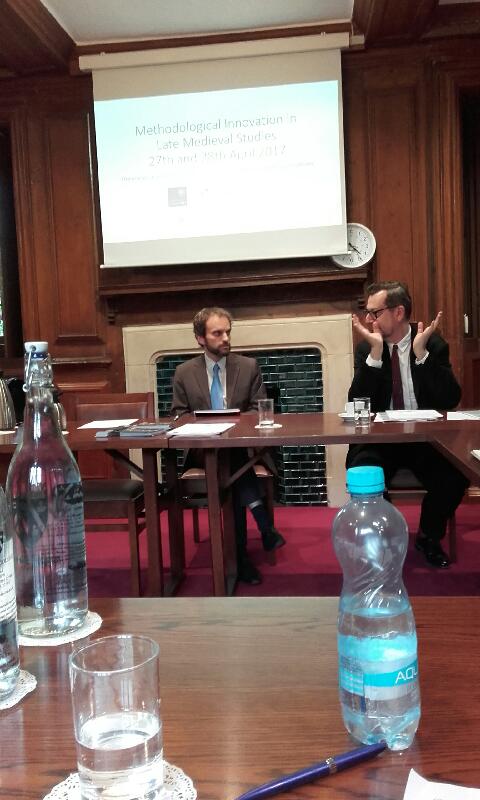
On Thursday morning, the workshop opened with a presentation from the MALMECC team, introducing the project in more detail and setting out some of the academic challenges facing us. This was followed by position papers from Elizabeth Eva Leach and Andrew Albin, sparking a lively debate about the extent to which medieval tournaments, plays and literary fictions ‘straddled’ the boundary between daily life and the imagined worlds of courtly love, medieval drama and cultural game-playing or performance.
In the afternoon, Ruxandra Marinescu and Mary Carruthers encouraged discussion of the many
meanings and functions of rhetoric in medieval culture, considering the concept of ekphrasis and the creative value of perplexity in particular. The role of pictures and musical notation in manuscripts such as the Roman de Fauvel (Paris, Bibliothèque Nationale de France, MS Français 146), and the problems of performing such a complex, ‘multimedia’ work in a court context were carefully examined.
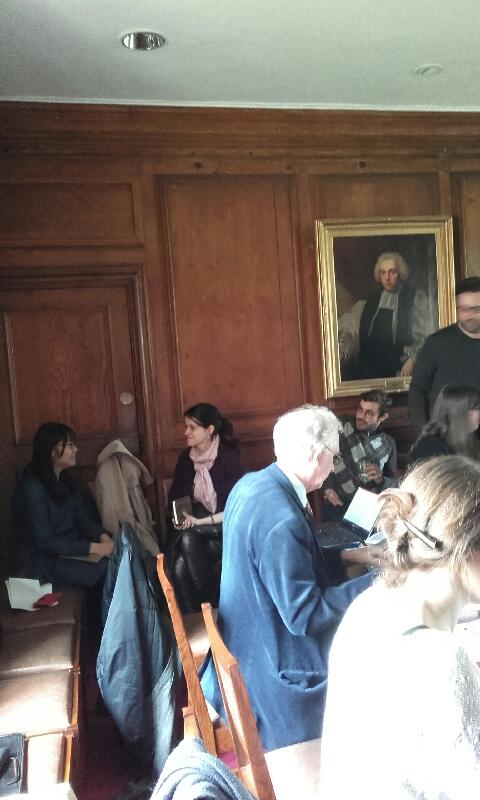
On Friday morning, John Harper introduced us to his fascinating ongoing research project, The Experience of Worship. We explored what the enactment of medieval liturgies and the recreation of medieval artefacts could reveal about the experience of worship in the medieval cathedral and parish church. Anna Kvičalová provided a Reformation-era perspective on pre-modern processes of seeing and hearing, discussing the new modes of listening that emerged in mid-sixteenth-century Geneva.
On the Friday afternoon, there was further discussion of the religious experiences of the laity and the role of the senses in medieval devotion.
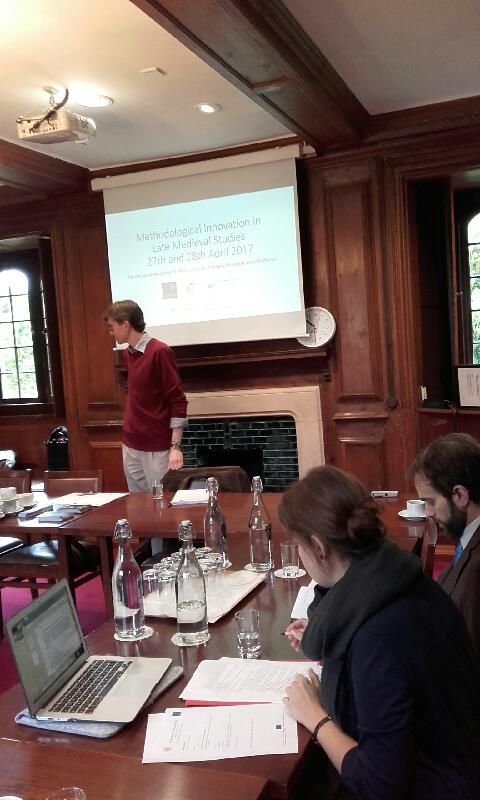
Kathryn Rudy reviewed her investigations of the physical uses of medieval manuscripts by their users, including her use of a densitometer to measure the grime that original readers deposited in their books. Finally, Ursula Gießmann discussed the textiles of the papal court of Felix V in Basle and their place in ceremonial and performance.
Formal presentations were kept to a minimum to allow time for debate and discussion amongst all participants.
The insights and intellectual contributions of all attendees have enriched the MALMECC project enormously. We thank everybody for coming with such interest, enthusiasm and intellectual generosity, and the staff at Wadham for their invaluable assistance. We hope that this shared workshop experience proves as intellectually exciting and methodologically valuable for all its participants as it has done for the MALMECC team.
In the General Prologue of The Canterbury Tales, Geoffrey Chaucer introduces the worthy and virtuous Knight, as one who ‘loved chivalrie,/Trouthe [truth] and honour, fre[e]dom and curteisie [courtesy].’ (lines 45-46). He stresses the knight’s crusading heroics, saying that he had ridden ‘As wel in Cristendom as in hethenesse [heathen areas]’, fighting at ‘Alisaundre...whan it was wonne’. The dramatic capture of the Egyptian city of Alexandria in 1365 by Peter of Cyprus was one of the great crusading victories of the fourteenth century. The Knight was also present ‘In Gernade at the seege eek hadde he be/Of Algezir’, probably a reference to the 1344 siege of Algeciras. Going on to namecheck other famous crusading battles, Chaucer is making it clear to his audience that the Knight is a warrior to be greatly respected, who spent his youth engaged pious and honourable acts. As he was writing in the late 1380s, these past glories also underline the Knight’s great age.
Chaucer completes the Knight’s ‘greatest hits’ of glamorous and iconic crusading destinations when he tells us that:
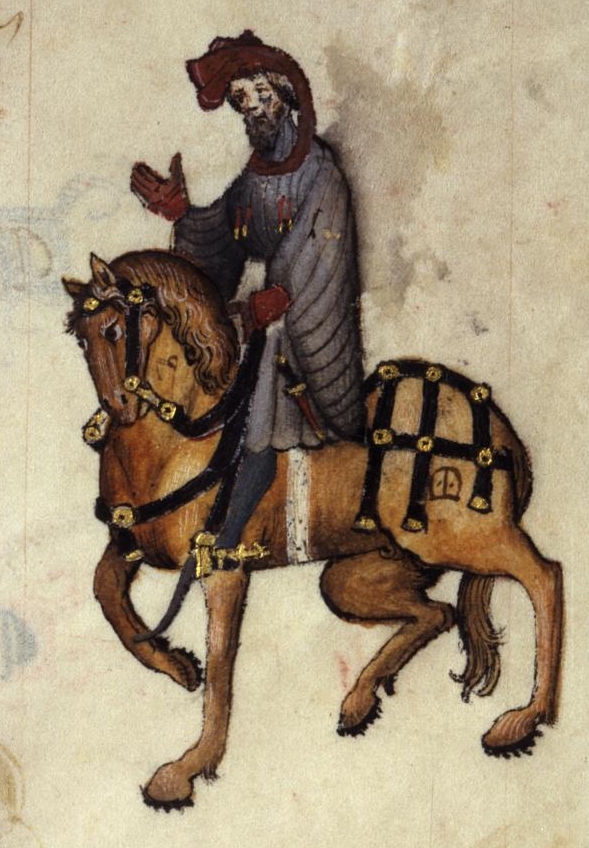
'The Knight' from the Ellesmere Chaucer, Huntington Library. EL 26 C 9 f.10
'Ful ofte tyme [often] he hadde the bord bigonne [sat in the place of honour]
Aboven alle nacions in Pruce [in Prussia]
In Lettow [Lithuania] hadde he reysed, and in Ruce
Chaucer’s original audience would have immediately understood the verb reysed, although the term is a Middle German one. The Reisen (journeys) were the seasonal campaigns conducted by the Teutonic Knights of Prussia in the ‘heathen’ Baltic regions and western Rus. The Teutonic Knights attracted enthusiastic volunteers from all across Europe, all arriving ready to fight (and so saving the Knights a great deal of money, as then they did not have to raise professional armies or buy expensive military equipment). In return, the Knights offered the perfect crusading package tour.

Marienburg Castle, built by the Teutonic Knights in Malbork, Poland - © Thomas Stegh
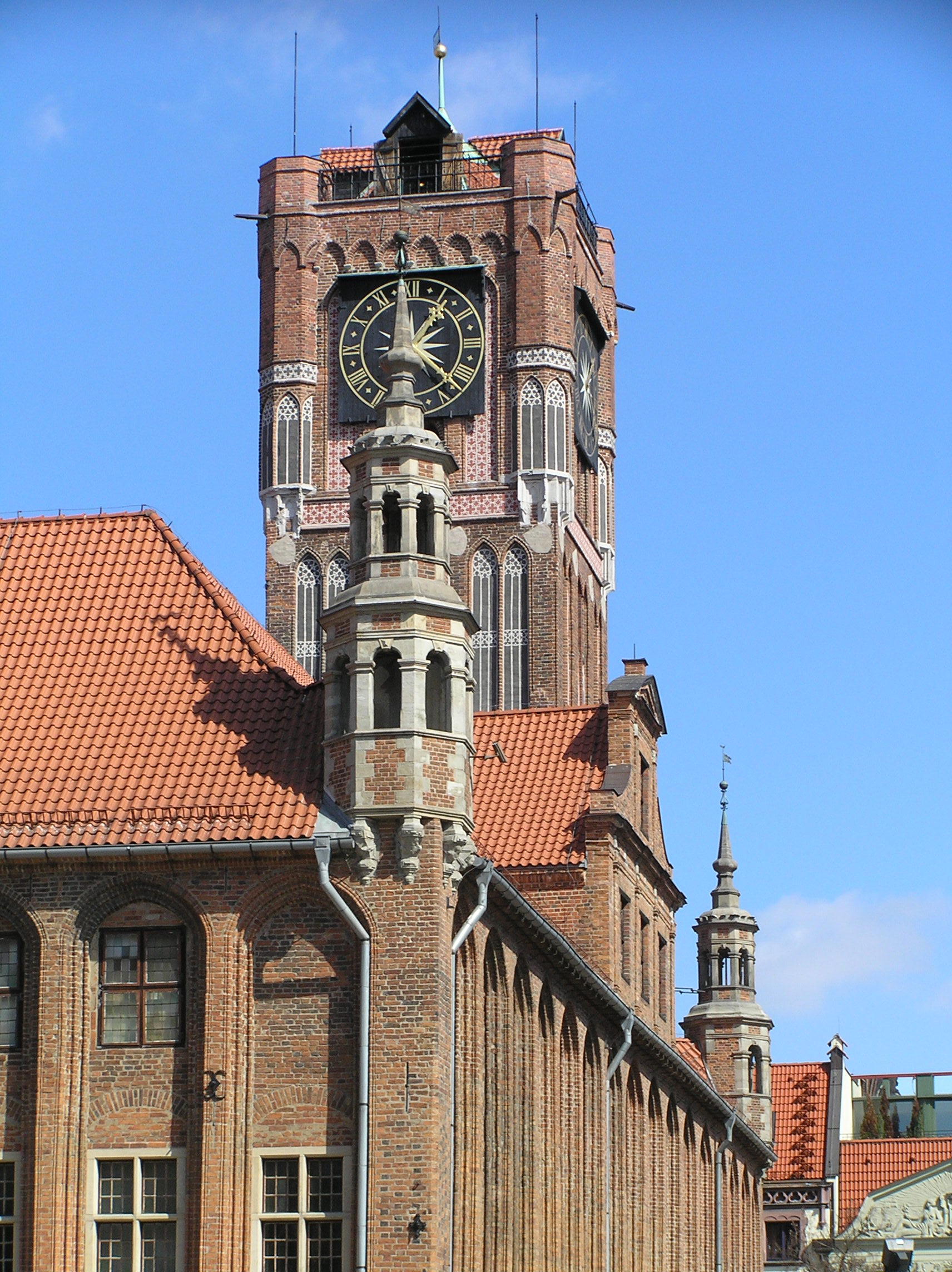
Old-Town Hall of Toruń, Poland. © Pko
You could stay for as little as a few weeks, or for months at time. The Knights provided guaranteed fighting against pagan ‘infidels’, so everybody could go back home and boast about their military exploits. In the frozen wastes of Lithuania in the winter, with even rivers and marshes iced over, it was impossible to fight pitched battles. Instead, short-term tactical raids or reysas were the order of the day. You could go out to fight for a few days or weeks, before returning to the warmth, safety, good food and on-site entertainment provided at the Order’s castles, especially at Königsberg (now Kaliningrad in Russia) or Riga (today the capital of Latvia). And if you didn’t fancy joining that day’s reyse, you might go hunting. Or you might go and visit a large town not too far away from the heathenesse: places like Marienberg (now Malbork in Poland), Thorn (now Toruń in Poland), Elbing (now Elbląg in Poland) or Danzig (now Gdańsk in Poland). All of these towns were large and thriving centres.
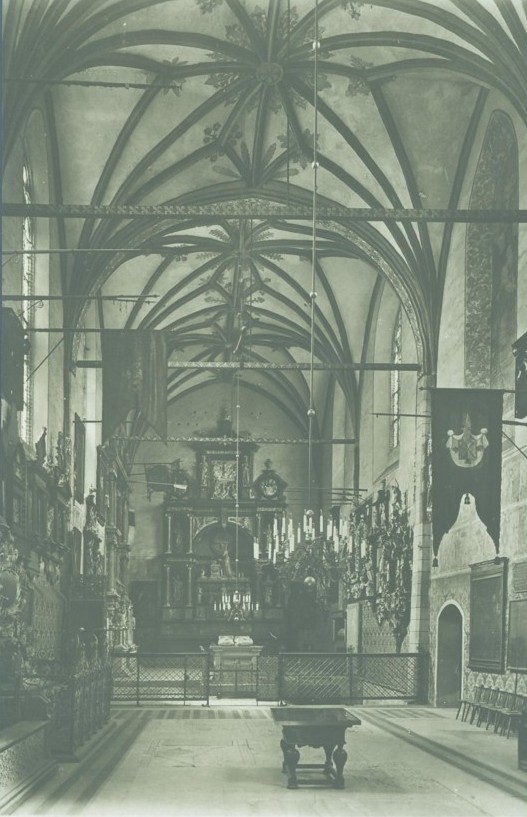
The choir of Konigsberg Cathedral, now situated in Kaliningrad, Russia
You might visit only to buy horses and supplies for your next reyse. But you could just as easily go shopping for luxury goods and souvenirs. Or you might spend some time visiting shrines and churches, such as St Mary in Königsberg, full of memorials to nobles killed on the reyse. Piety was an important part of the reyse, with most crusaders attending daily Masses. The Teutonic Knights organised their reysen not only for when the terrain was passable, but around the major feasts of their patroness, the Virgin Mary, such as the feast of her Purification (2nd February).
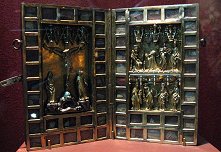
Reliquary made in Elbing in 1388 for Teutonic komtur Thiele von Lorich - © Maciej Szczepańczyk
After the raids, or in the more extended summer campaigns, the prolonged sieges, the crusaders could enjoy feasts and banquets galore. There were regular special prizes to be won, awarded for noble deeds and daring chivalric feats. Most coveted was a place at the Ehrentisch, the table of honour sat in by Chaucer’s Knight. So after a short season away from home, the keen crusading knight would arrive back at court with useful ‘combat experience’ to put to service in his king’s wars, some thrilling stories and things to boast about, interesting souvenirs, many new friends and even some useful contacts abroad.
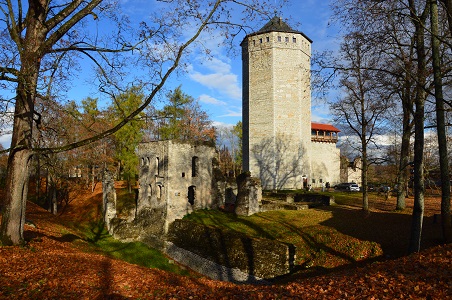
Teutonic Order Castle, Paide, Estonia - © Ivo Kruusamägi
This might make time on the reyse sound like the perfect student gap year for medieval nobles. And a campaign or two with the Teutonic Knights was certainly seen as a useful military apprenticeship, quite apart from the spiritual prestige that it conferred. But in fact, families would often travel together. Young noblemen were also likely to go on the reyse at a much earlier date than we might imagine. William Beauchamp and his brother Thomas went on crusade in Prussia in 1365, when he was just eleven years old. In contrast to other medieval theatres of war, the reyse was relatively safe: someone as small as William would have been protected by a heavily-armed retinue out in the field, and left behind in the Order’s castles when necessary.
Yet as Timothy Guard points out in his recent study, this wasn’t even William’s first crusade. The year before, aged just ten, he had been present at the battle of Nájera. When we are thinking about European court cultures, this aspect of courtly life can be easily forgotten. Edward III of England took part in his first battle at the age of fourteen. For all the courtly fun and games of knights competing in tournaments dressed as Tartars, or banqueting at the Ehrentisch, these men had been fighting since they were children.
In the second of her three blog posts on court cultures and the crusades, Laura Slater looks at how going on crusade could be a massive boost to one's chivalric reputation
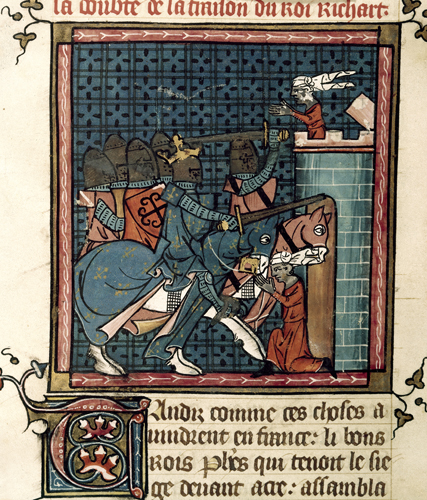
'Capture of Acre' Grandes Chroniques de France (BL Royal 16 G VI, f. 352v) - British Library
Princes as well as courtiers dreamed of going on crusade. In late medieval Europe, rulers were supposed to act as rex crucesignatus (‘the crusading king’): the perfect Christian monarch, always working towards the recovery of Jerusalem, and always ready and willing to lead their men into battle against the 'infidel'. In practice, however, most kings had responsibilities that kept them at home throughout their lives. Few rulers who took crusading vows were ever able to fulfil them.
So as a way of living up to the spiritual and secular ideal of the crusade, rulers were likely to offer knights going on crusade their protection and help: licences to travel abroad, letters of introduction and most importantly, extra money to meet the astronomical cost of equipping a miniature army and then shipping it thousands of miles across land and sea.
If you came home alive from your crusade, with lots of exciting stories to tell about exotic people and places, or death-defying combats with the enemy, the court was also one of the places where returned crusaders might reap more tangible, earthly rewards from all that hardship and heroism. Crusading missions were international ones. Knights from all across Europe joined the 1366 crusade of Amadeus VI of Savoy. Travelling and fighting in such a multinational group would spread word of your valour and glory throughout many lands. This kind of chivalric reputation was a huge career boost, perhaps helping you become an intimate of the king’s chamber or make a great marriage to a wealthy heiress once you arrived back home.
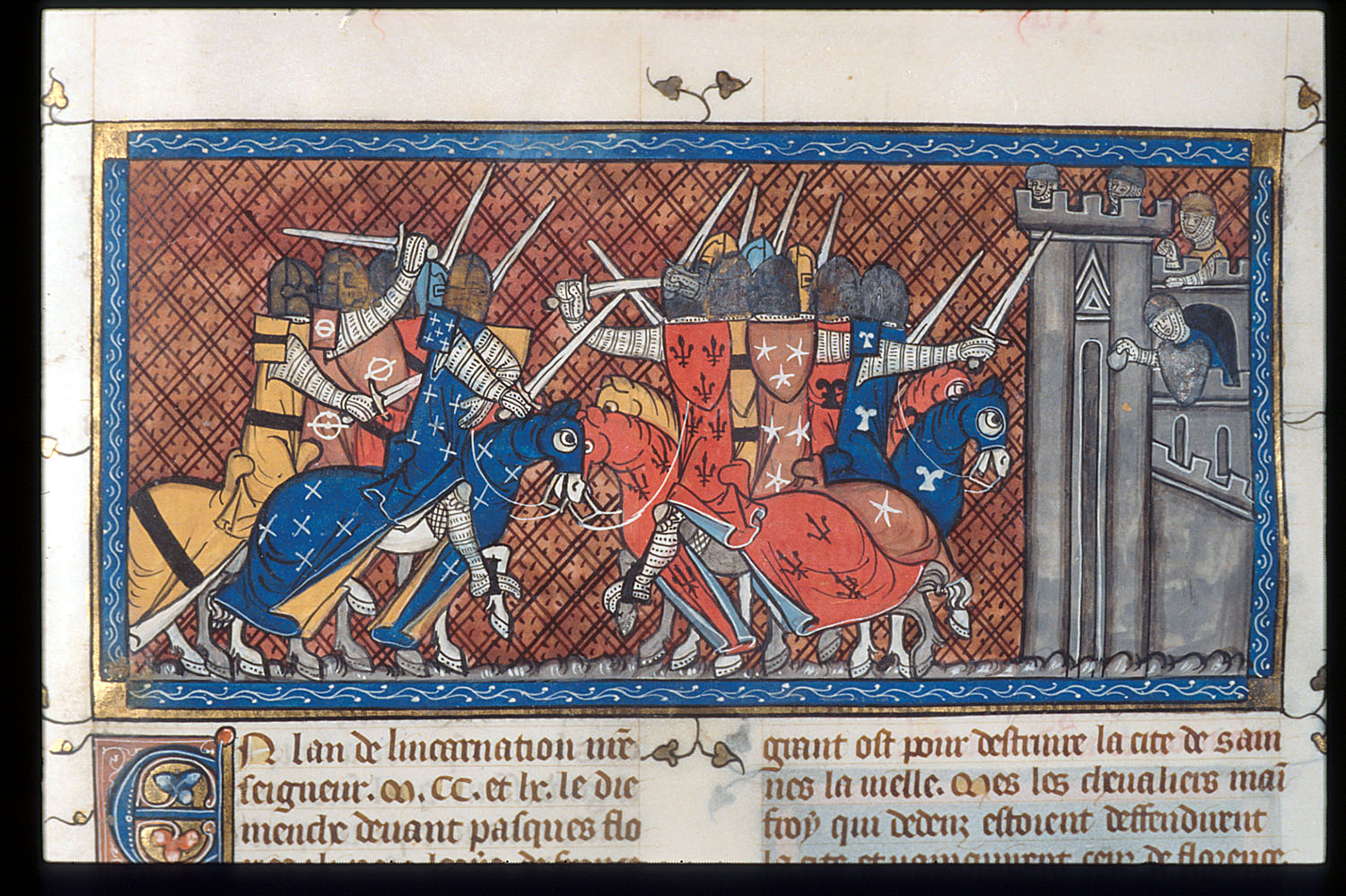
'An Attack of the Tartars' Grandes Chroniques de France (BL Royal 16 G VI, f. 427v) - British Library
At the English court, historical artefacts owned by Edward III of England included a supposed ‘helmet of Saladin’ and the dagger used in Acre to try and assassinate his crusading grandfather Edward I in 1274. Edward III’s courtly spectacles also played on crusading themes. In 1331, a tournament at Cheapside in London saw a parade of knights dressed as Tartars (a word used loosely to refer to nomadic Mongol and Turkic peoples from central Asia). Echoing a scene from a famous romance, The King of Tars, the ‘Tartars’ led a procession of noblewomen on silver chains into the jousting arena. The knights fighting in the tournament could play at being the crusading Christian champions of these ‘captives’, winning freedom for them through their victories in jousts and duels.
But late medieval crusading wasn’t just a matter of courtly fun and games….
In a new series of blog posts, Laura Slater examines the relationship between court cultures and the crusades, crusading as a late medieval ideal, and the penitential obligation and social cachet attached to becoming a holy warrior...
When we imagine knights going off on crusade to the Holy Land, we tend to locate this activity in the twelfth century. From the sixteenth century onwards, the legends of Robin Hood have been set in England during the absence of Richard I (‘Richard the Lionheart’) on the Third Crusade in the 1190s, with the kingdom suffering under the rule of his wicked and cowardly brother John.
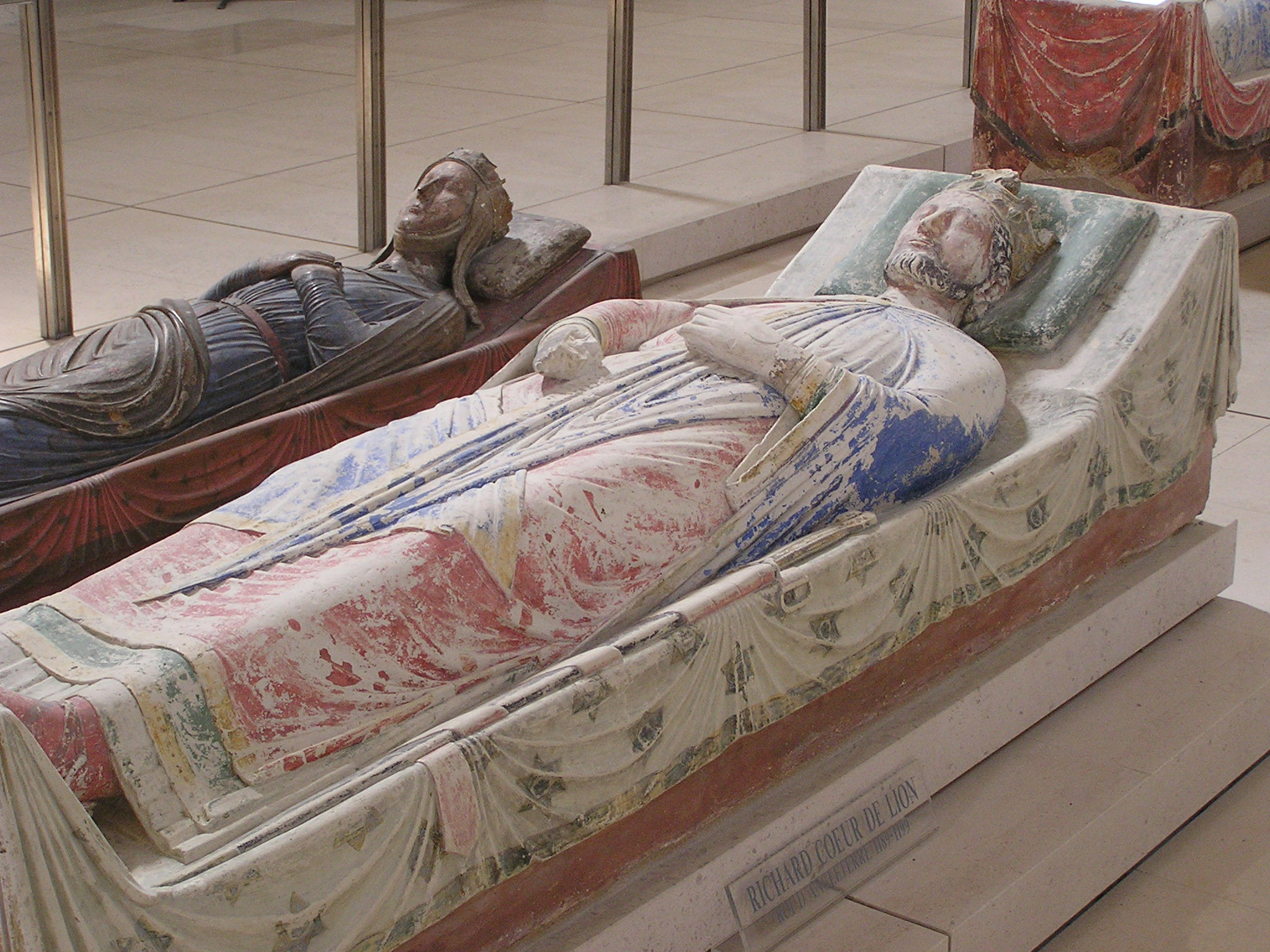
Richard I's tomb at Fontrevault
After the 1291 fall of the last crusader kingdom of Acre, it certainly became more difficult to go and fight for Jerusalem. But crusading remained a very powerful late medieval ideal. Fighting in God’s service was seen as spiritually purifying- a way of gaining forgiveness from God from all your sins. Holy warfare was seen by some as a religious duty and penitential obligation, a way of quieting and healing the soul through physical exertion of the restless body.

David Roberts, 'Isle of Graia' (1839)
There was also a great social cachet attached to becoming a holy warrior. Going on crusade was seen as the ultimate mark of chivalric honour. It was incredibly expensive to travel to faraway places ready to fight in this way. With the exception of a few, lucky early noblemen in the early years of the crusader states, such as the Ibelin counts of Jaffa and Ascalon, there were no great fortunes or estates to be won in medieval Syria and Palestine. Crusaders slogged at an endless grind of defensive warfare, in besieged castles or disease-ridden military camps. To be willing to risk your life and waste your material resources in this way was thought to demonstrate your impeccable noble lineage, the generosity of your Christian spirit and your great knightly virtue.
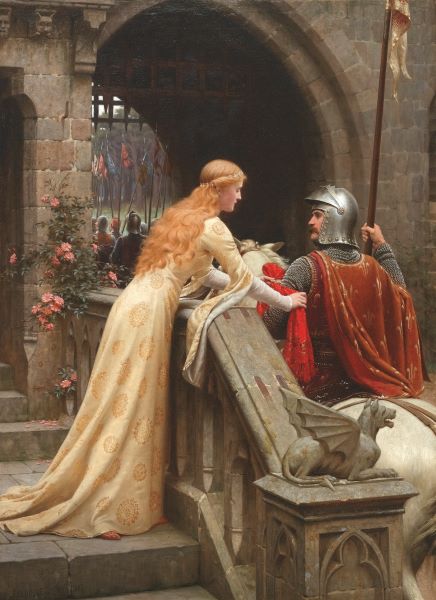
Edmund Blair Leighton, 'God Speed' (1900)
Such a combination of spiritual heroics, and the possibility of secular fame and wealth, made the late medieval European court a hub of crusading enthusiasm and recruitment. It was at court where idealistic knights hoping to prove themselves in battle met and signed up with the ‘professionals’ charged with organising crusading missions: papal envoys from Avignon, diplomatic embassies from Byzantium or Spain, or crusading orders such as the Knights Hospitallers of St John. The increasing threat of the Ottoman Turks to Europe saw the creation of naval leagues financed by the papacy, the Hospitallers, and the great maritime and trading powers of Venice and Cyprus. Throughout the fourteenth century and later, European knights continued to travel to Palestine and northern Syria, fought in modern-day Turkey against the Ottomans, took part in the Reconquista led by the Spanish monarchy, or crusaded on the eastern edges of Europe with the Teutonic Knights of Prussia.
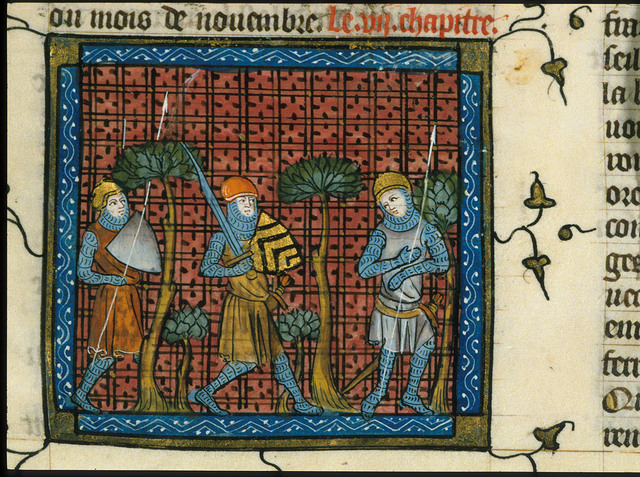
Crusaders from Grandes Chroniques de France (BL Royal 16 G VI, f. 316v) - British Library
At court, knights might hear friars preaching sermons encouraging them to take the cross. They would also come across luxury artefacts depicting ancestral crusading exploits, or relics and souvenirs from the Holy Land. In 1251, Henry III of England commanded that his personal chamber at the palace of Clarendon be painted with the ‘story of Antioch and the duel of King Richard’, either depicting events from the Third Crusade, or the epic romance history of the First Crusade, the Chanson d’Antioche. The Grandes Chroniques de France, a royalist official history of the kings of France coped and circulated at the French court, includes many pictures of crusading heroics by the French kings.
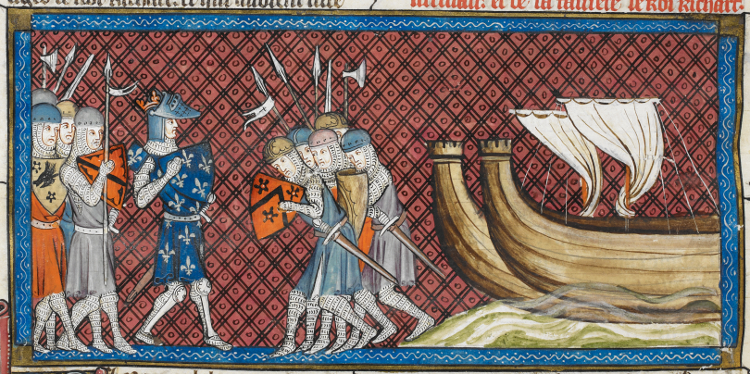
Philip Augustus arriving in Palestine from Grandes Chroniques de France (BL Royal 16 G VI, f. 350v) - British Library
In March, project team member Dr Laura Slater visited the Dr Williams’s Library in London. Her project looks at the cultural patronage of Queen Philippa of Hainault, wife of Edward III of England, focussing particularly on the manuscripts made for her personal religious devotions. One of these manuscripts, a psalter possibly made for Philippa on her arrival in England in 1327, is today part of the collections held by this fascinating library.
Laura’s first priority was to go through the manuscript folio by folio. Like many medieval manuscripts, MS Ancient 6 had been catalogued some decades ago, but not researched, displayed or photographed in any detail since. It is one thing to know from a catalogue that on f.20r there is a depiction of King David, but much more can be learned from seeing this image on the page. How has King David been portrayed? What kind of dress, gestures or expression does he have? The next thing is to think about what these images might have communicated to the medieval viewer, and what kind of deeper meanings or Christian symbolism they may have had.
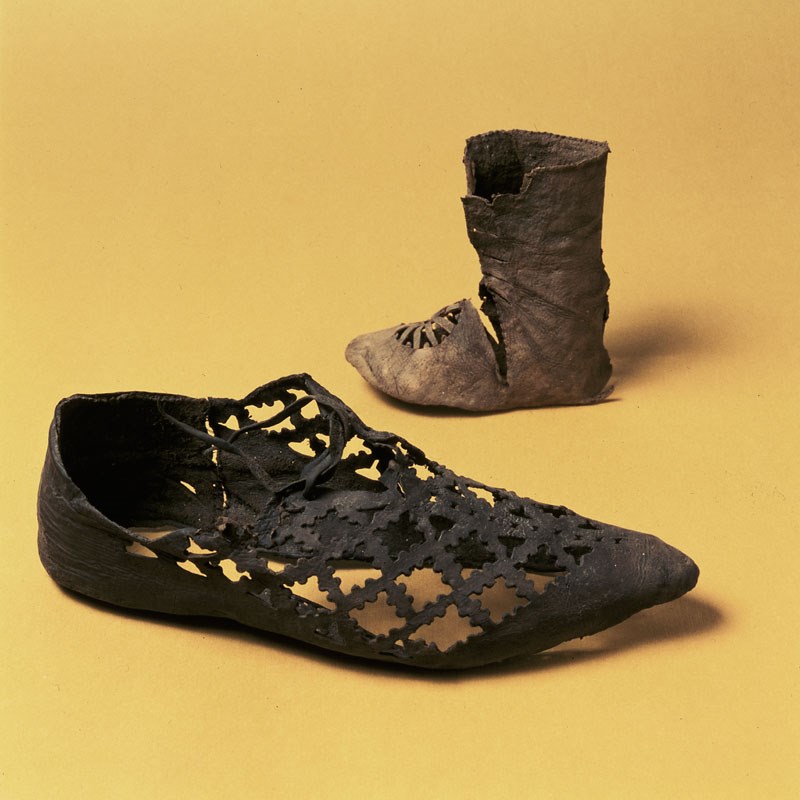
Man's Shoe and Baby Boot (1300-1500) from http://www.stockholmskallan.se/Soksida/Post/?nid=30523 (taken 2016-09-16). On display at the Museum of Medieval Stockholm
On f.20r of MS Ancient 6, for example, David is dressed in elaborate, multi-coloured and decorated robes. His shoes are formed by a complicated pattern of crossed black lines. This is exactly the kind of fashionable shoe mocked in The Canterbury Tales by Chaucer, when he describes a vain young clerk ‘With Poule’s wyndow corven on his shoos’ (l. 210 of The Miller’s Tale). Chaucer was referring here to the complicated, criss-crossing patterns of tracery found in church windows such as St Paul’s Cathedral in London. By dressing a Biblical icon of virtuous kingship in the latest courtly fashions, Philippa’s psalter gives a divine sanction to magnificent courtly display. This subtle visual lesson may have found a willing pupil in Philippa, for we know that in her later life, she spent lavishly on clothes and jewels.
Minute individual details like the state of David’s shoes are never going to be noted down by a cataloguer, so it is essential for the researcher to spend time patiently working through the manuscript, noting down any features that might be of further interest or require more research. A particularly valuable detail to look out for is any marks of ownership and use. Many of the images in MS Ancient 6 are damaged and partly scratched away. Some small human heads in the initials have even been scored out with a cross mark. This tells us that MS Ancient 6 was probably in England during the Reformation, when ‘idolatrous’ images were deliberately destroyed as part of a new Protestant focus on the Word of God alone. Yet the psalter can still be easily read. Such careful iconoclasm suggests that Philippa’s psalter was still being read and used as a book of prayer in the sixteenth century. Its new audience may have been concerned to not let themselves be distracted by all its lovely images.
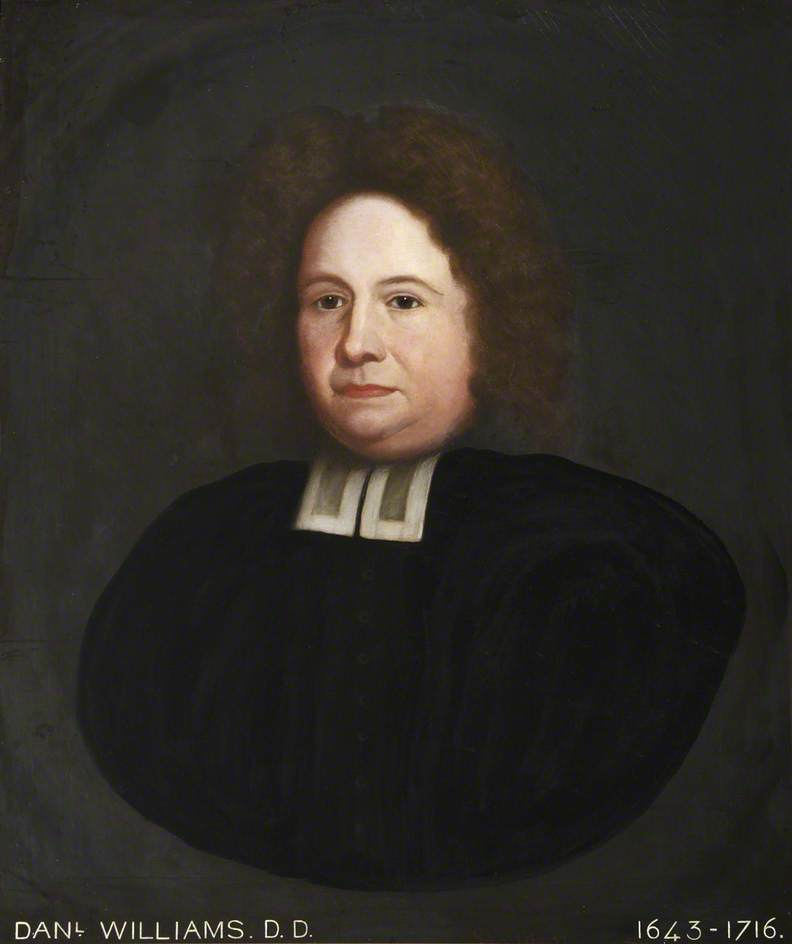
The Dr Williams' library was founded by Dr Daniel Williams (c. 1643-1716), a Presbyterian minister. Born at Wrexham in north Wales, he worked for some years in Dublin before moving to London and becoming a leading figure in the world of Protestant dissent: ‘his large Acquaintance and diffusive Influence, gave him Advantages for Usefulness beyond many of his Brethren’. In 1678, he even took part in an exorcism recorded by Richard Baxter in his 1691 book, The Certainty of the Worlds of Spirits.
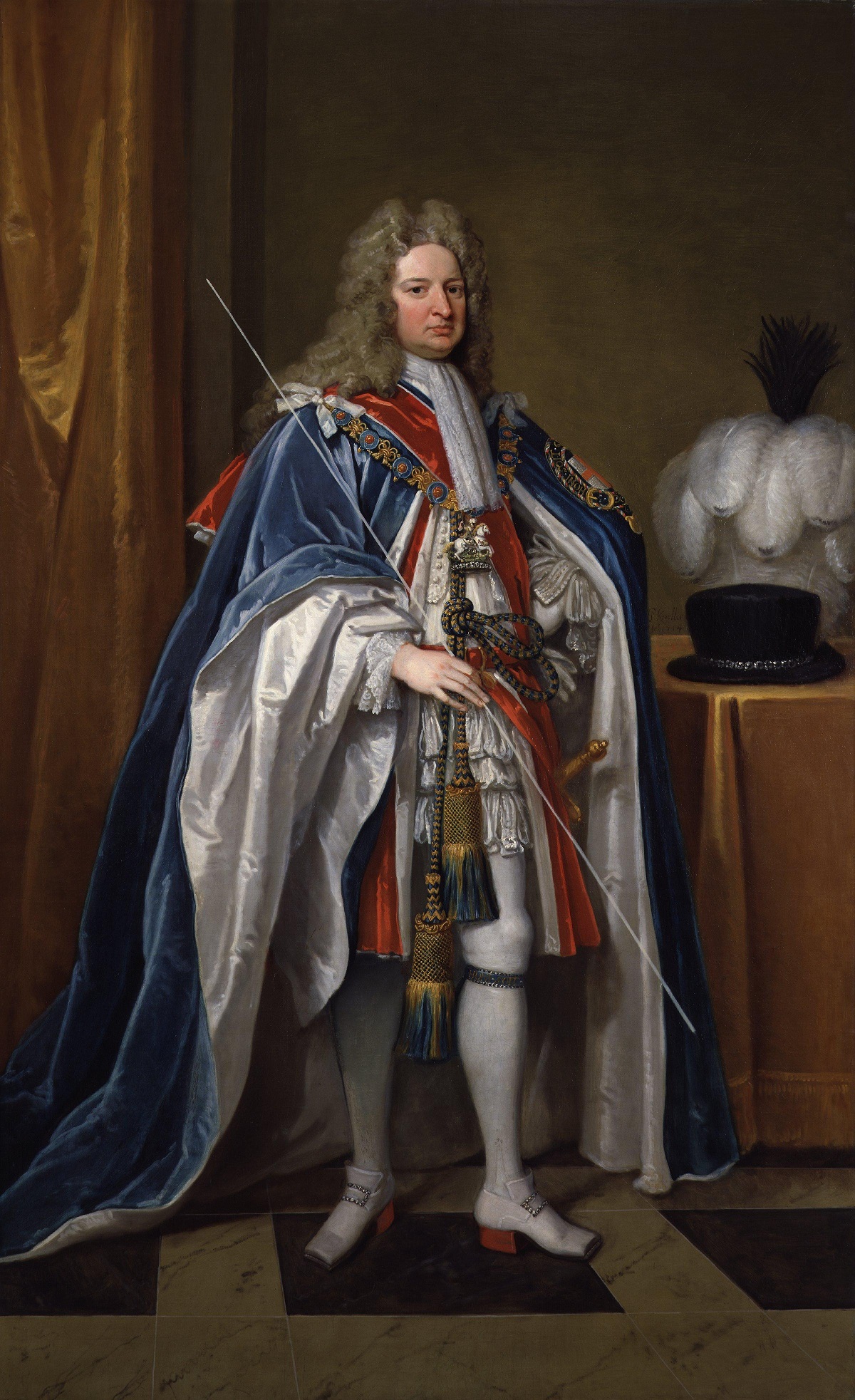
Robert Harley, 1st Earl of Oxford by Sir Godfrey Kneller
The term ‘dissenter’ applies to Protestants who ‘dissented’ from the official articles of faith of the Church of England. After the restoration of the British monarchy in 1660, an Act of Uniformity was passed in 1662, setting out the rites and ceremonies of the Church of England in detail. All clerics and all holders of public office (such as MPs or soldiers) were required to take the Oath of Uniformity, swearing to uphold this official, state version of the liturgy and sacraments. Nonconformists- for example, a Quaker or a Presbyterian- refused to do this. As all students at Oxford or Cambridge were required to take the Oath of Uniformity, the Act also excluded such dissenters from practising the law or training as doctors. Other civil and commercial careers, while not formally impossible to pursue, were in practice often equally difficult to embark on.
Williams took an active part in the disputes between Presbyterians and Congregationalists in the 1690s and tried to use his growing prominence in public life during the reign of Queen Anne to support dissenters in the American colonies as well as in England, Ireland and Scotland. From at least 1701, he had an active correspondence with Robert Harley, the first earl of Oxford. A powerful politician, the earl was also a great collector of manuscripts, leaving what is now the Harleian collection in the British Library to the nation at his death in 1724.
The Dr Williams’s Library started more modestly. Williams bequeathed 7,600 of his books to be made available for all nonconformist ministers, tutors and students in the City of London, establishing one of the first public libraries in the United Kingdom in the process. He set up a trust for religious and educational purposes in his will, but it was the commitment and fundraising efforts of its first trustees that enabled the library to open in 1729 in Red Cross Street, Cripplegate. In 1865, the coming of the railways forced its removal to Bloomsbury, traditional heartland of the London intelligentsia.
After a time at 8 Queen Square, the library moved to a purpose-built new location in Grafton Street East. In 1890, the library moved to its present home at 14-15 Gordon Square. This grand building was designed as the first hall of residence of University College London and later shared between UCL and what was then called the Manchester New College (now Harris Manchester College in Oxford). Both institutions were founded by dissenters, and the grandeur of the Dr Williams’s Library building is quite deliberate. Nobody was going to be allowed to dismiss nonconformist educational centres as shabby poor relations of Oxbridge. Architectural glories? Grand libraries and intimidating wealth? Available here to anyone, no matter what they believe in. These buildings are proud statements of rebellion and dissent.
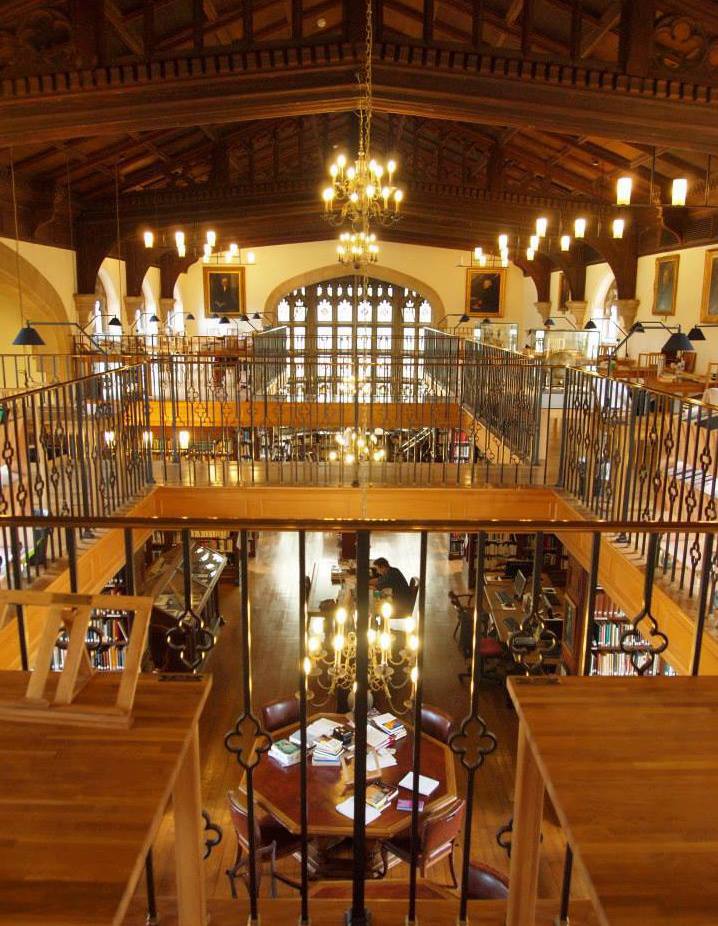
© David Hawgood
Have you ever visited the Dr Williams’s Library?
In the next instalment of our 'Meet the Researchers' series, David, our resident Literature scholar, talks about songs, Salzburg, and Oxbridge rivalry...
You arrived for this post in September. How are you settling in?
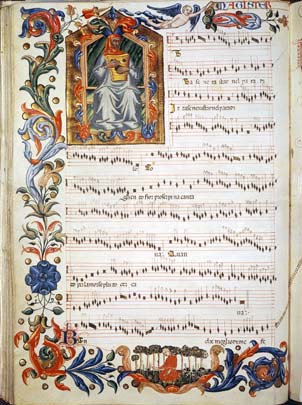
I’m enjoying being back in the UK, having spent the previous two years working in France, and have especially liked getting to know Oxford better. The
University is a wonderful place to be a medievalist, both for the people, whether they are Oxonians or visitors, and for the resources. The project team is a very stimulating and supportive group, and I’m looking forward to a fruitful couple of years.
Is there any one type of literature you feel particularly drawn to?
I wouldn’t say that I am drawn by any particular type. What I find most stimulating are literary texts that challenge our expectations and ways of categorising things and people. My PhD work was focused on poems or songs that ‘moved’ around Europe, whether that was in the form of one melody being re-texted in different languages (think ‘One Song to the Tune of Another’), or songs whose lyrics resist linguistic labels like ‘French’ or ‘Italian’.
What was a court, and how did music interact with,
say, politics or the visual arts?
In the same way, the court of the Prince-Archbishops of Salzburg sits on the fault-line between secular power (the Archbishops were independent rulers) and the Church. So I am looking forward to thinking more how this mixture of influences and connections affected the cultural life of this milieu.
How would you explain this project to interested members of the general public?
Studying medieval courts is not in itself new. Nor is thinking about the musicians who performed there or the composers who wrote the music. MALMECC is something of an experiment in medieval studies: what happens when you take people without an academic background in musicology (with the exception of the project leader, of course), have them work together closely for four years? Essentially we are aiming to give a more integrated understanding of culture at court in the long fourteenth century. What was a court, and how did music interact with, say, politics or the visual arts?
What’s the most exciting thing about the project for you?
Something I am enthused by is being able to roam across the full scope of medieval studies and look for points of interactions disciplines other than literary studies. For instance, at the moment I am looking at the intersections of representations of the Virgin Mary in sculpture and in the songs of the Monk of Salzburg, something that I might not have thought about doing otherwise. Similarly, being able to work in depth with a single composer’s works, particularly one for which there is so much surviving music, is a refreshing change from my previous work on multiple troubadours. I’m particularly looking forward to getting to grips with the sound of the Monk’s songs and the court at Salzburg.
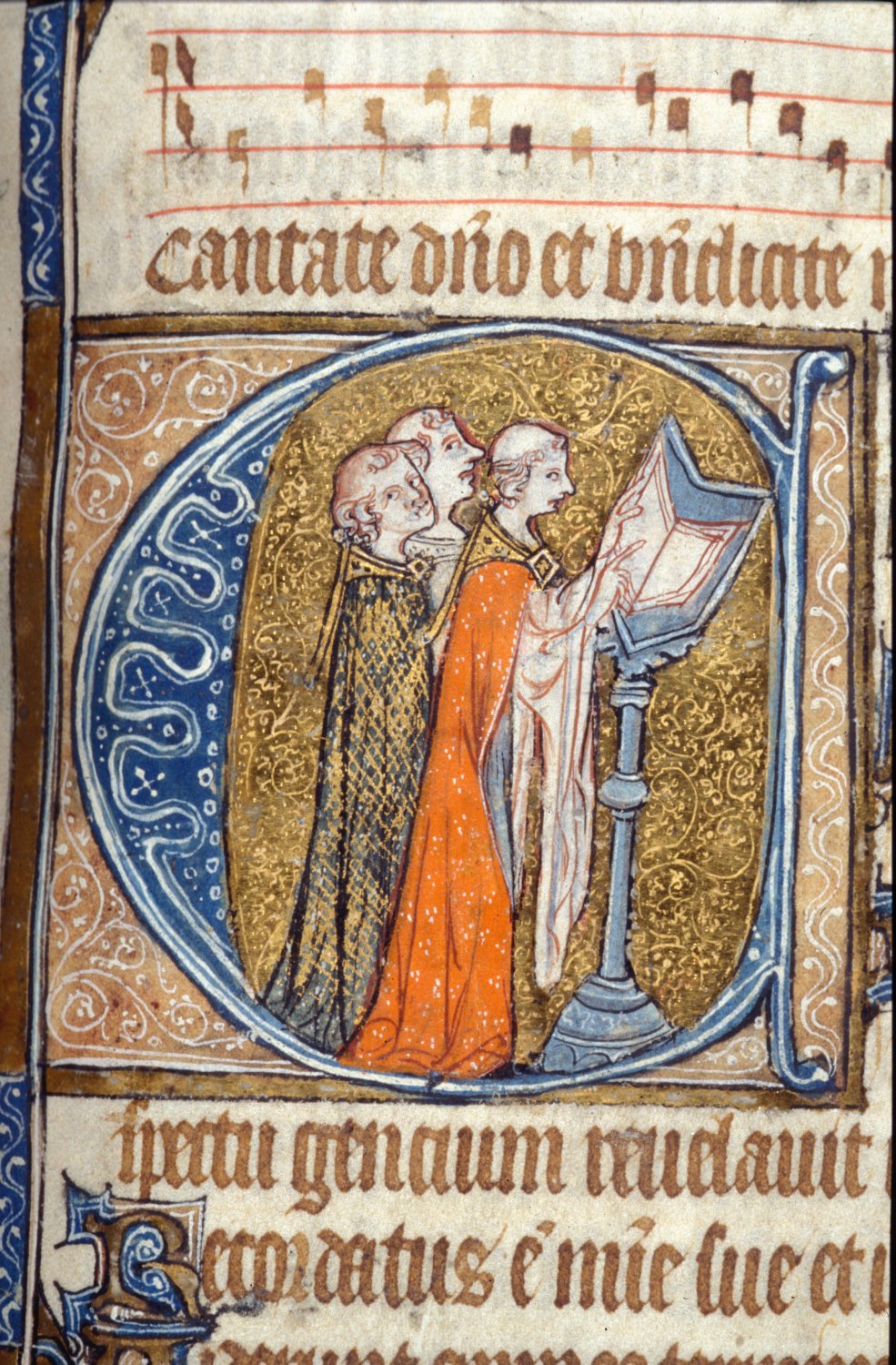
Harley 2899
What are you up to when you are not researching?
Cake, both making and eating. Reading, of course—sometimes even things as recent as the nineteenth century! I also play the piano, in a somewhat agricultural style.

Finally, because I know where you took your undergraduate degree… Oxford or Cambridge?
What a question! I am enjoying life in Oxford tremendously, but to paraphrase Miss Jean Brodie, give me a medievalist at an impressionable age, and he is mine for life…
In the final post of the current series on the patronage of Charles IV, Laura Slater looks at the work of Master Theodoric, court painter to Charles IV.
Another famous panel painting found in the Holy Cross Chapel at Karlštejn Castle is an image of St Luke the Evangelist, found on its north wall.
St Luke is shown with his symbol or attribute to help us recognise him: the winged bull at his shoulder.
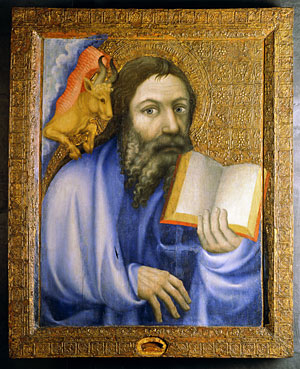
Calves and bulls were the beasts sacrificed on the altar in the Jewish Temple. The motif was intended to remind a medieval viewer of Christ’s own sacrifice to God, in his suffering and death on the Cross. In St Luke’s gospel, in his account of the Last Supper, Jesus says ‘This is the chalice, the new testament in my blood, which shall be shed for you’ (Luke 22:20). St Luke is also shown holding an open book. This refers to his gospel, found in the New Testament of the Bible. So the image of book and bull link together: as Christ is the Word made Flesh (John 1:14), his flesh-and-blood suffering and sacrifice on the cross, in echo of what happened to the bull in the Old Temple of Judaism, creates a New Temple of Christianity, founded on the words of the Gospels. Luke wears a sky-blue robe, symbolising the eternal heavenly realm he now moves in.
Yet St Luke looks straight out at the viewer, meeting our eyes with a clear, direct gaze. He is the only figure in all the portrait panels to do so. Art historian Jiří Fajt suggests that the panel may be a self-portrait of Theodoric himself. St Luke was the patron saint of painters, thanks to the legend that he painted a portrait of the Virgin and Child. In the Middle Ages, many famous icons were thought to be ‘autograph works’ by St Luke, including the now-lost Panagia Hodegetria icon in Constantinople. It was believed to have been brought back from the Holy Land in the fifth century by Eudocia, the wife of the Byzantine Emperor Theodosius II.
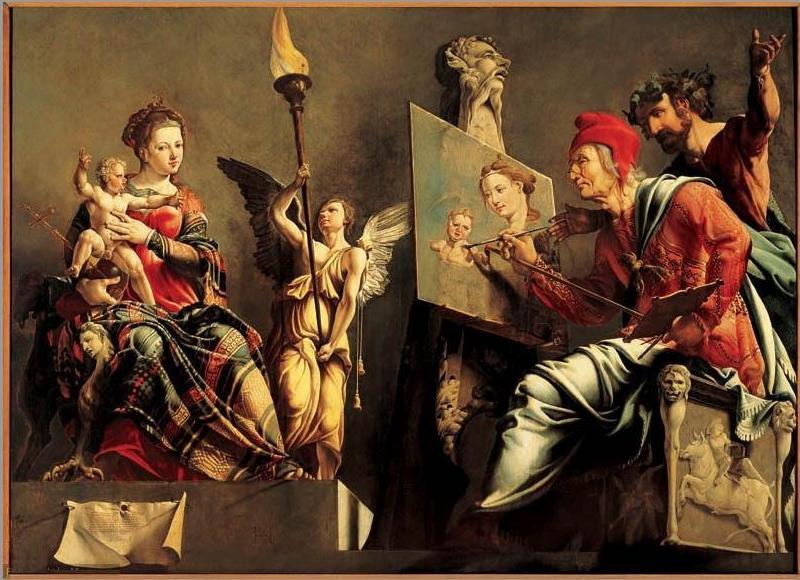
'St Luke Painting the Virgin and Child' - Maerten Van Heemskerck
Many guilds and early academies of painting in Europe were dedicated to St Luke for this reason. Theodoric himself was the head of the Brotherhood of St Luke in Prague. As his team of artists had worked flat-out over four years to paint and decorate the Holy Cross Chapel at Karlštejn, including finishing all 130 saintly portraits, Theodoric may have thought that he deserved to be permanently honoured in the Holy Cross Chapel in this way. And since Charles IV later rewarded Theodoric for what he described as ‘profound and masterly’ work at his court, the emperor may not have minded such a clever visual conceit.
Thanks to Laura for the insight into the art and design of the Holy Cross Chapel. Get in touch via. the contact form or Twitter, and let the team know what you would like to hear about next!
In the next of her blog posts looking at the life and patronage of Charles IV, Laura explores the opulent Chapel of the Holy Cross at Karlštejn Castle...
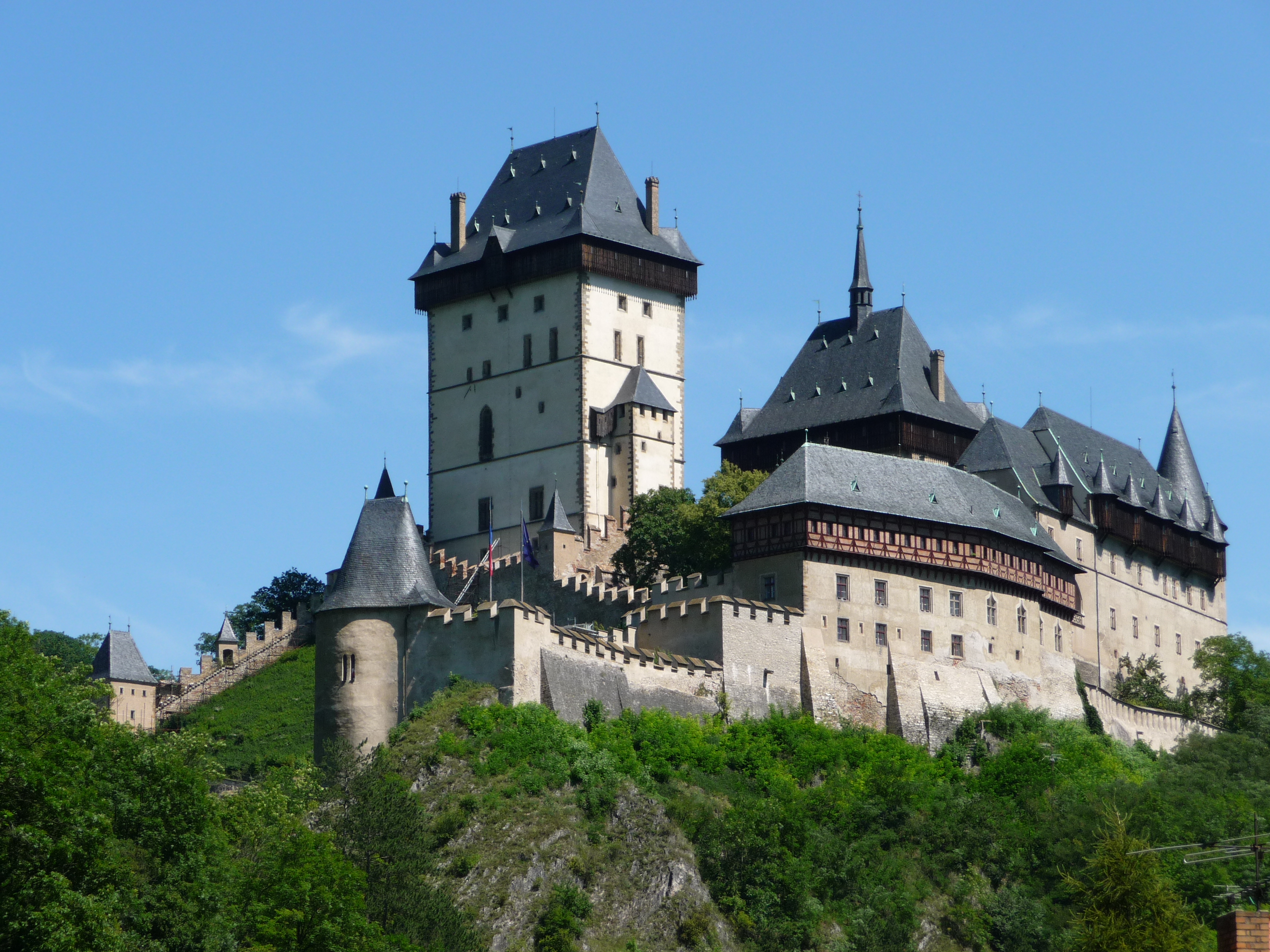
A day’s horse ride away from Prague, Karlštejn Castle became one of Charles’ most important courtly residences. He stored his imperial treasure and the imperial regalia there. It was also a place where this deeply pious ruler could honour his absent family, and the saints he believed were looking out for him in heaven, watching over him and helping him with his daily life.
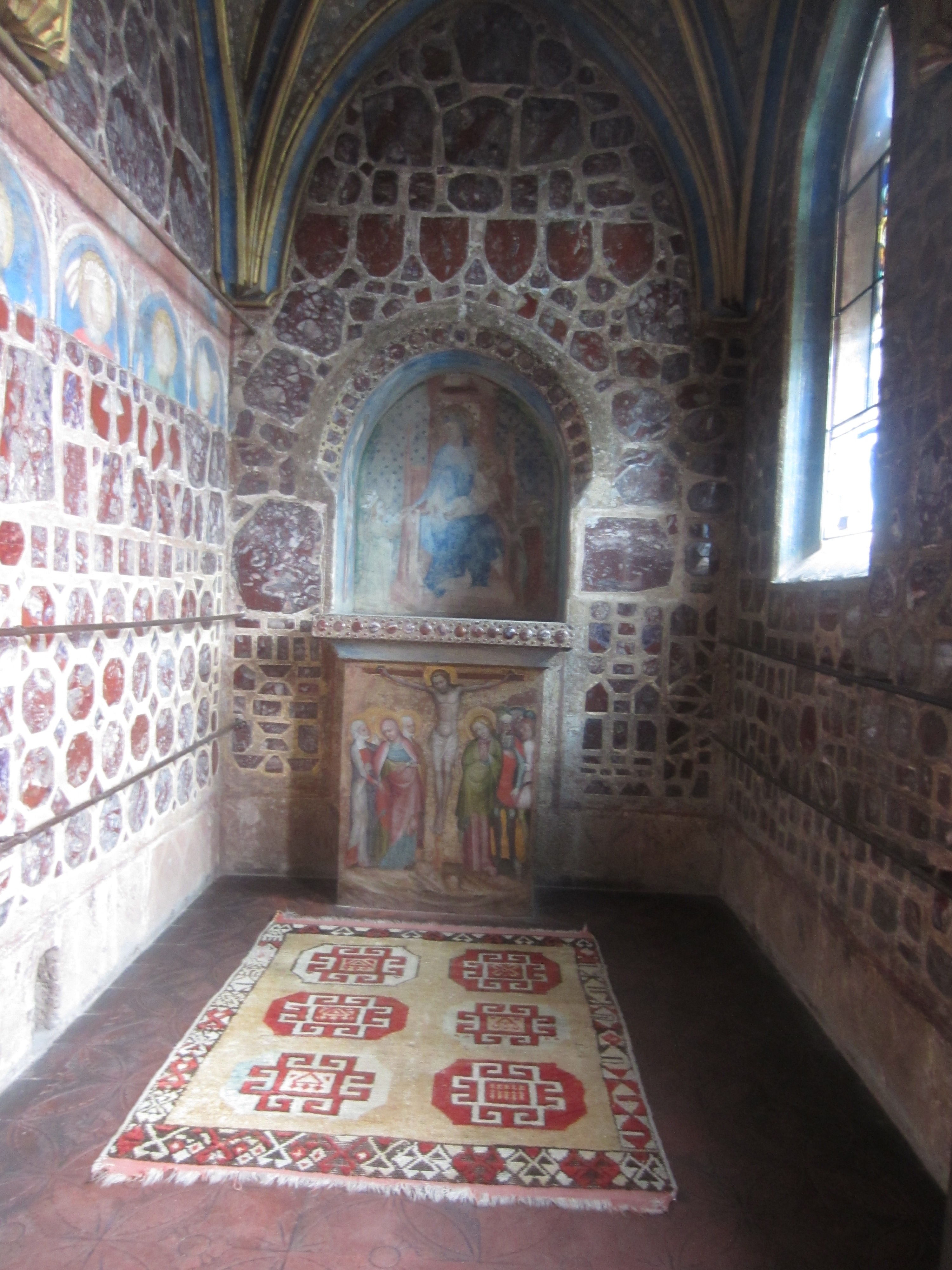
© Jürgen Regel, Marian
When Charles returned to Prague in 1333, aged seventeen, his mother had died and his father was far away, ruling other countries. In an autobiography begun in 1346, Charles writes that ‘when we arrived in Bohemia we found neither father nor mother nor brothers nor sisters nor anyone else we knew. In addition, we had completely forgotten the Czech language…’
Perhaps feeling lonely and isolated, Charles turned to saintly protectors with enthusiasm, particularly saints who were also family, such as his holy ancestor, St Wenceslas. He became a great collector of relics- the earthly remains of saints, which could be anything from a fragmentary body part, such as limbs or even locks of hair, to an object owned or perhaps even just touched by the saint while they were alive. These objects were thought to have become charged with the holy essence of the saint and could now work miracles, particularly healing and protective ones.
‘when we arrived in Bohemia we found neither father nor mother nor brothers nor sisters nor anyone else we knew. In addition, we had completely forgotten the Czech language…’
At Karlštejn, Charles had an oratory dedicated to St Wenceslas in his private apartments. And he had pictures of his ancestors painted all over the castle. Perhaps they reminded him of who he was, and where he came from before he started on his travels between different European courts. Karlštejn Castle hall was painted with a huge family genealogy, starting with Noah and the Trojans and finally reaching Charles’s more recent Luxembourg and Brabantine ancestors. Portraits of Charles and his own family were also placed in other castle chapels.
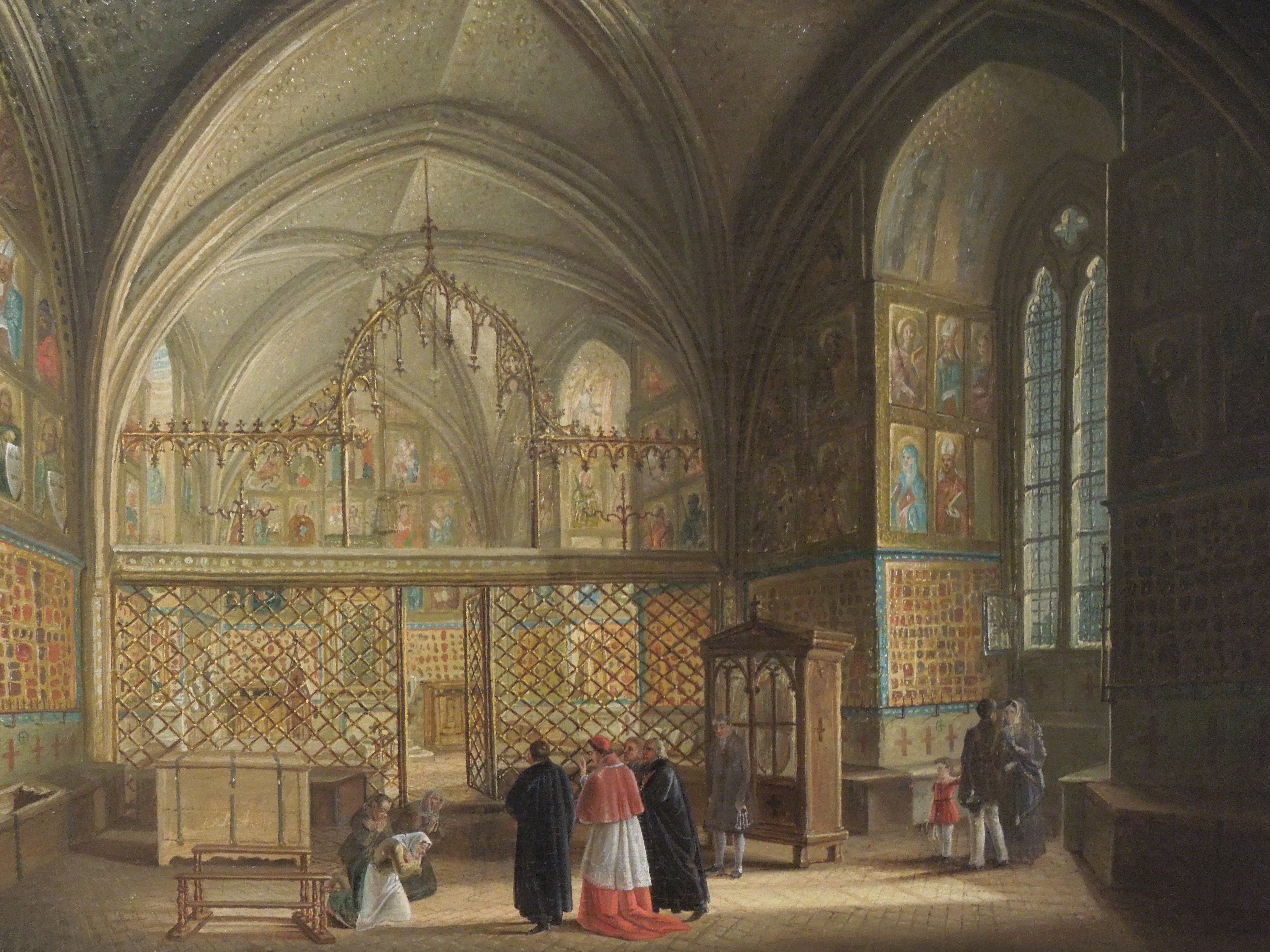
Ludvík Kohl - Chapel of the Holy Cross (1820)
There were at least five chapels at Karlštejn, but the largest and most splendid was the chapel dedicated to Holy Cross. The Holy Cross Chapel is accessed by a staircase, and Charles decorated it with scenes from the lives of two of his holy ancestors, St Wenceslas and St Ludmila.
Decorated between 1360 and 1364, the walls of the chapel are covered with slabs of precious and semi-precious stones, including gold, jasper and amethyst, set in the form of large gold crosses.
The brilliance of the decoration evokes the heavenly Jerusalem described in Revelation 21, 18-19: ‘the city itself [was of] pure gold like unto clear glass. And the foundations of the wall of the city were adorned with all manner of precious stones. The first foundation was jasper: the second,sapphire…’ Charles clearly liked to imagine Prague as a new Jerusalem. He made sure that a smaller chapel in Karlštejn, known today as St Catherine’s Chapel, also echoed the gem-studded walls of the heavenly city. In the Holy Cross Chapel however, there is a very unusual feature. Amongst the glitter of gold and precious stones, three tiers of portraits are lined up on the chapel walls. The Holy Cross Chapel looks like a huge picture gallery, hundreds of years before they became popular.
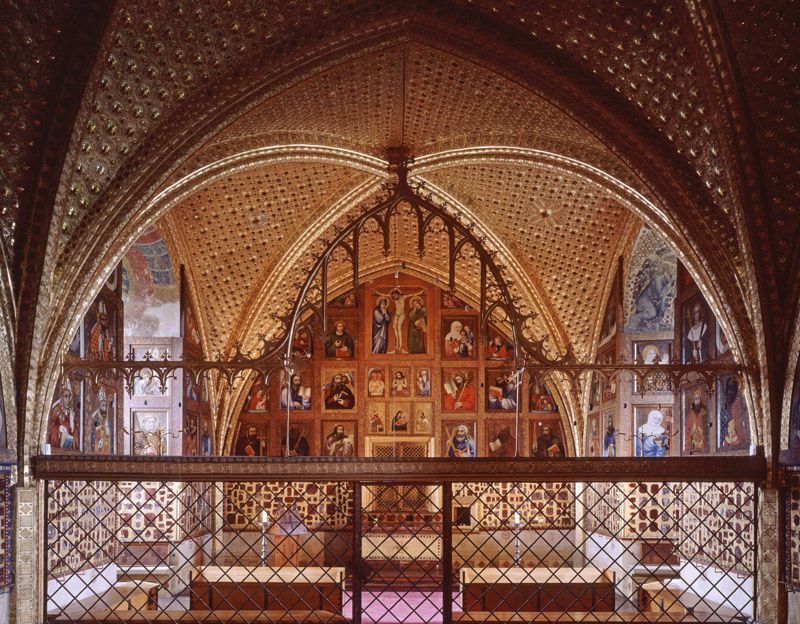
The Holy Cross Chapel - czechtourism.com
Charles IV - Master Theodoric
A medieval visitor is more likely to have seen a resemblance to the iconostasis, the wall of paintings and icons found in Orthodox Christian churches between the nave and the sanctuary. Painted by Charles’ court painter, Master Theodoric and his workshop, there are 130 portraits of different Christian saints, placed like witnesses to the Crucifixion of Christ that was painted on a panel behind the altar. On the north wall are portraits of the authors of the gospels, the apostles and angels. On the west wall are holy bishops, abbots and rulers. Most of the panels have a textured or engraved gold ground, matching the textured and gem-encrusted golden walls of the chapel and its vaulted roof. In each frame is a small compartment, designed to hold a relic of the saint depicted in the panel painting.
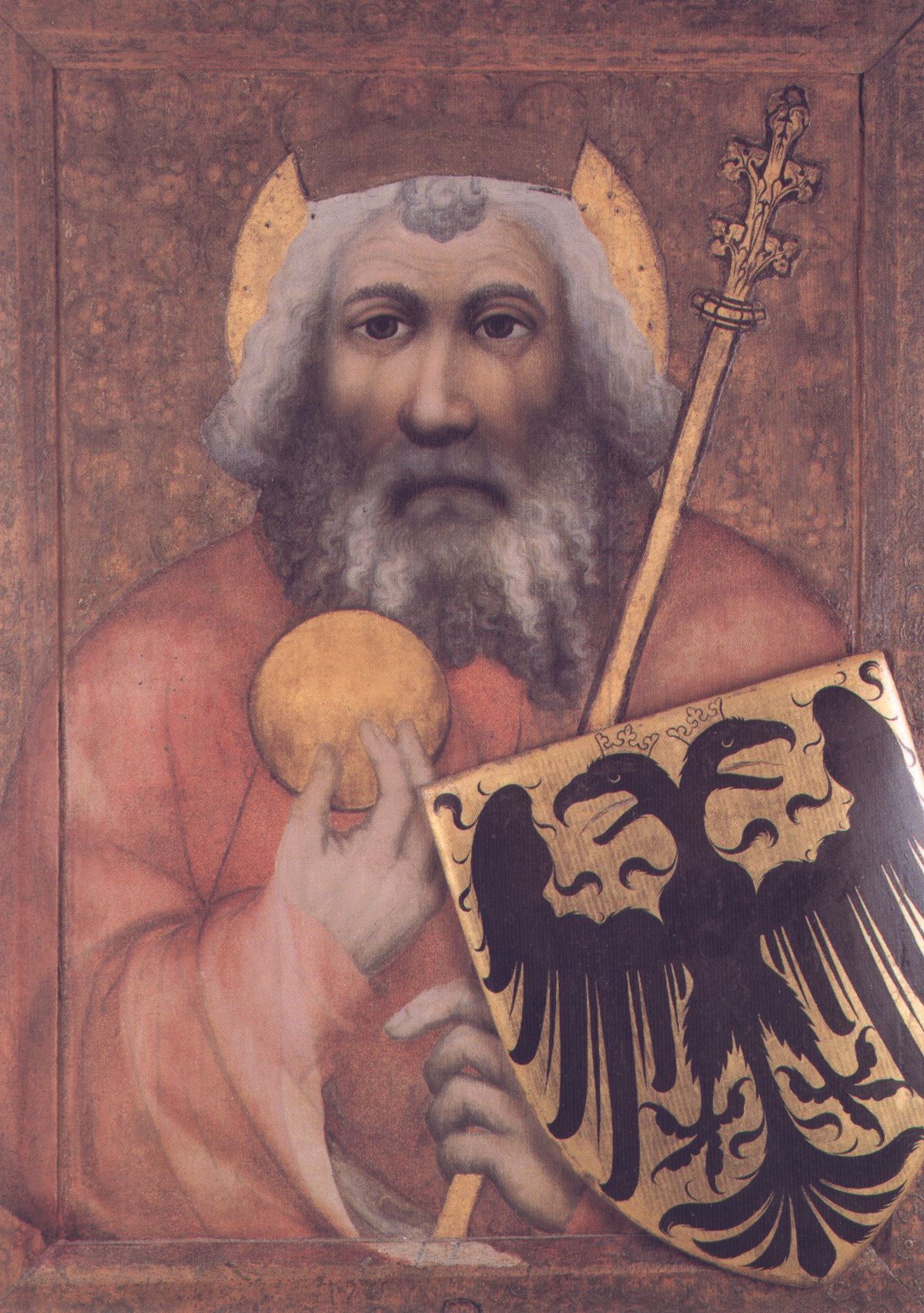
Even here, Charles made sure to honour his ancestors. One of the most famous panels from the Holy Cross Chapel is this painting of his ancestor Charlemagne, believed by the fourteenth century to be a holy saint as well as a great ruler.
Charlemagne is shown holding the golden orb and sceptre found in the imperial treasury. The shield emblazoned with the imperial eagle, like the now-missing crown on Charlemagne’s head, were both carved separately and added to the panel at an angle. By overlapping with the frame of the panel, and standing out from the circular metallic appliqués decorating the gold background, the crown and shield stop Charlemagne from blending in with the rest of the paintings on the walls. Your eye is unable to drift from picture to picture.
Charlemagne is a solemn, bearded figure- and he does seem to look a lot like Charles IV…
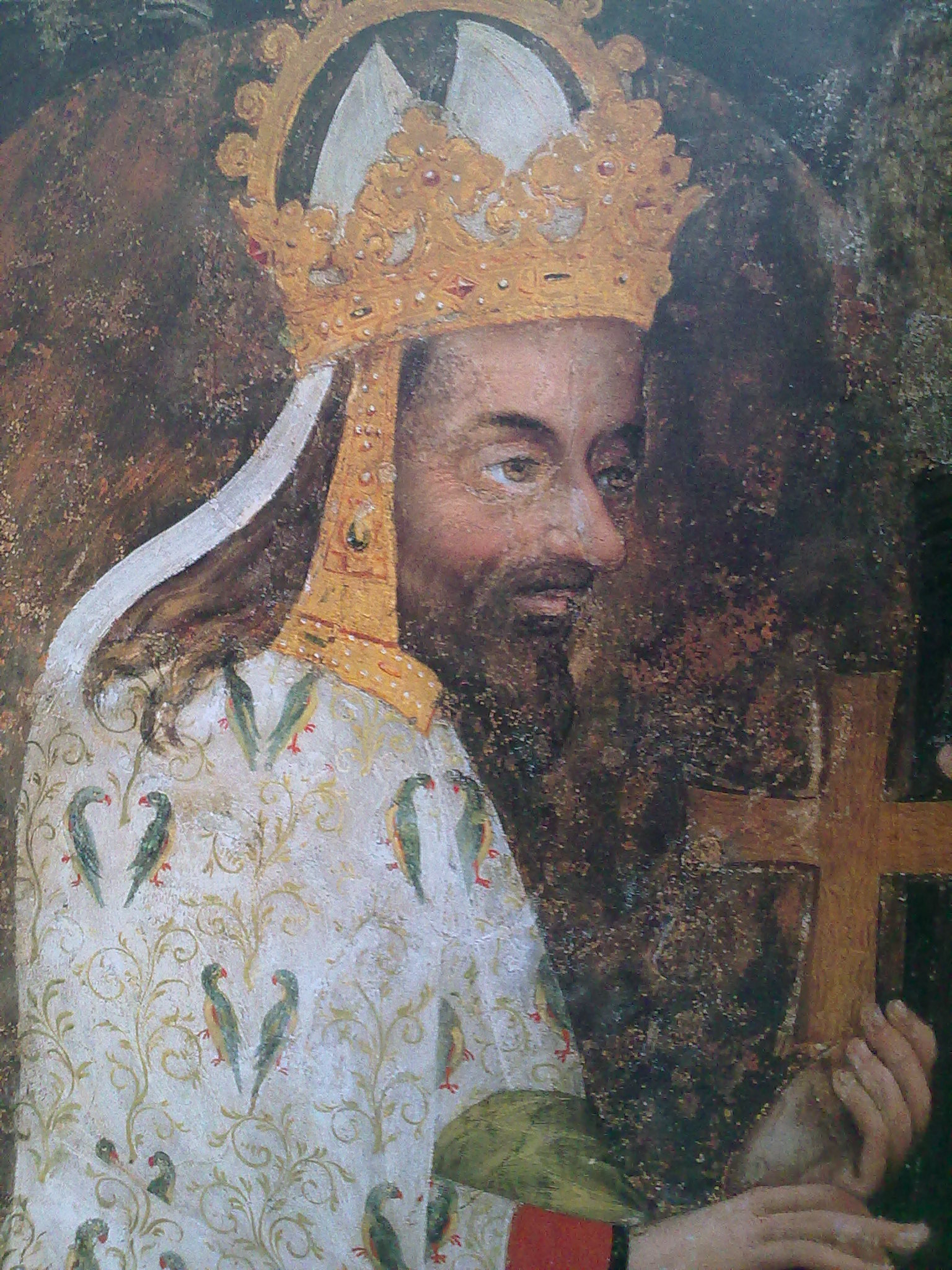
Charles IV - Master Theodoric
Discover more about Master Theodoric, the court painter of Prague, in our next post...
Here Christophe, our newest team member, gives an insight into the project and his interests...
So, you’ve come from Liège, how are you finding Oxford?
They are two completely different cities. Liège is quite a bit bigger than Oxford but destruction caused by war and modern urbanization means that most pre-eighteenth century buildings, except churches, have disappeared.
As a historian, I love being brought back into the past when walking in Oxford. It’s great being able to find everything I want, from seminars to cinemas, from research libraries to pubs, in less than a 20 minute walk. I am sure I am just mentioning the most obvious things though. Hopefully, the time I will spend here will make me discover much more than that!

Christophe Masson
I was the type of kid who always wanted
to take his family to visit every possible
kind of museum during holidays!
Have you always been drawn to the medieval period?
As far as I remember, I always have been passionate about culture and history, and mainly about the period before the eighteenth century. So I was the type of kid who always wanted to take his family to visit every possible kind of museum during holidays! At that time, the Middle Ages seemed to me as interesting as, let's say, Alexandre Dumas' musketeers or the prehistoric period. It was at university that I devoted myself to the Middle Ages, thanks to some teachers I had back then, and probably also to the opportunity of studying castles and knights.
You have previously specialised in military history, are there any differences in this field?
There are lots of differences, of course, between military and court history, mainly regarding the questions we are asking sources—not “How many knights were there in this army?” or “What materials did they use to storm this castle?” but “What was the role of literary culture in structuring courtly life?”, “What was the place played by women, if any?” and “How was the court turned into a stage by courtiers and princes?”. This project also crosses multiple disciplines. However, many medieval captains were also courtiers who enjoyed staying in princely households, and talking about ladies, romances, music, or jousts. So I see this new research as a way to expand my knowledge of late medieval élites in a new direction.
What’s the most exciting thing about this project for you?
To discover new disciplines “from the inside” and to be part of an ambitious project that aims to redefine what we may think we already know, namely the cultural identity of late medieval courts.
How would you explain this project to interested members of the general public?
Even if we have studied courts for centuries, the focus has remained too often on their national and institutional aspects. The main questions have been “Who was present?” “How were the courts organized?” and “How did the courtly system help kings to centralize their State?”
In contrast to this, the MALMECC team wishes to question the cultural aspect of courts, emphasizing the role played by musical performances and international cultural exchanges.
The ultimate aim is to design a new model of late medieval courts; one where national boundaries may well appear less powerful than we used to think.
What are your interests outside of academia?
I enjoy reading (reading, always reading...) novels and comic books, fantasy, science-fiction, histories, humour, and classics, as well as watching movies and television series. I also love walking, trekking, and of course visiting lots of different countries and their museums!
Why are the cultural connections of Charles IV so important for the MALMECC project? Laura Slater begins a series of blog posts looking his life and patronage.
In September 2016, the MALMECC project team travelled to the Charles University in Prague (https://www.cuni.cz/UKEN-1.html), to take part in a workshop held as part of the ‘Sound Memories: The Musical Past in Late-Medieval and Early-Modern Europe’ project (http://www.soundme.eu/)
Founder of the Charles University in 1348 and responsible for making Prague into such a splendid cultural capital, Charles IV of Bohemia (1316-1378) remains a highly respected figure in the modern-day Czech Republic.
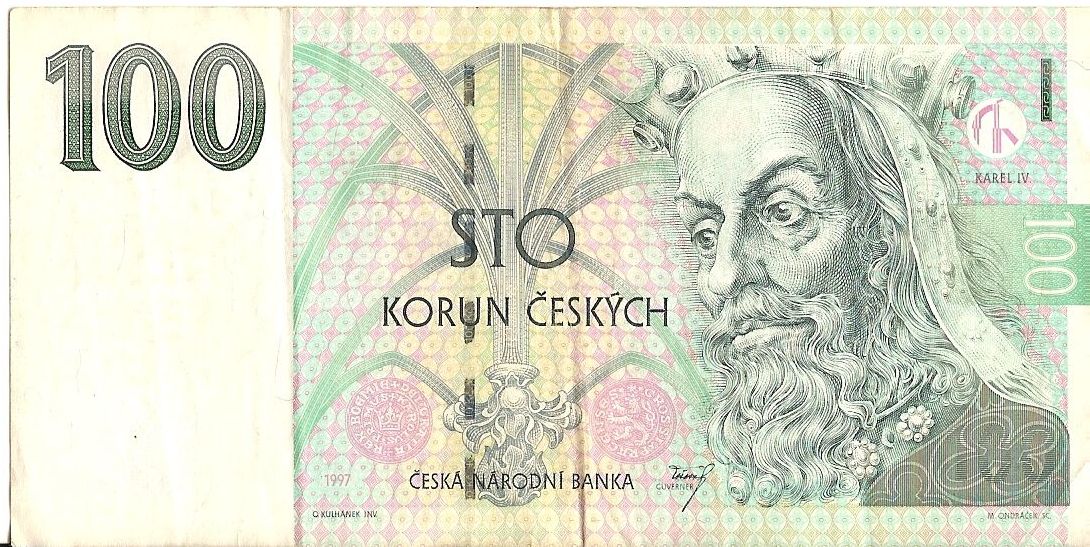
Charles would probably enjoy seeing his face on the Czech koruna today. In his own lifetime, he made sure that his portrait could be seen in many public places, and, through his seal, on important documents that might be publicly inspected or displayed for all to see.
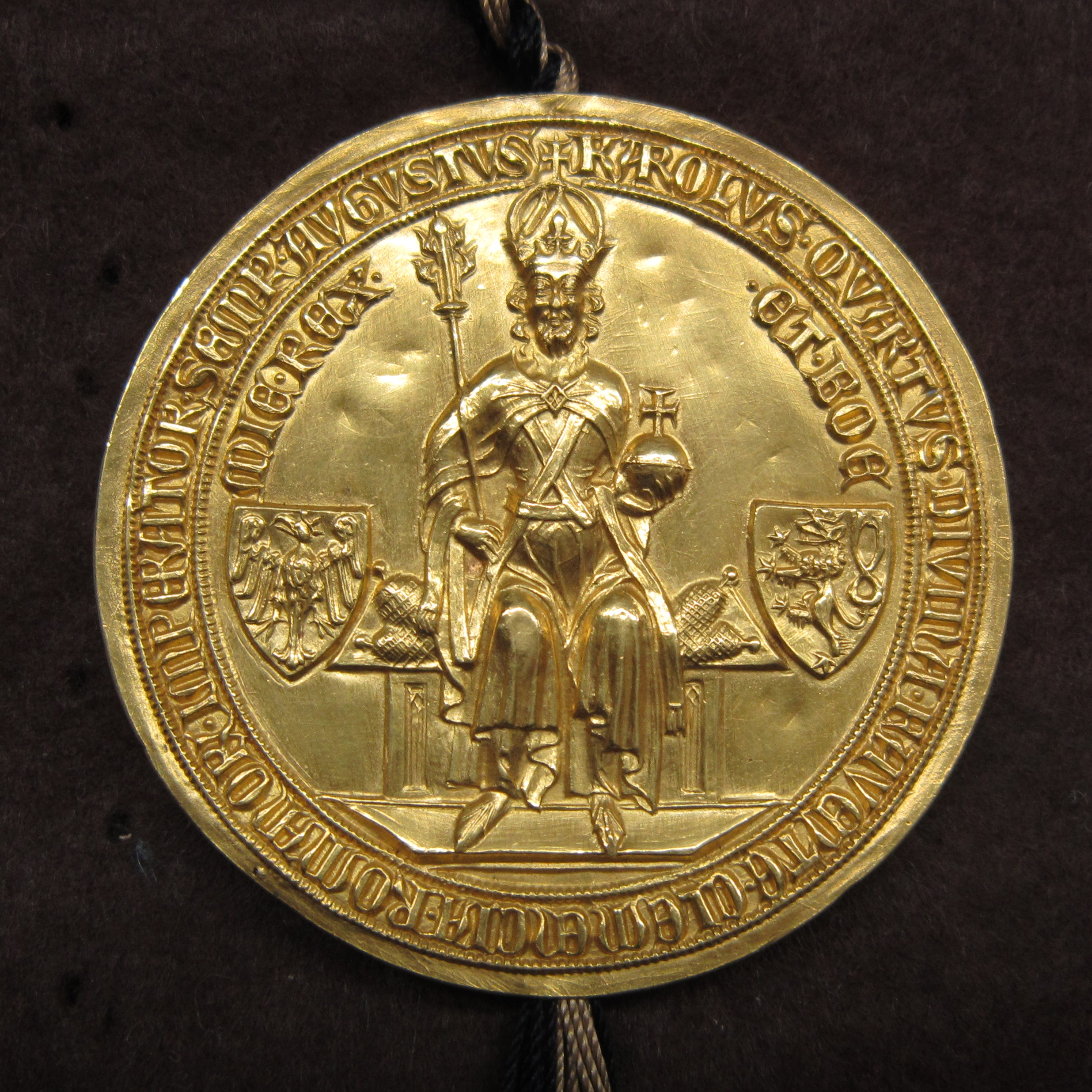
Seal of Charles IV from the 'Golden Bull' of 1356
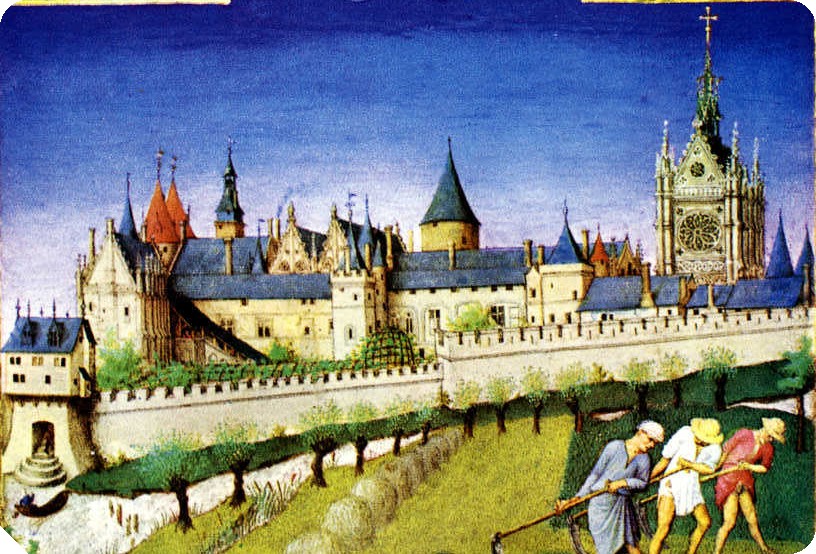
Palais de la Cité, the residence of the Kings of France from the 6th century until the 14th century
Later crowned Holy Roman Emperor, Charles’s court in Prague is a perfect test case for MALMECC’s research into the interactions between different late medieval court cultures and their music, looking at these environments from a pan-European, transnational perspective. Charles IV brought not only art, books, music and song from across Europe to Prague, but even his own name. When he was born, he was baptised Wenceslas (Václav) after his Bohemian ancestors. But at the age of only seven, he was sent away to be educated at the French royal court in Paris.
Ruled over by his uncle, Charles IV of France, Wenceslas took the name of a man who must have become an important father-figure for him. In 1330, Charles was sent off to Italy by his own father, King John. Now fourteen years old, in a medieval context he would have been considered quite old enough to start ruling some of the far-flung domains of his paternal family, the Luxembourg dynasty. In fact, Charles had already been married for some years, to a French princess named Blanche of Valois.
In Italy, Charles came into contact with the art and culture of sophisticated urban centres like Siena. So when he finally returned to Prague in 1333, he was determined to make the city and his court as famous for its beauty, culture and learning as some of the many European cities he had travelled through or lived in. As well as founding the Charles University, Charles rebuilt Prague Cathedral and built himself a new royal residence at Prague Castle.
He also founded new religious houses, such as the Carmelite monastery of Our Lady of the Snows, and in 1348, he founded the New Town, a new residential district outside the city walls.
But how much did he ever feel at home there? After 1355, he started rebuilding an old Luxembourg country residence: Karlštejn Castle, deep inside the royal forests surrounding medieval Prague...
Do you have a research interest in Charles IV or medieval Prague? Let us know!