

Blogs 08 2017 - 12 2017
Fourteenth-century courtly society may have been more intolerant of ‘sodomitical acts’ than earlier in the Middle Ages, with sodomites, traitors and heretics now bracketed together as deadly sinners. By contrast, in the eleventh and twelfth centuries, a unique tradition of passionate Christian friendship developed in clerical writing. Friendship was seen as the highest form of human relationship, helping you to learn how to know and love God. And these friendships could have a consciously erotic element to them.
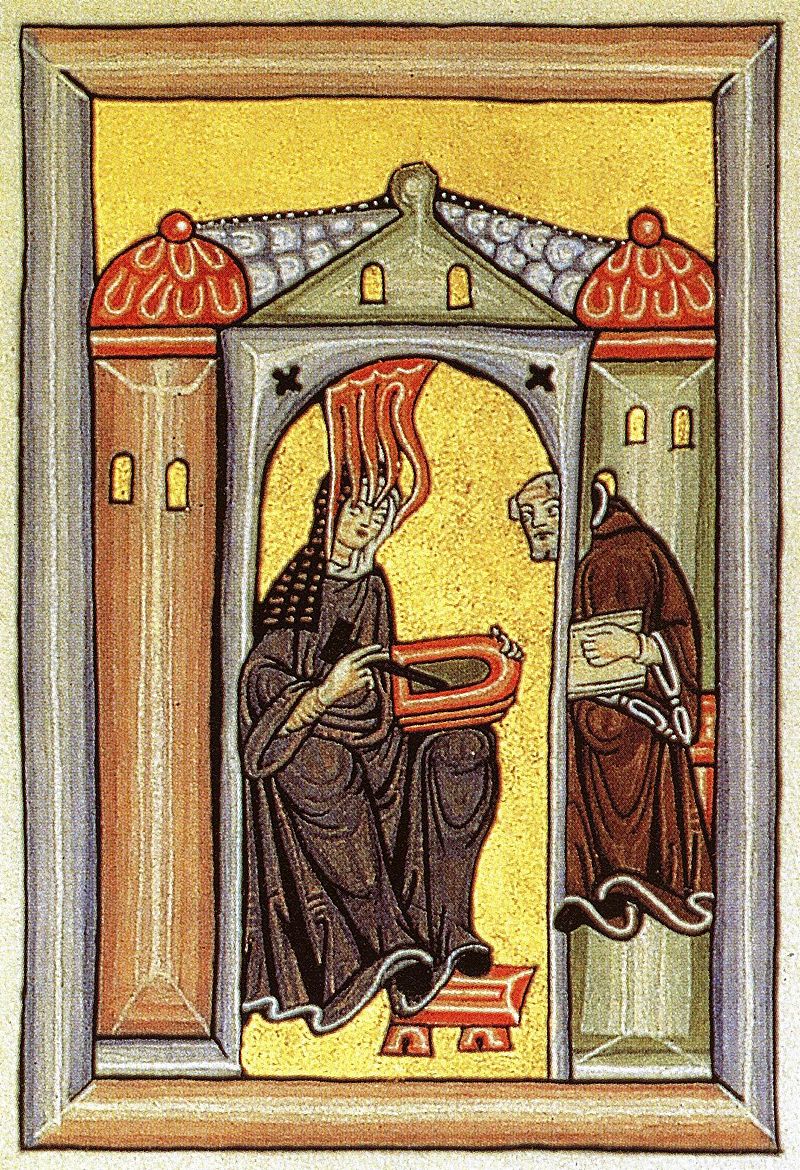
Hildegard von Bingen
The twelfth-century nun St Hildegard of Bingen is best known today for her intellectual talents: as a visionary and mystic, as a theologian and Biblical exegete, as a musical composer and scientific writer, and even as a popular public preacher and respected papal correspondent, in an age when women were ordered, as St Paul puts it in 1 Corinthians 14. 34, to ‘keep silence in the churches: for it is not permitted them to speak’.
For around a decade, Hildegard had an extremely close friendship with another woman in her convent, Richardis of Stade. Its exact nature continues to puzzle her biographers.
Erotic love and spiritual desire can be very difficult to separate in a medieval context, especially in a medieval monastery whose inhabitants were all dedicated to spiritual service, love and prayer.
In his famous study, Christianity, Social Tolerance and Homosexuality: Gay People in Western Europe from the beginning of the Christian era to the Fourteenth Century (University of Chicago Press, 1981), John Boswell highlights the erotic verse letters written from one woman to another found in a twelfth-century manuscript from Tegernsee in Bavaria. The writer declares:
I love you above all else,
You alone are my love and desire;
Another letter begins:
To G., her singular rose,
From A.-the bonds of precious love.
What is my strength, that I should bear it?
That I should have patience in your absence?
Would these women have seen their desires as a transgression of their vows of celibacy? Or would they be seen as an expression of spiritual love?
Aspremont Psalter-Hours, detail of fol. 57v
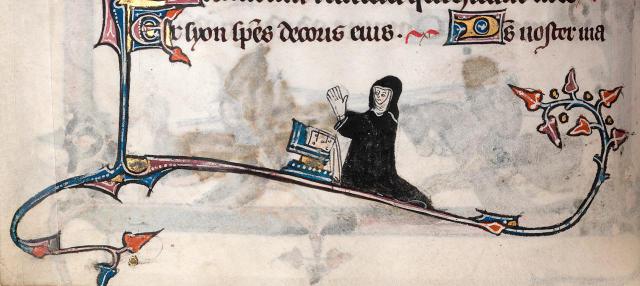
Same-sex female sexual activity was not discussed in detail by medieval manuals of sin and penitence, although such acts were still classed as sodomitical sins contra naturam. The seventh-century archbishop of Canterbury, Theodore of Tarsus, prescribed three years of penance for women fornicating with other women. An Italian legist in the early fourteenth century, Cino da Pistoia, puts his finger on exactly why lesbianism was considered an offence to the social order. He interpreted the ancient imperial Roman edict of lex foedissimam (‘laws of wickedness’) as a condemnation of ‘women who exercise their lust on other women and pursue them like men [italics added]’.
For Cino, just like the critics of Edward II and his friendships, the problem was men and women who acted ‘out of kind’, ignoring or undermining the natural boundaries that God had set for human relations.
Edith Benkov has discussed the legal implications of this idea in a recent essay. In 1405, the king of France granted a royal pardon to a married peasant woman named Laurence. Laurence had been imprisoned following the exposure of her affair with another married woman, Jehane. As Laurence describes it, Jehane had asked Laurence to be her sweetheart (‘mie’). Laurence did not see anything evil (‘mal’) in the request, a defence that would be used again by women accused of homosexual relations. After her surprise at Jehane’s sexual advances, the two would regularly meet, with Jehane doing ‘what a man does to a woman’. After Laurence sought to end the relationship, Jehane attacked her with a knife.
Valencia, Biblioteca Universitaŕia 387, f.7v
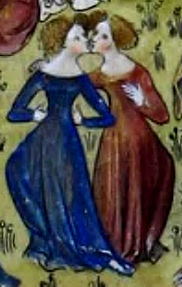
Laurence’s appeal may have been successful because it is Jehane (in this telling of the story) who took on the ‘male’, active and dominant role in the relationship. It is Jehane, not Laurence, who truly transgressed against the supposed natural order of things. We don’t actually know what happened to Jehane, or even why the case originally came to court and on what charges. But this record, possibly the earliest known criminal trial for lesbianism in Europe, shows us that female love did exist, even if it was rarely spoken about. In the Romance of the Rose, Guillaume de Lorris describes:
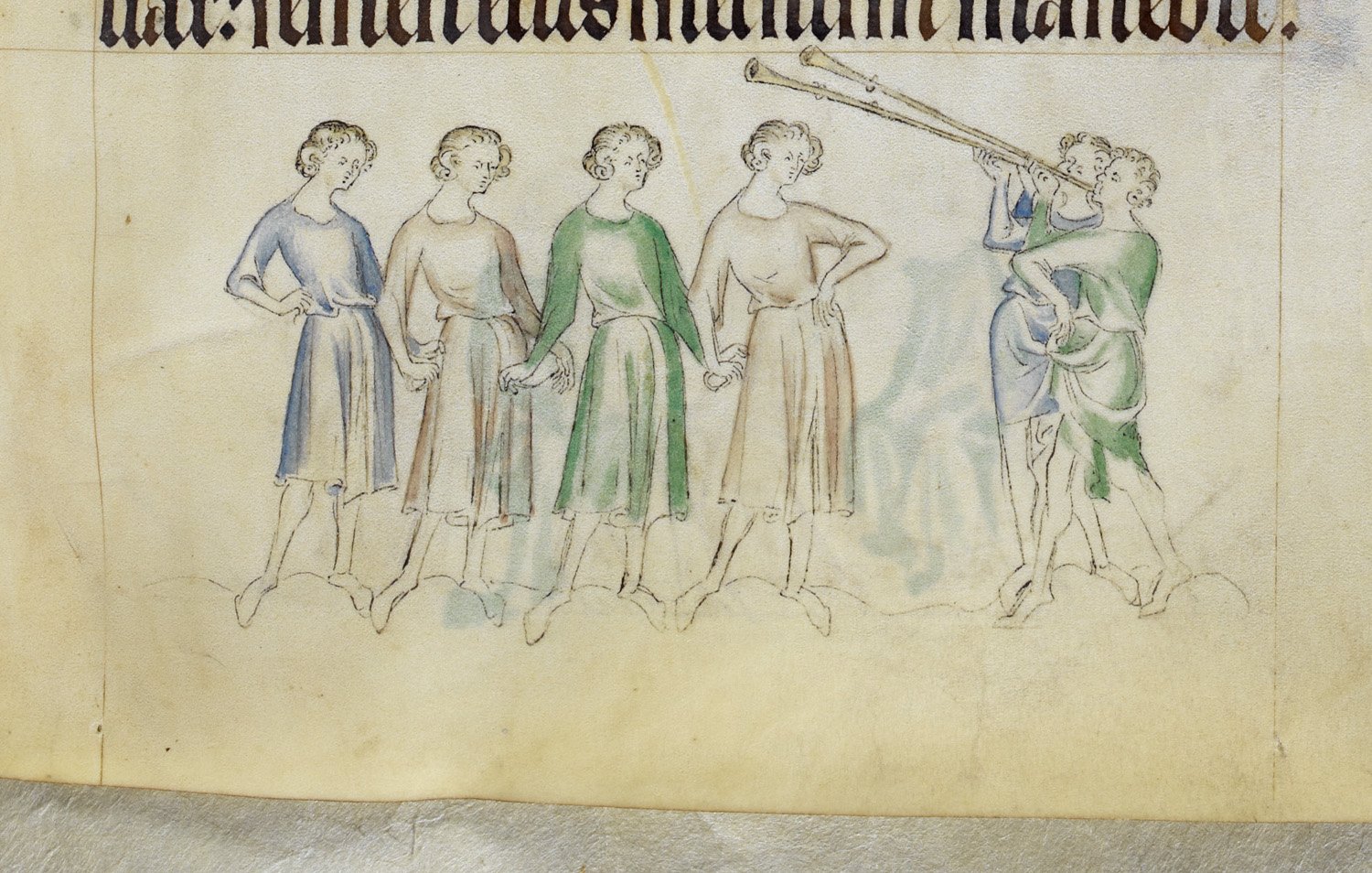
‘Two very charming maidens with their hair in a single braid and dressed only in their tunics […] but I need not say how beautifully they danced: one would approach the other very elegantly, and when they were close together, their lips would touch in such a way that you might have thought they were kissing one another’s faces. They knew well how to sway in the dance. I cannot describe it to you […]’
‘I need not say’. ‘I cannot describe it’. If male homosexuality was ‘the love that dare not speak its name’ in the Middle Ages, lesbianism may have been the love that others didn’t dare speak about. Especially at court.
References
Edith Benkov, ‘The Erased Lesbian: Sodomy and the Legal Tradition in Medieval Europe’ in F.C. Sautman and P. Sheingorn, ed. Same Sex Love and Desire Among Women in the Middle Ages (Palagrave Macmillan, New York, 2001), pp.101-122.
John Boswell, Christianity, Social Tolerance and Homosexuality: Gay People in Western Europe from the beginning of the Christian era to the Fourteenth Century (University of Chicago Press, Chicago, 1981)
Francesca Canadé Sautman and Pamela Sheingorn, ‘Introduction: Charting the Field’ in F.C. Sautman and P. Sheingorn, ed. Same Sex Love and Desire Among Women in the Middle Ages (Palagrave Macmillan, New York, 2001), pp.1-48.
In the last of her 'Sex at Court' posts, Laura examines attitudes to homosexuality at the medieval court - was Edward II really 'England's first gay king'? In the end, all that really mattered was power...
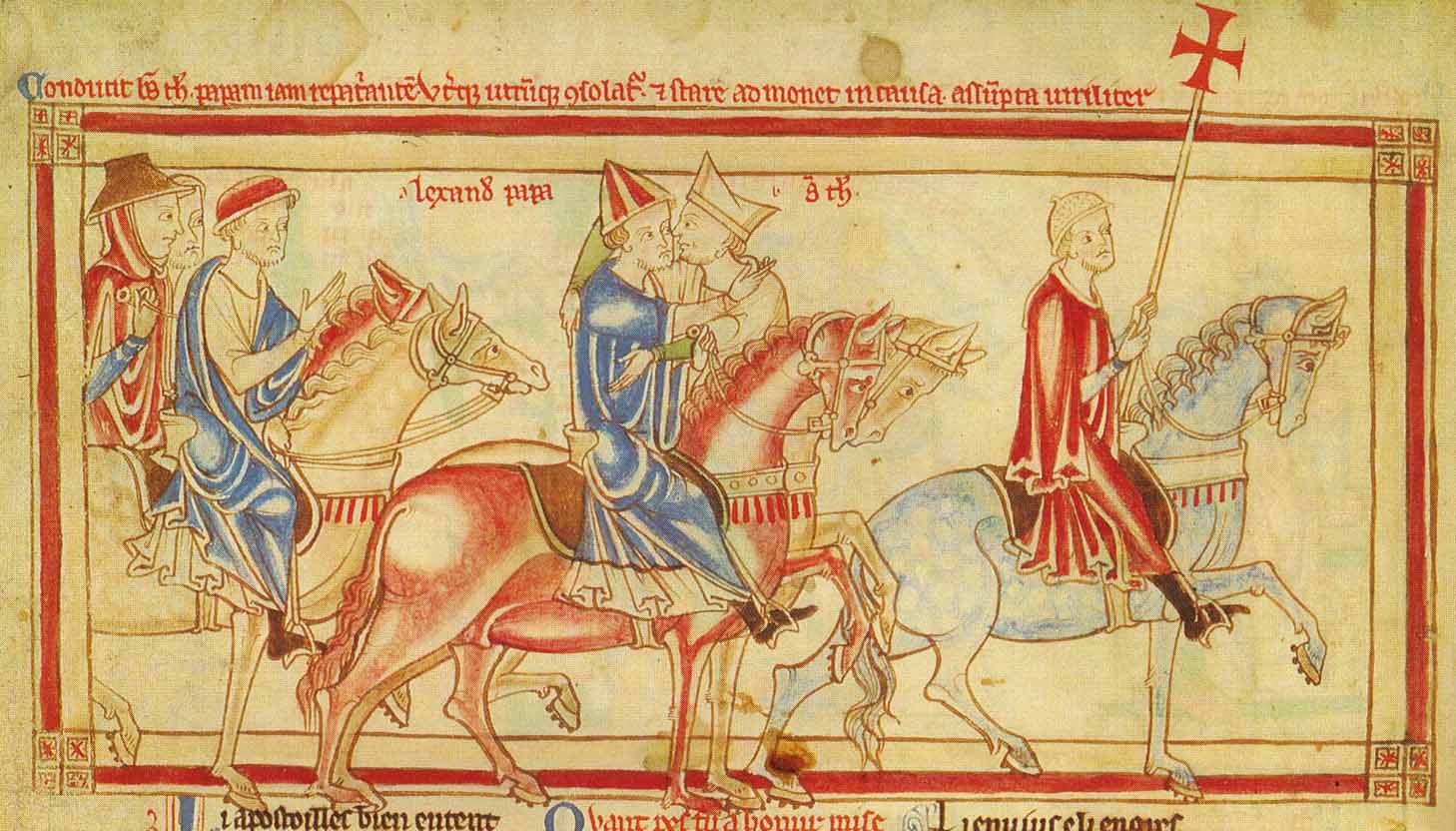
Actually the ‘kiss of peace’ (BL Loan MS 38, f.1v)
The phrase, ‘the love that dare not speak its name’ is a line from the poem Two Loves, by Lord Alfred Douglas. It was used in the late nineteenth century as a euphemism for homosexuality, including at the trial of Oscar Wilde for gross indecency.
Homosexuality as a specific type of sexual identity is another nineteenth-century social construct. Throughout the Middle Ages, men and women may have satisfied their physical desires with members of the same sex, and/or had their deepest and most fulfilling emotional relationships with members of the same sex. But they would not have thought of themselves as ‘gay’ or ‘lesbian’ or ‘bisexual’. These are all much later ways of categorising sexual desires and behaviour.
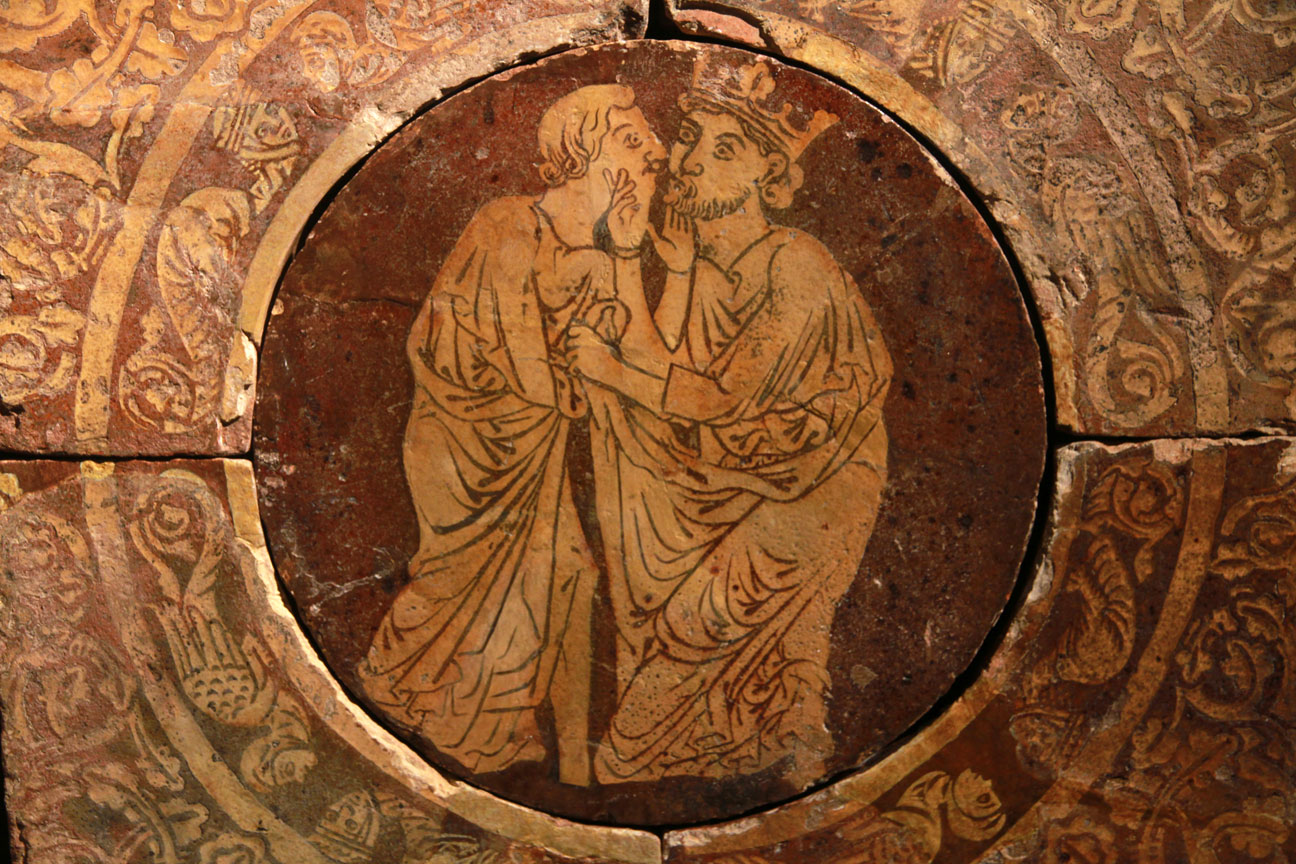
Encaustic tile from Medieval England
In popular history, Edward II has been anachronistically cast as ‘England’s first gay king’. The king did have intense, affectionate and emotional relationships with successive male ‘courtly favourites’. Contemporaries complained of the king’s ‘immoderate’ and ‘excessive love’ for Piers Gaveston, a boyhood friend. Gaveston was besieged, kidnapped and murdered by several English barons in 1312.
Yet Edward also had at least one illegitimate son, Adam, named in a wardrobe account of 1322 as Ade filio domini Regis bastardo (‘Adam, bastard son of the lord king’). Adam was probably born around 1307. By his wife, Isabella of France, Edward became the father of four healthy Plantagenet heirs. Piers Gaveston also fathered both legitimate and illegitimate children, at exactly the period when his closeness to the king was causing so much political controversy.
It may be difficult to put a modern label on the relationship between Edward II and Gaveston, but we know that contemporaries did speculate on the king’s possible sodomy. In 1334, Adam Orleton, the bishop of Winchester, was accused of publicly calling the king a sodomite, in a sermon preached at Oxford in October 1326. He strongly denied the charge, and it would have been an incendiary claim to make in public, whatever people might have thought in private.
It may be difficult to put a modern label on the relationship between Edward II and Gaveston, but we know that contemporaries did speculate on the king’s possible sodomy.
Queen Mary Psalter, Royal MS 2 B VII, f.201r
The term ‘sodomy’ is also a complex one in a medieval context. As Robert Mills highlights in his book, Seeing Sodomy in the Middle Ages (University of Chicago Press, 2015), medieval references to the ‘sodomitic sin’ (sodomiticum peccatum) usually referred to anal intercourse between males. Yet they could encompass a much wider variety of ‘sins against nature’ (contra naturam). A sin against nature might be defined as any act of fornication that failed to lead to human reproduction within the bond of marriage. Oral sex, for example, and other forms of sexual activity that ‘wasted’ semen, could all be classed as sodomitical ‘sins against nature’. These kinds of sexual excess were thought to have terrible consequences, unmaking a man and producing a homo effeminate or vir evirate- an effeminate, unmanned man.
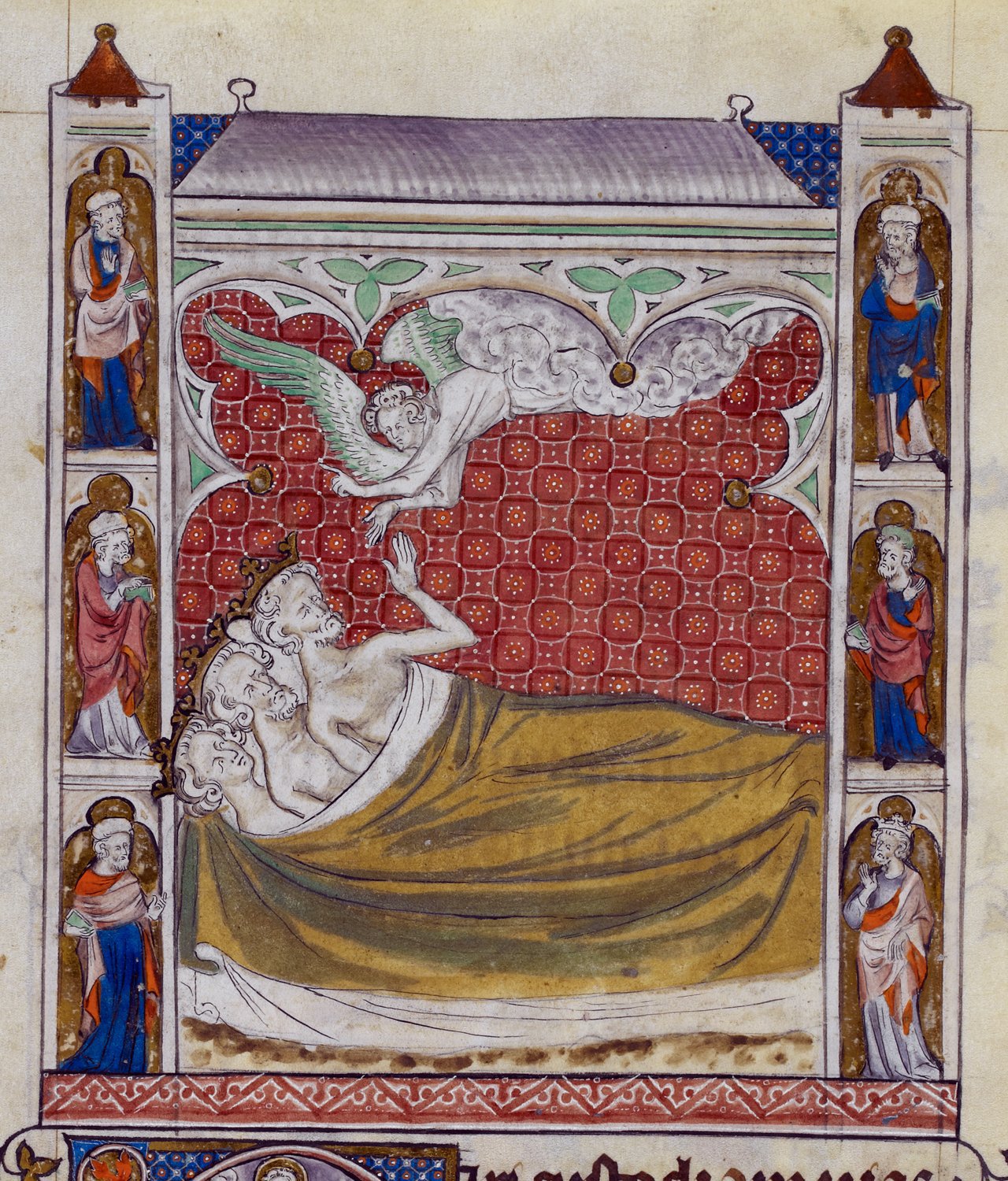
In the world of the court, the dreadful sin of sodomy could also be a powerful political weapon. After all, courtiers were almost all men, and lived side-by-side in intense competition with each other. Every ambitious man at court wanted to get as close as possible (both physically and emotionally) to the king, and the power and favours at his command. Men aspired to a ‘sworn brotherhood’ with each other, modelled on the covenant sworn between David and Jonathon in the Bible. This could lead to affectionate, fraternal behaviour between them that their excluded rivals might well have cast as ‘unmanly’, ‘effeminate’ or ‘sodomitical’.
The Dream of the Magi’, Queen Mary Psalter, Royal MS 2 B VII, f.131v
This was especially the case if your ‘brother’ was the king. Kings were not supposed to be equal to anyone. The idea of a king desperate to fulfil the desires of his ‘brother’ (or his wife), a needy, weak and ‘unmanly’ king who would not do what was best for his kingdom, but only what would satiate his own personal desires, was what really turned the stomachs of medieval courtiers.
So what of Edward II and the charge of sodomy? In his fascinating essay, ‘The Sexualities of Edward II’, the historian Mark Ormrod discusses the contemporary speculation surrounding Edward II’s sexuality in detail. Ormrod outlines how accounts of Edward’s death in Berkeley Castle in 1327, apparently killed by a red-hot poker being inserted into his anus, or the complaints of his ‘unnatural’ relationship with his last courtly favourite, Hugh Despenser the Younger, helped articulate some of the fundamental political problems of Edward’s kingship.
Casting the king as a sexual deviant and degenerate, prone to debauchery and licentiousness (among a range of other failings) helped chroniclers to explain his disastrous reign- and justify his deposition in 1327. The rex effeminatus is a rex inutilis (‘useless king’) and must be removed from power in the same way.
So while there may often have been sex at the medieval court, with all the permutations and partners that one can think of, what really mattered in the end was power.
In part three of 'Sex at Court' , Laura considers the status of mistresses and bastards. Throughout the medieval period, there was little stigma attached to being the close kin of a powerful man, whatever side of the blanket you might have been born on, and many mistresses were tolerated by royal wives...
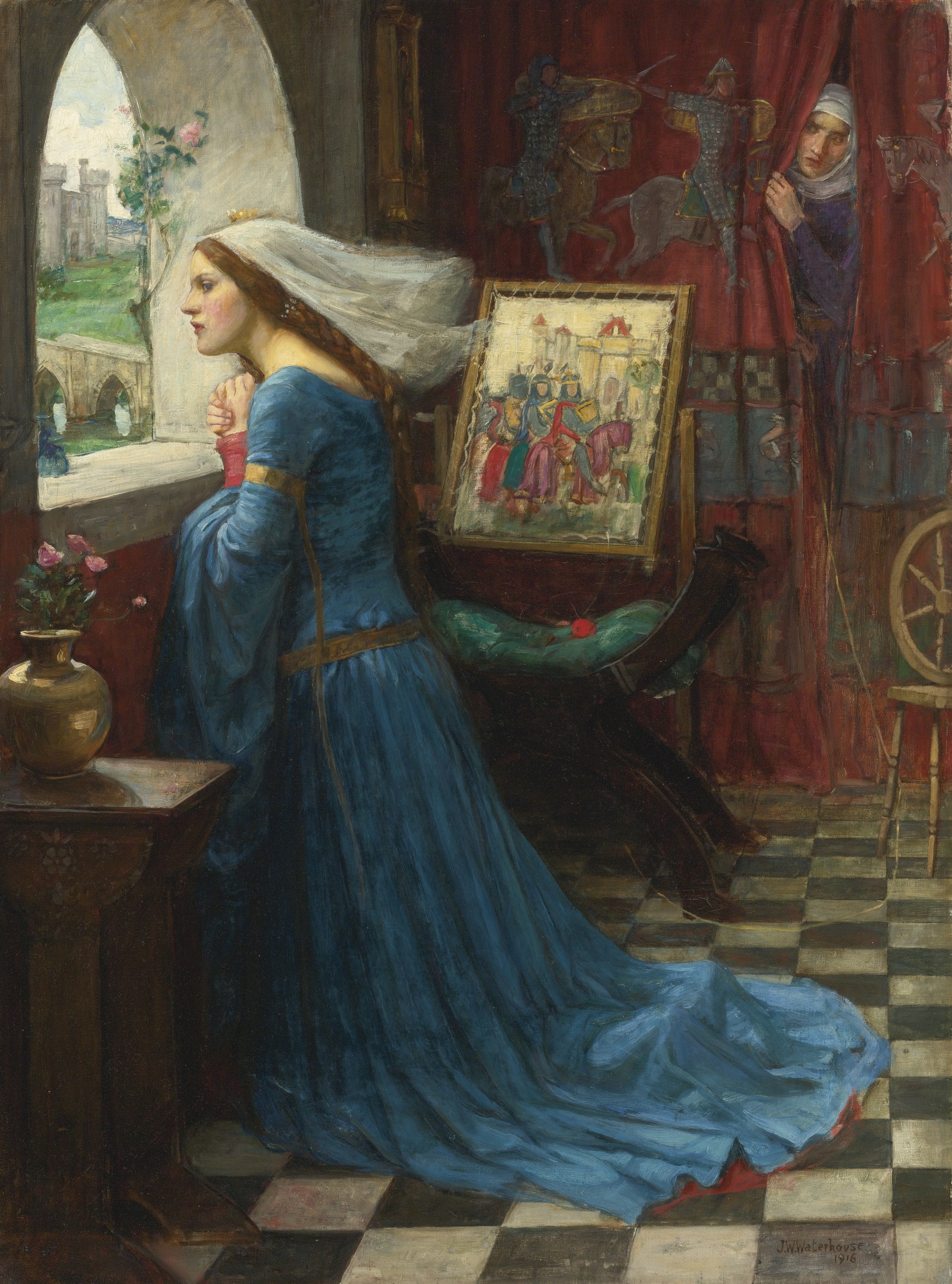
John William Waterhouse, Fair
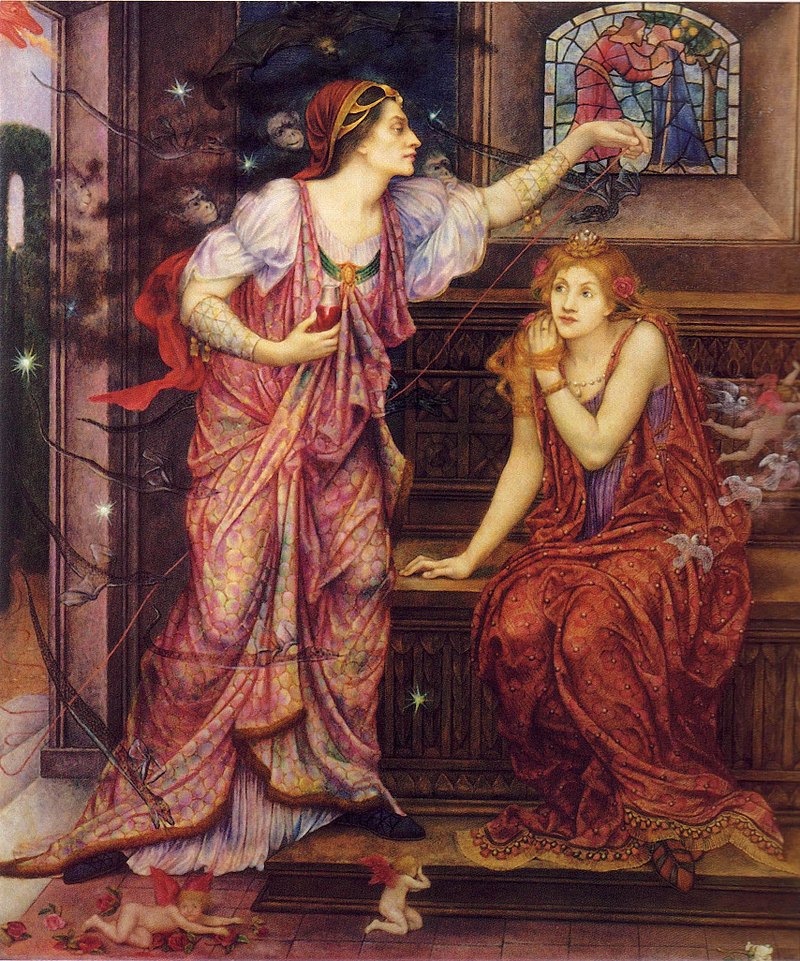
Evelyn de Morgan, Queen Eleanor and Fair Rosamund. c. 1880-1919
Courtiers and kings did not dally with whores, but as more befitting their status, maintained mistresses. The mistress of Henry II of England, Rosamund Clifford, a famous beauty, became legendary enough to inspire later Victorian art.
In the thirteenth century, the royal palace at Woodstock contained a ‘Rosamund’s Chamber’, named after her. Later legends suggested that Henry’s wife, the great patron of troubadours and courtly love, Eleanor of Aquitaine, tried desperately to poison ‘the fair Rosamund’. Henry II supposedly hid his mistress inside a labyrinth in the gardens of Woodstock palace, but the wicked Eleanor found her way in.
Unfortunately for fans of soap-opera history, the story is completely false. At the time that Rosamund was Henry’s mistress, Eleanor was in fact living under house arrest, on the orders of Henry II. The only person she might have wanted to poison would have been her husband! After her relationship with the king ended, Rosamund retired to Godstow Abbey, a nunnery just outside Oxford. Her tomb- paid for by the king and her family- even became something of a local shrine.
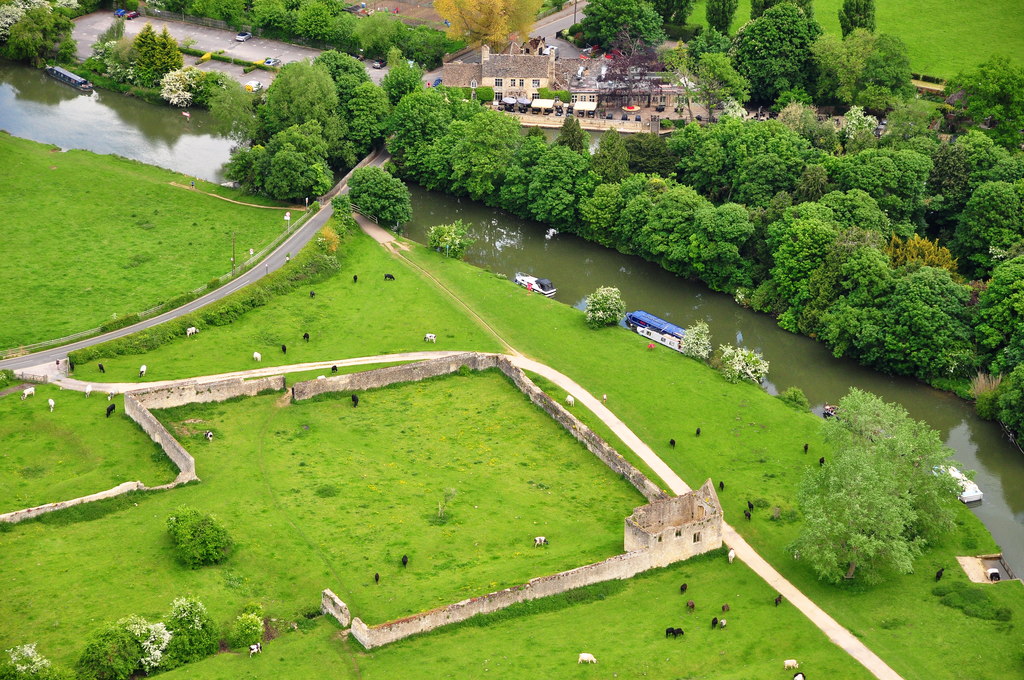
Godstow Abbey Ruins, © Dave Price
Although Henry and Eleanor’s marriage was a turbulent one- the queen was imprisoned for around sixteen years by her husband, after supporting a rebellion against Henry in 1173- it is most unlikely that Eleanor was particularly upset or disturbed by Rosamund’s existence. In the first place, Rosamund was only one among many. It has been suggested that Henry also bedded Rosamund’s aunt, Ida of Hainault, and Ida’s own daughter, Ida de Tosny. Another known mistress of Henry II is a woman called Ykenai, who gave birth to Geoffrey Plantagenet, a future archbishop of York. Geoffrey was even brought up in Eleanor’s household, suggesting great tolerance for her husband’s affairs.
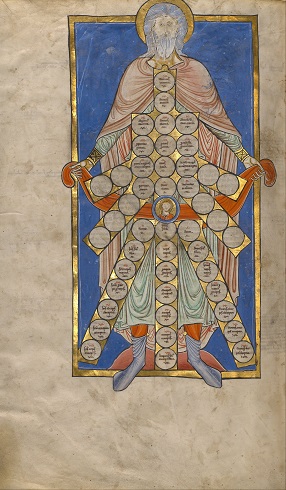
An illuminated 'table of consanguinity' Getty Centre, MS Ludwig XIV 2, f.227v)
Why might Eleanor have brought up her husband’s bastard child in her own household? She may have seen in the infant Geoffrey a useful future ally. Mere mistresses, and the bastards they produced, were no threat to Eleanor’s power and position as Henry’s wife. Nor would they challenge the inheritance rights of her own children. Unlike in the early middle ages, the strict teachings of the church now gave illegitimate children no claims to the royal succession.
As a result, illegitimate kin could be relied upon. Henry II’s legitimate sons all rebelled against their father. His bastards did not. Henry II was the fount of all their wealth, power and position. Without him and his dynasty, they were nothing- so understandably, they were some of the staunchest supporters of the Angevins. Courtly half-brothers and sisters seem to have got on very well, no doubt for this reason.
Nor was Henry II unusual. His grandfather, Henry I, fathered at least twenty-four illegitimate children.
Henry I’s eldest natural son, Robert of Gloucester, became a great magnate. Another natural daughter, Maud FitzRoy (literally, ‘son of the king’) married Conan III, Duke of Brittany.
King Henry II of England and his children. (British Library, Royal 14 B VI)
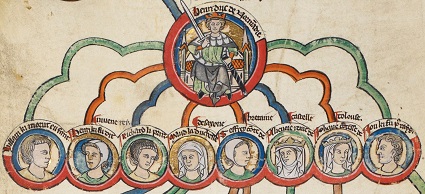
Bastards provided kings with spare ‘assets’ to be disposed of in the international courtly marriage market, helping establish peace treaties and cement wavering allies. They also provided proof of a ruler’s continuing virility. Giving birth to heirs was an essential part of a ruler’s job description. In another public display of power, the existence of many bastard children provided continuing, public proof of a ruler’s ‘manhood’- and silently implied that any problems producing legitimate heirs were due to his wife, and not to him.
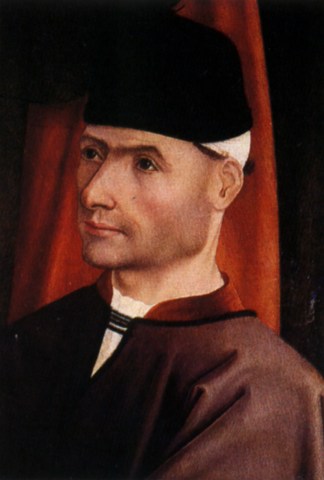
Jean de Dunois
The fifteenth-century nobleman Jean de Dunois was widely known as the ‘Bastard of Orléans’, in recognition of his status as half-brother to Charles VII of France. Anthony, the natural son of Philip III, Duke of Burgundy, was known as the ‘Bastard of Burgundy’ or simply ‘the Grand Bastard’. All such nicknames may seem incredibly rude to modern ears- but were in fact markers of great respect.
In the second part of her 'Sex at Court' series, Laura Slater looks at the phenomenon of prostitutes at court, and the various measures - including licensing, imprisonment and taxes - that were taken in order to try and regulate them.
The late medieval court was an overwhelmingly male place to be. Apart from laundrywomen, almost all of its menial household staff were male. The queen usually lived in a separate household from the king, as did their children. Female servants and ladies-in-waiting would attend these courts. But the vast majority of the courtly ‘staff’ around the ruler: courtiers and counsellors, clerics and bureaucrats, soldiers and bodyguards, diplomats and visitors, musicians and entertainers…were all going to be men. This image of courtly feasting from the Très Riches Heures shows us the all-male world of the court very clearly.
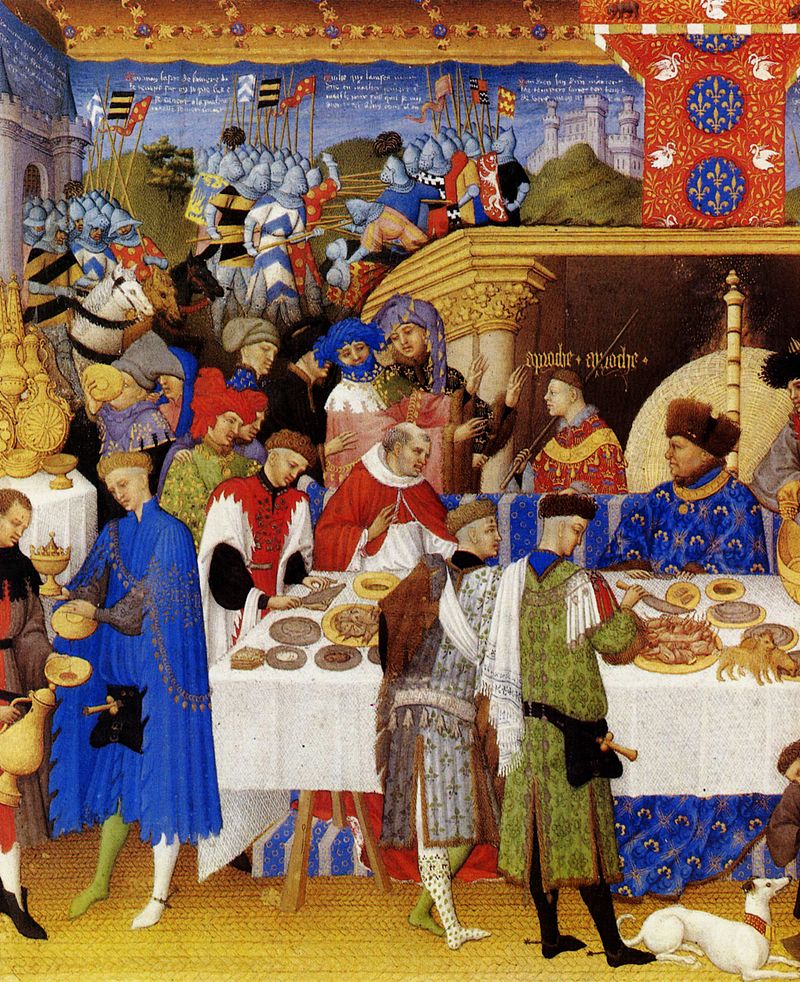
(Museé Condé, MS 65, f.1v)
The assorted hangers-on following in the train of the court would also usually be men: hopeful petitioners, messengers, spies and noble retainers. Most of these people had no official place in the royal household. Efforts were made throughout the Middle Ages in European courts to try and clear these people away from the vicinity of the court, and stop them eating, drinking and travelling at the ruler’s expense. But they invariably came to nothing. People needed to be at court: to get charters witnessed or marriages agreed, to get licenses and permissions for things, and generally just do business- sometimes with the king himself, but as often with his officials, or some of the great nobles in attendance on him. Other people’s business was the court: making a career in royal service, joining the royal household, or supplying the king and his household with the vast quantities of food, wine, clothes and jewels that courtly splendour required.
]
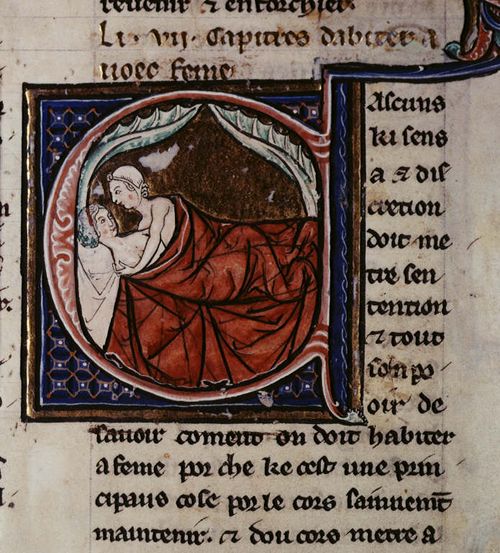
Sloane MS 2435, f. 9v. -British Library
In this all-male world, prostitutes were perennial, ever-tolerated (or at least, pragmatically accepted) court followers. During the reign of Henry II of England, one Ranulf de Broc held the office of ‘marshal of the whores of the royal household’. As Ruth Mazos Karras’s study, Common Women: Prostitution and Sexuality in Medieval England (Oxford University Press, 1998) shows, this legal regulation of prostitution was not unusual. Seen as a necessary outlet for otherwise unruly male desires, licensed brothels or ‘stews’ could be found in England, just as they were established across medieval Europe- especially in port towns such as Sandwich in Kent, or Southampton in Hampshire. In London, the red light district area was the suburb of Southwark, within the legal liberty of the bishop of Winchester. Prostitutes in Southwark were known as ‘the bishop of Winchester’s geese’.
Museé Condé, September
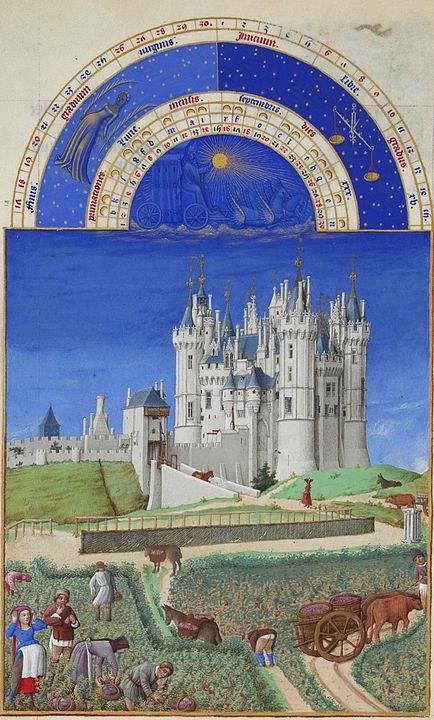
Regulation went hand in hand with ‘crackdowns’ and exclusion. In 1318, Edward II issued ordinances against prostitutes at court. A ‘bawd’ caught a third time within the legal vicinity of the court (known as ‘the verge of the court’) would be imprisoned for forty days.
Yet the rulings had little effect- in 1370, a marshal of the court prostitutes was again appointed. He was licenced to take four pence in ‘tax’ a week from each whore following the court.
As we saw in the 'Marriage at Court' posts, matters of romance were not always plain sailing... In the first of a series of posts on 'Sex at Court', Laura Slater looks at some notable examples of marital breakdown and adultery in medieval England.
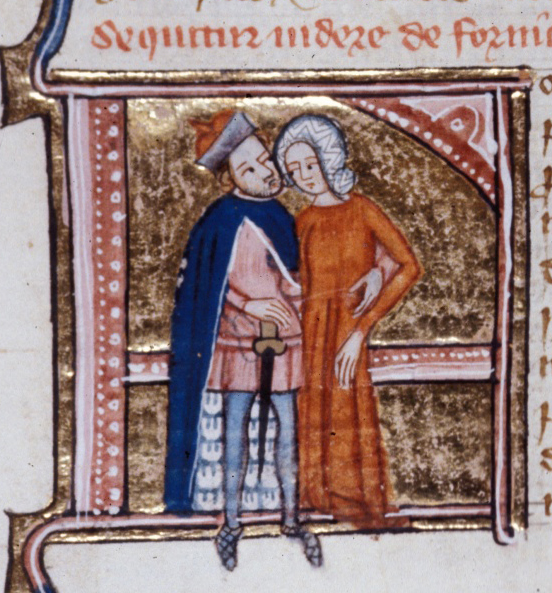
British Library Stowe 17 f. 143
While a happy medieval marriage was possible, just like today, marriages could also break down. Joan, the ‘fair maid of Kent’, was the daughter of Edmund of Woodstock (d.1330, one of the younger sons of Edward I), and she spent much of her childhood in the household of Queen Philippa of Hainault. Over the winter of 1340-1341, when she was around twelve or thirteen years old, she was married to Sir William Montagu, the son of the earl of Salisbury, who was one of Edward III’s best friends. The grand alliance of Montagu with this ‘spare’ Plantagenet daughter shows the power of marriage as a form of courtly reward for loyal royal service. Yet in 1347, Montagu’s steward Sir Thomas Holland opened proceedings at the papal court in Avignon, claiming that he had already married Joan in secret, (making ‘a clandestine marriage’) in spring 1340.
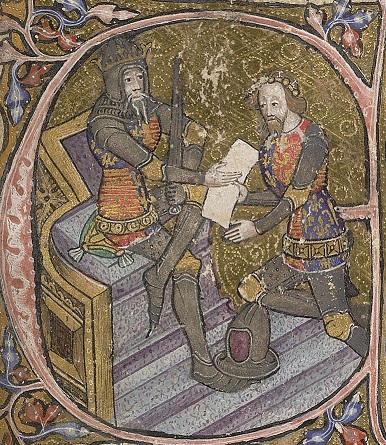
The 'Black Prince' in British Library - Cotton MS Nero D VI, f.3
Now that he was a wealthy man thanks to the profits of fighting at the battle of Crécy, Thomas Holland could afford to marry for love, and the historian Michael Bennett suggests that the story of the clandestine marriage might have been a convenient legal fiction*. It's possible that by 1347 the Montagu marriage may have broken down, with Joan embarking on an affair with Holland, her husband’s steward. However, the idea of a premarriage saved the honour of all parties. Once widowed, Joan would go on to marry her cousin the Black Prince, the eldest son of Edward III, in 1361. This marriage must again have been a love match, for negotiations had been underway to marry Prince Edward to a more suitable bride, Margaret of Flanders- the kind of strategic royal union that cemented diplomatic and trading alliances. In later life, Joan was referred to sarcastically as ‘the Virgin of Kent’, and seems to have ended up with something of a reputation for loose living. In the Peasants’ Revolt of 1381, the peasants who invaded the Tower of London made (sadly unrecorded) ‘ribald remarks’ to the dowager princess, and even, most disrespectfully, invited her to kiss them.
*see Bennett's essay ‘Honi soit qui mal y pense: Adultery and Anxieties about Paternity in Late Medieval England’
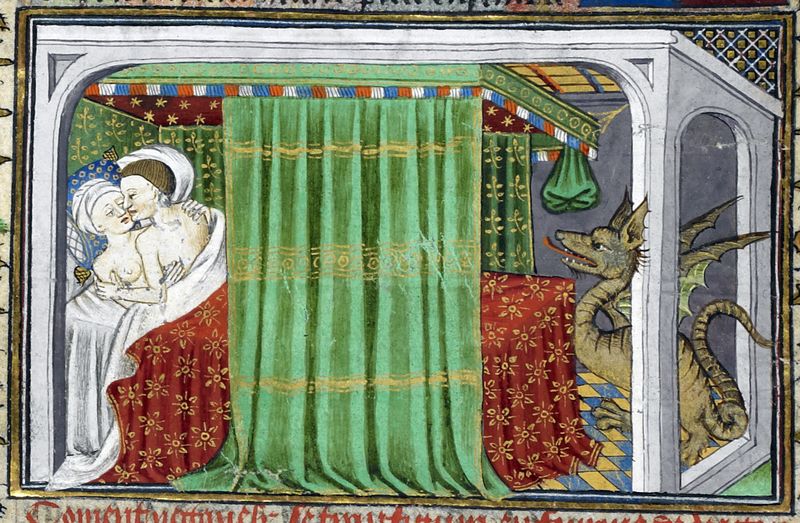
British Library - Royal MS 15 E VI, f. 6r
Less happy than Joan's love matches is the story of the prolonged marital breakdown between John de Warenne, the seventh earl of Surrey, and his wife Joan of Bar. Joan was the daughter of the Count of Bar in northeast France, and a granddaughter of Edward I - a great political match for John. When they wed in 1306, John was around twenty. Joan was probably below the age of ten. While this was not an unusual age gap for the period, the marriage proved unhappy and childless.
By June 1313, Joan was living in the Tower of London, supported by her uncle, Edward II. Warenne was living with his mistress, Maud Nereford- a deed for which he was excommunicated by the bishop of Chichester. Lengthy legal battles followed, for Warenne wanted to dissolve his marriage to Joan, marry Maud and legitimise his two Nereford sons. By 1316, Joan had departed for her native France. All Warenne’s legal efforts to dissolve his marriage were unsuccessful, and his two sons by Maud Nereford eventually joined the Hospitaller order.
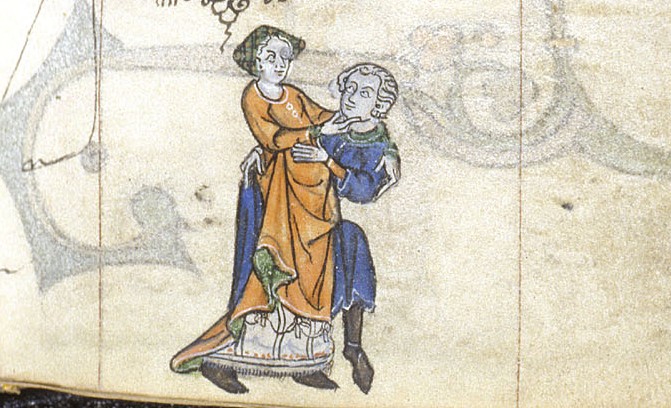
British Library - Royal MS 6 E VII, f. 150r
The couple may have reconciled in the 1320s, but in 1337, Joan returned to France with her household. By the 1340s, Warenne had another mistress, Isabella Holland, the daughter of a leading knightly follower of the earl of Lancaster. His will refers to her as ‘my companion’. When John died in 1347, he had at least six illegitimate children. All were left gifts and bequests in his will, but Joan received nothing.
Perhaps unsurprisingly after such a difficult experience, Joan didn’t marry again, living as a widow until her own death in 1361.
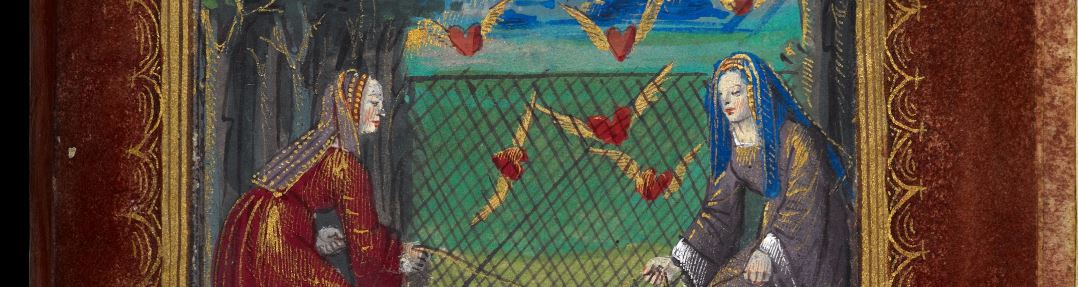
(banner picture from British Library, Stowe MS 955, f.13r. 'Friendly Expression' and 'Courteous Manner' catch hearts in their net)
A few months ago the Archivio Segreto Vaticano opened again after their traditional summer break, to the delight of the scholars that regularly gather there in search of unknown, interesting, surprising, or shocking documents. The archives are surrounded by an air of mystery, created partly by their name – the Vatican Secret Archives. Christophe, a veteran of the archive who will soon be travelling back for MALMECC, remembers his first visit…
The first time I went to the Vatican was during the last year of my PhD thesis. I must admit that despite having visited a number of archives before that, I was very intimidated. It was the Vatican after all! Thankfully I had been briefed by an expert of the Archivio on how to do it right.
Porta Sant'Anna, Vatican City (Mattes)
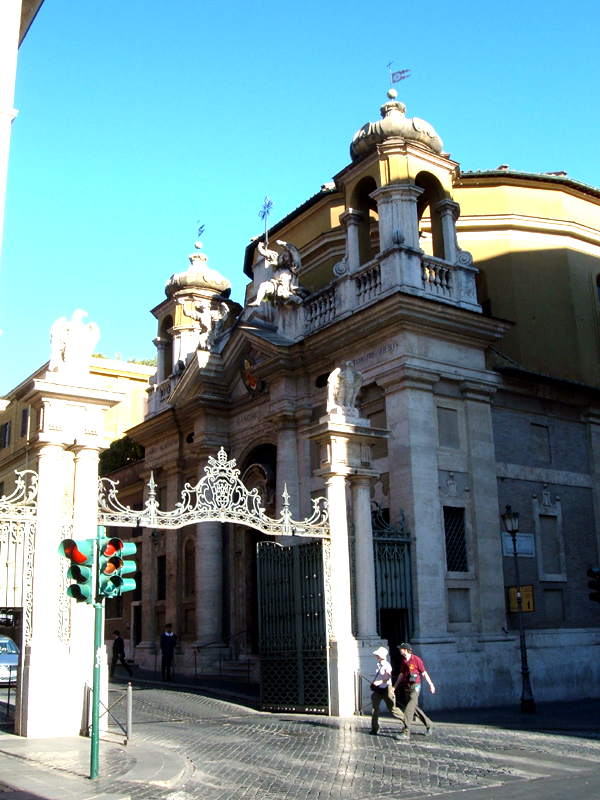
As students are not usually allowed in, there is quite a list of documents to bring - a letter explaining why you wish to access the Archivio, a
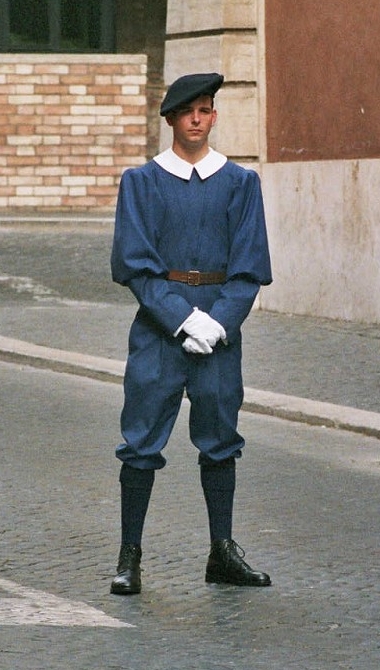
recommendation letter signed by your supervisor, proof that you have graduated (ideally a copy of your certificate), and a copy of your passport. Then, you go to the Santa Anna gate, to the right of Bernini’s famous colonnade, and explain to the Swiss guards, (yes, the real Swiss Guards, who are unfortunately not dressed in their colourful uniforms), why you are there. The most important thing is that they don’t think that you are just another tourist looking for the Vatican Museum! There is a sign just next to the door indicating the way to the Museum, which points totally in the opposite direction, but it nevertheless seems to be invisible to some… Once through the Santa Anna gate, you have entered the Vatican, and are likely to come across more cardinals, archbishops, monks and nuns than you have ever seen before!
Swiss Guardsman (Simone Casadei)
Don’t relax just yet - getting past the Swiss guardsman was just the beginning. Then come the local carabinieri. As a state, the Vatican City has its own police force. You have to explain to them, again, why you are there. In Italian, like everywhere else. They will show you the way to a small office where you have to hand over your ID or passport in exchange for a temporary visitor card (once you have your actual reader card, you can bypass that step). Then you keep on walking until you reach a third keep, where you are asked to show your card before walking through the Belvedere courtyard and finally accessing the Archives.
There, you will meet the academic equivalent of the Swiss guardsman - one of the archivists - who will ask you all about you: name, university, research subject, recommendation letter, requested documents, duration of your research stay… After that you will be asked to leave your bag and everything except what you need to take notes—not photographs—in the cloakroom and go upstairs to the reading rooms. Once there, you are almost done. Just drop the locker key to the archivists sitting behind the banco, write down your name and hour of arrival and sign the register, and order the documents you are here to see. “As simple as that”, I was told! In fact, while it seems like a lot of procedures, it’s actually quite logical and mechanical in the end. Once you are used to it, you might even inadvertently try to enter the Santa Anna gate without showing your reader card…
Research in the Archivio is often a treasure hunt. You can have a relatively clear idea of your itinerary and what you expect to find, but you will never have a clear idea of all that you could find - sources are so numerous and varied that it is hardly possible to have an idea of how far they extend.
Belvedere Square
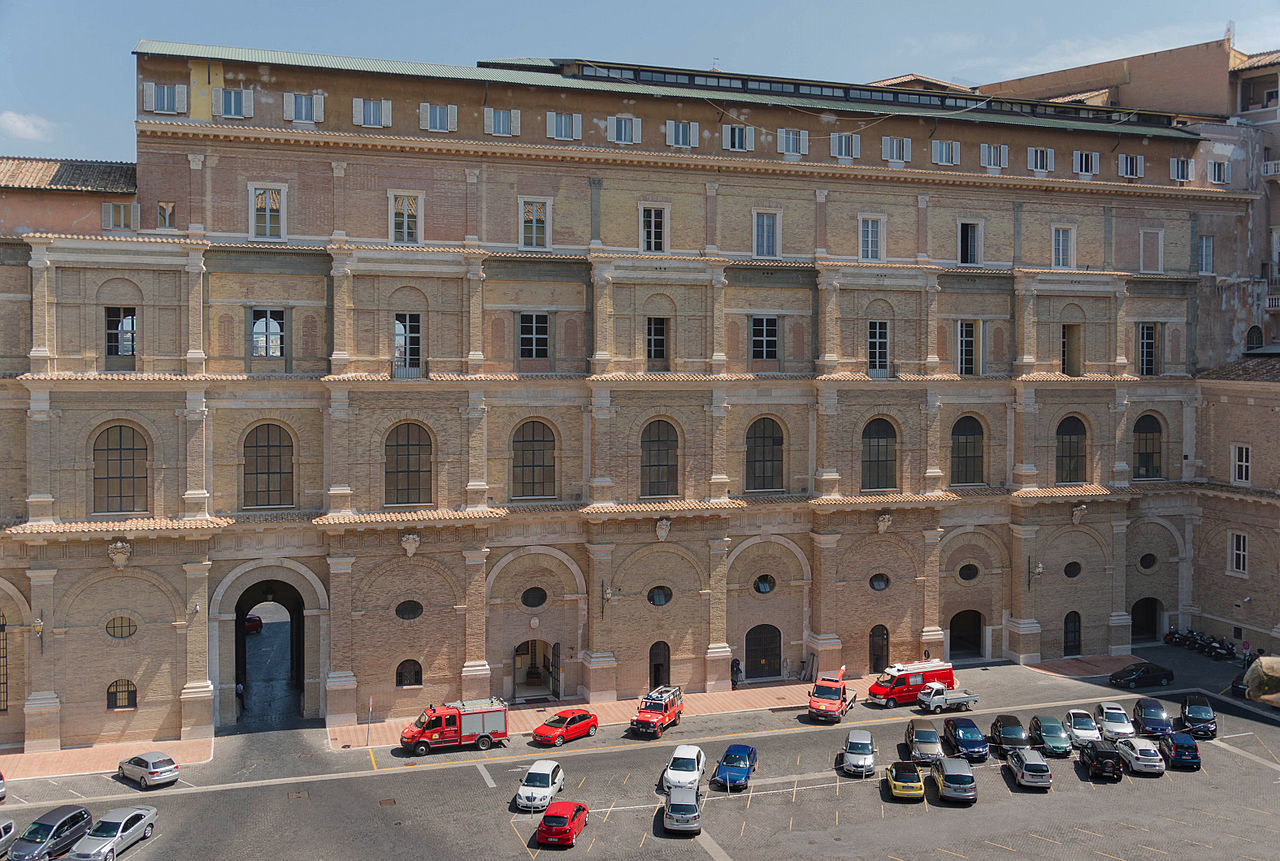
What really matters for researchers is not this all of this ceremony, but what is to be found in the Archives. The wealth of their collections is amazing.
Papal letters, account books, and diplomatic documents, to name but a few. More or less catalogued or inventoried, barely digitalized, you are neither allowed to photograph them, nor to see more than three volumes in one day. Research in the Archivio is often a treasure hunt. You can have a relatively clear idea of your itinerary and what you expect to find, but you will never have a clear idea of all that you could find - sources are so numerous and varied that it is hardly possible to have an idea of how far they extend. Luckily, you will find scholars who have been going there for years, some since they were writing their DPhil, who will be more than happy to share what they have found and suggest new collections to search. Of course, you cannot talk out loud with them in the reading rooms, but there is a garden, and a cheap but delicious cafeteria, where you can – and should - gather to exchange ideas, ask questions or give answers in a relaxed way. That is where the real social life of the Archivio happens, and also what makes the community of Archivio users so special. You don’t just go there to develop your research through reading, but to also move it forward through discussion over coffee. That has to be the ideal way of doing things!
Banner image courtesy of Patrick Landy

Christophe Masson (the lead on the 'Ecclesiastical Courts as Cultural Hubs' sub-project) looks at one of the most fraught periods of papal history to explain why there is a memorial inscription to 'the former pope John XXIII' in a medieval Florentine church.
When in Florence, you are permanently overwhelmed by art, and also, less enjoyably, by cohorts of badly-behaved tourists. Nevertheless, almost every street, square, corner or church should be visited, because there is so much to see: paintings, sculptures, manuscripts, astonishing pieces of architecture... It feels like you are outside time and away from the ordinary political concerns of the world. In fact, a lot of what you see displays a political message. The equestrian statue of Cosimo I of Medici is one well-known example, but the same could be said of the replica of Michelangelo’s David or the high tower of the Palazzo della Signoria. All of these pieces are not just beautiful, but meaningful.
In front of the cathedral and its exceptional dome stands the baptistry, where you may have been baptized, had you been born in the Middle Ages. Figures of Christ, Mary, and the apostles are on the ceiling, portrayed in one of the most marvelous thirteenth century mosaics conserved today.
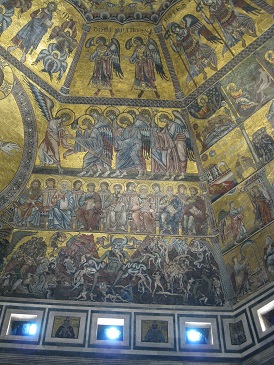
The baptistry of San Giovanni
Also in the baptistry, almost, but artistically, squeezed between two antique Roman columns, is a medieval tomb. Lying there at peace is a churchman, watched over by the Virgin and baby Jesus. But his epitaph might strike the reader as odd - Joannes quondam papa XXIII? The once pope John XXIII? Wasn’t pope John XXIII elected in 1958, before dying in 1963 and becoming canonized in 2014? In fact, this inscription refers to the 15th Century pope of the same name, and the explanation lies deep in the complex world of pontifical politics.
The tomb of antipope John XXIII
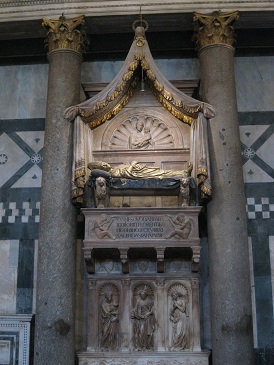
At the end of the Middle Ages, the Church experienced some of its worst days. Expelled from Rome and taken to the Rhône Valley by the French king
Philipp IV the Fair, the papacy settled in Avignon. There, it developed its administration to a point never experienced before, profiting from pontifical taxation and the seizure of local ecclesiastical charges. But, in the meantime, people wondered why the popes were not returning to Rome where they belonged. Finally, in the late 1370s, they settled back. For a moment. Almost as soon as they elected a new pope, Urban VI, the cardinals faced his hard-tempered manner and concluded that the election—held under intense external pressure and terrible conditions—was not valid, electing Clement VII instead. After a failed attempt at crushing Urban’s military forces, Clement made his way back to Avignon, where he died in 1394. Two popes were fighting, and Europe was divided between obedience to Rome and Avignon.
Antipope Alexander V
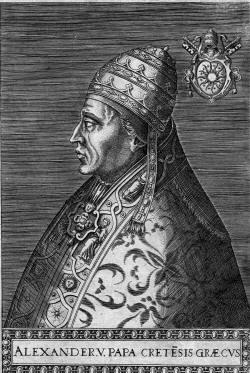
In 1409, exhausted by what they considered a dead end, several cardinals, theologians, prelates, princes decided to hold a council in Pisa, to solve what is now known as the Great Western Schism. They elected a new pope, Alexander V, But the other two existing popes, Benedict XIII (Avignon line) and Gregory XII (Roman line), refused to capitulate. Alexander (the first pope of the Pisan line), was succeeded by Baldassare Cossa, a Neapolitan churchman who was one of the main characters of the Pisan council.
He was a fighting pope, who was known before his election for his effective, yet harsh, manner. He ruled the Romagna province from Bologna and defeated several more Roman adversaries in Northern Italy. Having taken the name of John XXIII, he took Rome in 1410, signed alliances with some of the main rulers of Western Europe, and condemned the heresy of Jan Hus and John Wyclif, gaining, albeit briefly, the position that in those days was expected to be the Pope’s. But the odds were against him. With too many enemies (mainly Ladislas of Duras, the king of Naples, and the king of the Romans and future emperor Sigismund of Luxemburg) and not enough supporters, he finally had to leave Rome.
Baldassare Cossa, Antipope John XXIII
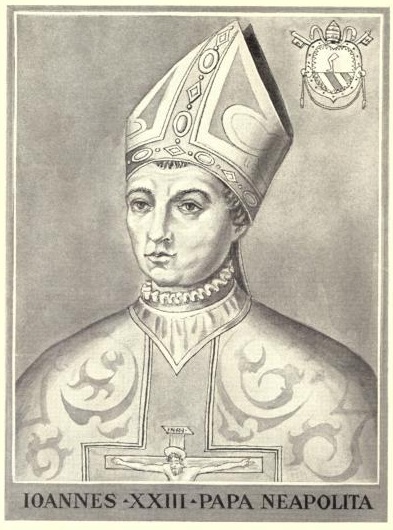
When a new council opened in Constance, he joined it, only to resign his papacy. Truth be told, he had no other choice. Seized by some of his fiercest opponents, he confessed his faults and resigned the papal tiara, leaving for four years of captivity in the Empire. In 1419, finally freed, he met the new, and only, pope, Martin V. He was on the move to regain a position of importance in Italian politics when he died in Florence, on the 27th December of that year.
The Medici, whom he had helped to enter the pontifical financial administration, and thus to make lots of profits, paid him back, so to say, by ordering his tomb from two of their best artists: Donatello and Michelozzo. It remains a masterpiece of the early Renaissance and a testimony to the interest of Florence in pontifical matters. One century later, that same Medici family would have given two popes to the Christian world…
Additional image of interest: J. Paul Getty Museum -
Master of the Getty Froissart (Flemish, active about 1475 - 1485), Pope Urban VI and the Anti-Pope Clement VII, about 1480 - 1483,
In the final part of her series of blogs on 'Marriage at Court', Laura Slater shows that privacy was a rare thing in aristocratic marriages, but that affection was still possible.
So what happened once you were married in the courts of medieval Europe? The Victorian idea of ‘separate spheres’- men dominating the public world of work and politics, women responsible for the private, domestic life of home and children- does not apply in the Middle Ages. We cannot make a clear distinction between the public and the private, or even between work and home.
(Bodleian MS Douce 6, f.160v)
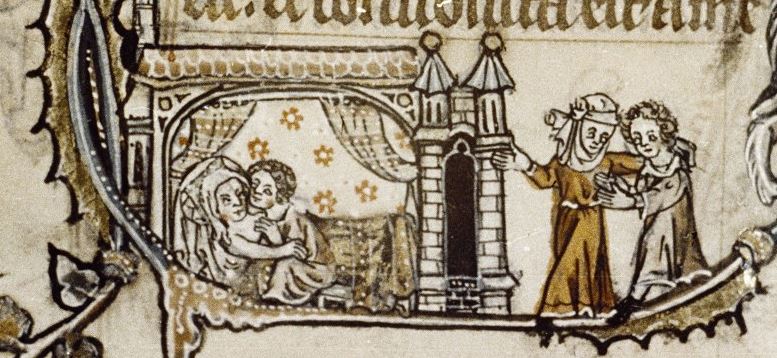
Aristocratic men and women lived their entire lives in public. Although they could retreat to more private chambers, surrounded only by trusted servants and intimate friends, they were almost never alone. If you were sleeping with your spouse (or someone else), your servants and guards always knew about it. Some servants slept in their master or mistress’s bedroom, or even in bed with them, as a matter of course. Whether you were dining happily with your spouse, at prayer together, suffering from insomnia or having a row, somebody, somewhere, always knew about it. And knowledge was power. Strangers to the court wanting to make a good first impression, or get a successful answer to their request, would pay handsomely to know what topics to avoid or emphasise in conversation with the king or queen, to make sure such meetings went well.
(Museé Condé, MS 65, f.1v)
So your ‘private’ married life could become very public. And your ‘private’ home was never closed to strangers. The noble household was a centre of business and administration, flocked to by public visitors and petitioners. Lavish feasts and entertainments, generous hospitality, the giving of alms and other forms of charity were integral to day-to-day public business. By showing off how rich, powerful and important you were, you could become even more so.
Noble landed possessions might be scattered across different territories, so managing those estates- not just accounting for their yields, livestock and crops, but sometimes physically making sure that your family or your tenants were still in possession of disputed manors- could mean long journeys across different areas of a kingdom by both husband and wife, just to keep track of everything.
Whatever their age or gender, medieval aristocrats were expected to rule- to make decisions, issue orders and give commands. A successful working partnership might be all either party expected from some unions.
(Museé Condé, MS 65, f.5v) - May
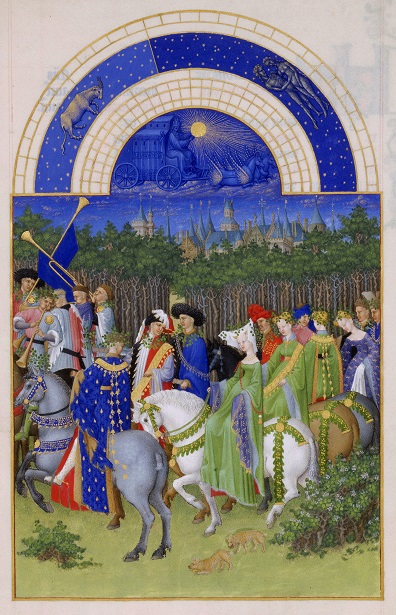
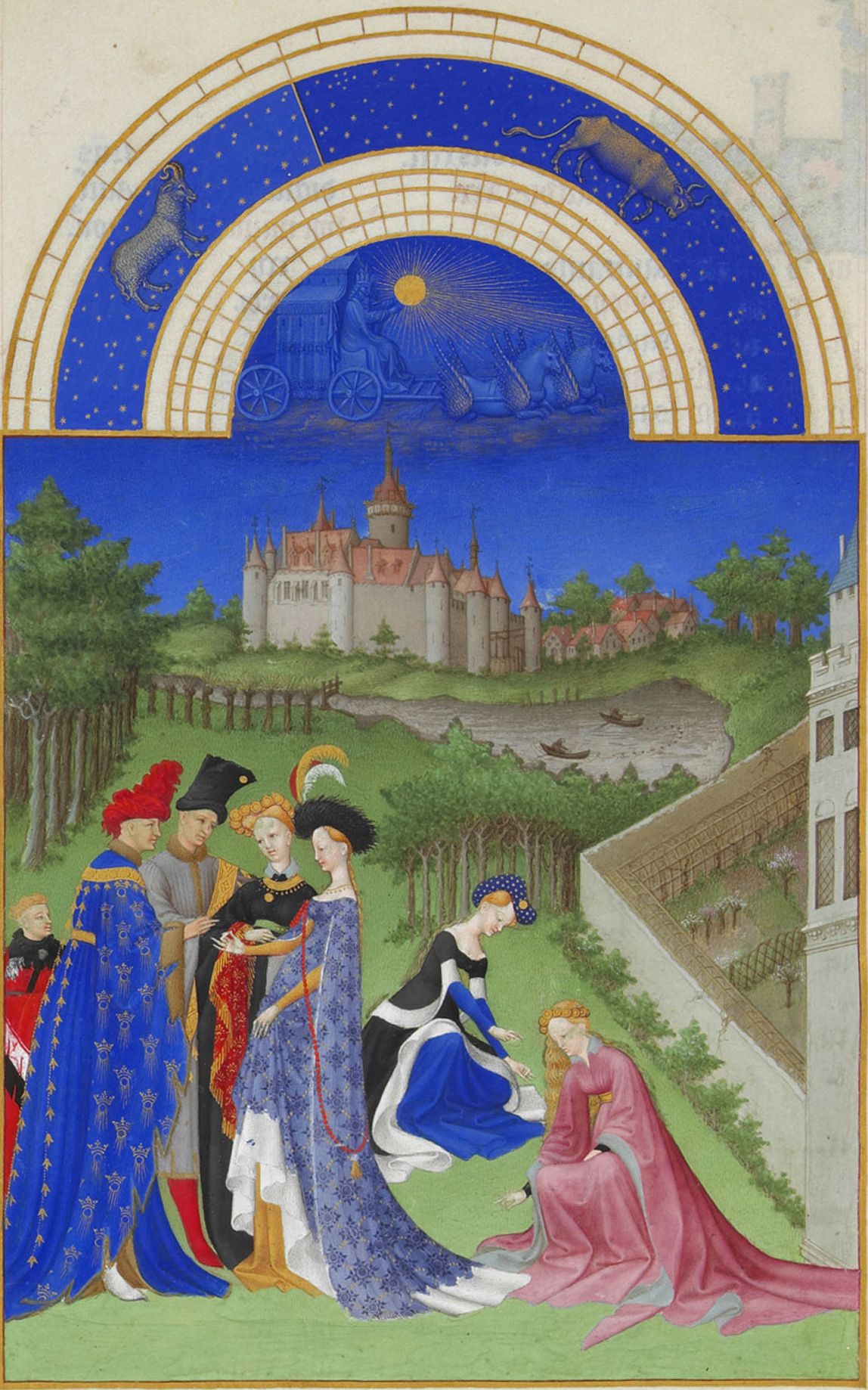
In these images from the famous c. 1412-1416 Très Riches Heures, made for Duc de Berry, one of the sons of King Jean II of France, we can see his Paris residence, the Hôtel de Nesle, in the background of the calendar page for May. In April, another residence can be seen in the background: the Château de Dourdan. The reality of married life for aristocrats was an endless circuit of travel, from palace to manor to court.
(Museé Condé, MS 65, f.4v) - April
A young noblewoman who had been married at twelve or thirteen to a man thirty years older than her would still be expected to start playing her role in the management of the family wealth, household and estates. And apart from her own personal servants, the rest of the household staff were almost certainly male. Whatever their age or gender, medieval aristocrats were expected to rule- to make decisions, issue orders and give commands. A successful working partnership might be all either party expected from some unions.
But love and affection certainly developed between some couples. Edward III and Philippa of Hainault’s union was a matter of diplomatic expediency on the part of Edward’s mother, Isabella of France. But the couple went on to enjoy an extremely happy and harmonious marriage, with Philippa giving birth to twelve children. The couple travelled together and spent most of their time together, frequently sending each other gifts. In their few surviving letters, Edward repeatedly addresses his wife as douce cuer (‘sweetheart’). So although love at the medieval court was rarely private, it was at least possible.
Many thanks to Laura for this interesting series on medieval courtly marriages. If you haven't read them yet, do take a look at the previous entries, and let us know what you think.
In the second part of her 'Marriage at Court' series, Laura looks at the pressures faced by young royal brides to start paying their 'marital debt', and its potentially life-threatening consequences.
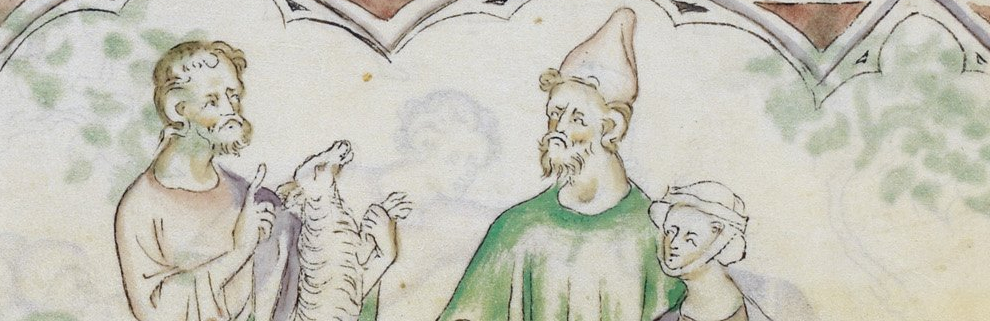
Samson recovers his wife (Queen Mary Psalter, BL MS Royal 2 BVII, f.45r)
Royal princesses usually journeyed to meet their future husbands with a grand household, attended by many of the family’s most trusted servants. But most, if not all, of this entourage would be required to formally depart: sometimes at a mid-point between the kingdoms, sometimes a few weeks or months after the wedding itself. Left alone in a foreign country, and perhaps not yet speaking its language, it could be very difficult for a young bride to resist starting to pay her ‘marriage debt’. This medieval term for conjugal relations brings us back to the transactional nature of such alliances. The modern marriage ceremony still includes the words, ‘to have and to hold’. It might sound romantic, but the phrase habendum et tenendum is found in every medieval deed marking the transfer of property between two owners.
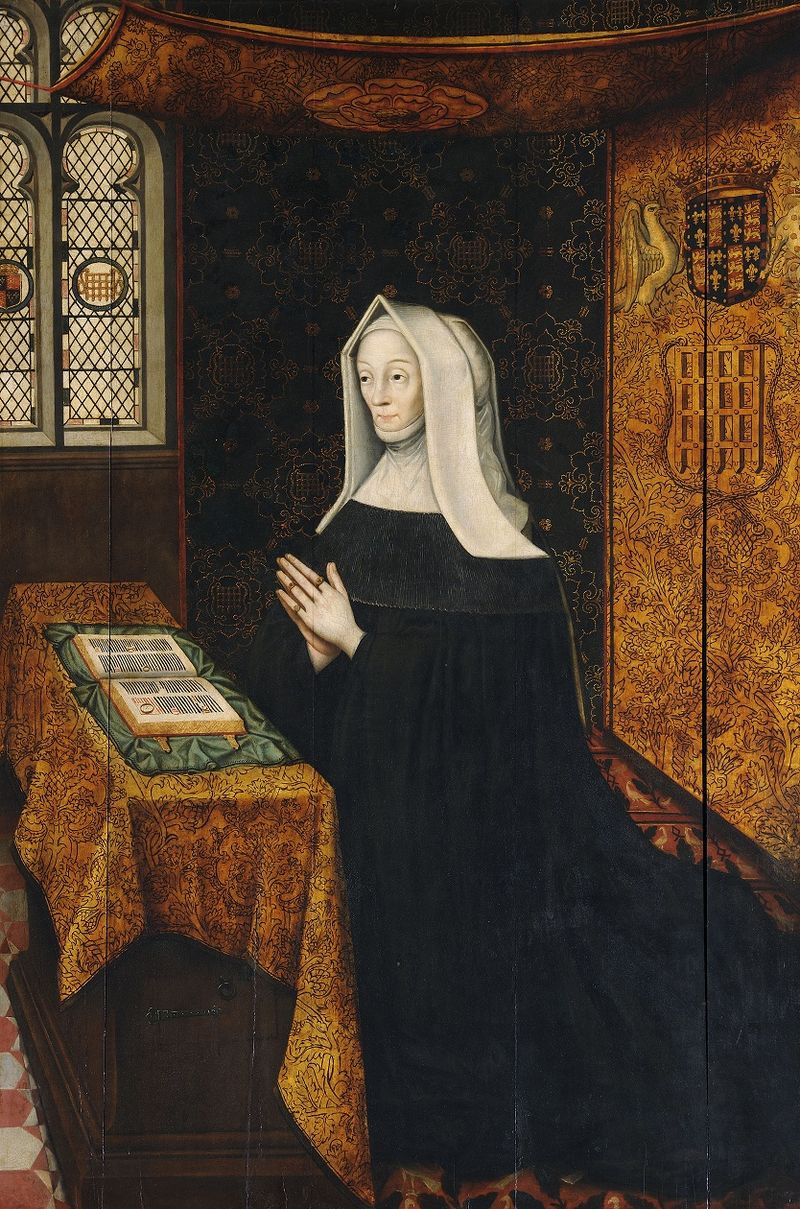
'Lady Margaret Beaufort at prayer', by Rowland Lockey, St John's College, Cambridge.
When Richard II agreed to marry a seven-year-old French princess, neither he nor anyone else was expecting him to start having full sexual relations with his new wife. He would have to wait until Isabella was of full adult age, which medieval canonists placed at between the ages of 12 and 14, the age when infancia ended and adolescentia began. In an era when you could be classed as ‘old’ by thirty, teenage pregnancies were positively encouraged. Yet childbirth was a dangerous business in the Middle Ages. Not all twelve or fourteen year olds might be physically mature enough to safely carry a pregnancy to its full term. Margaret Beaufort gave birth to Henry Tudor when she was thirteen (and already married to her second husband, who was twelve years older than her). It is possible that she was seriously injured in the process, for despite two more husbands, she never had another child.
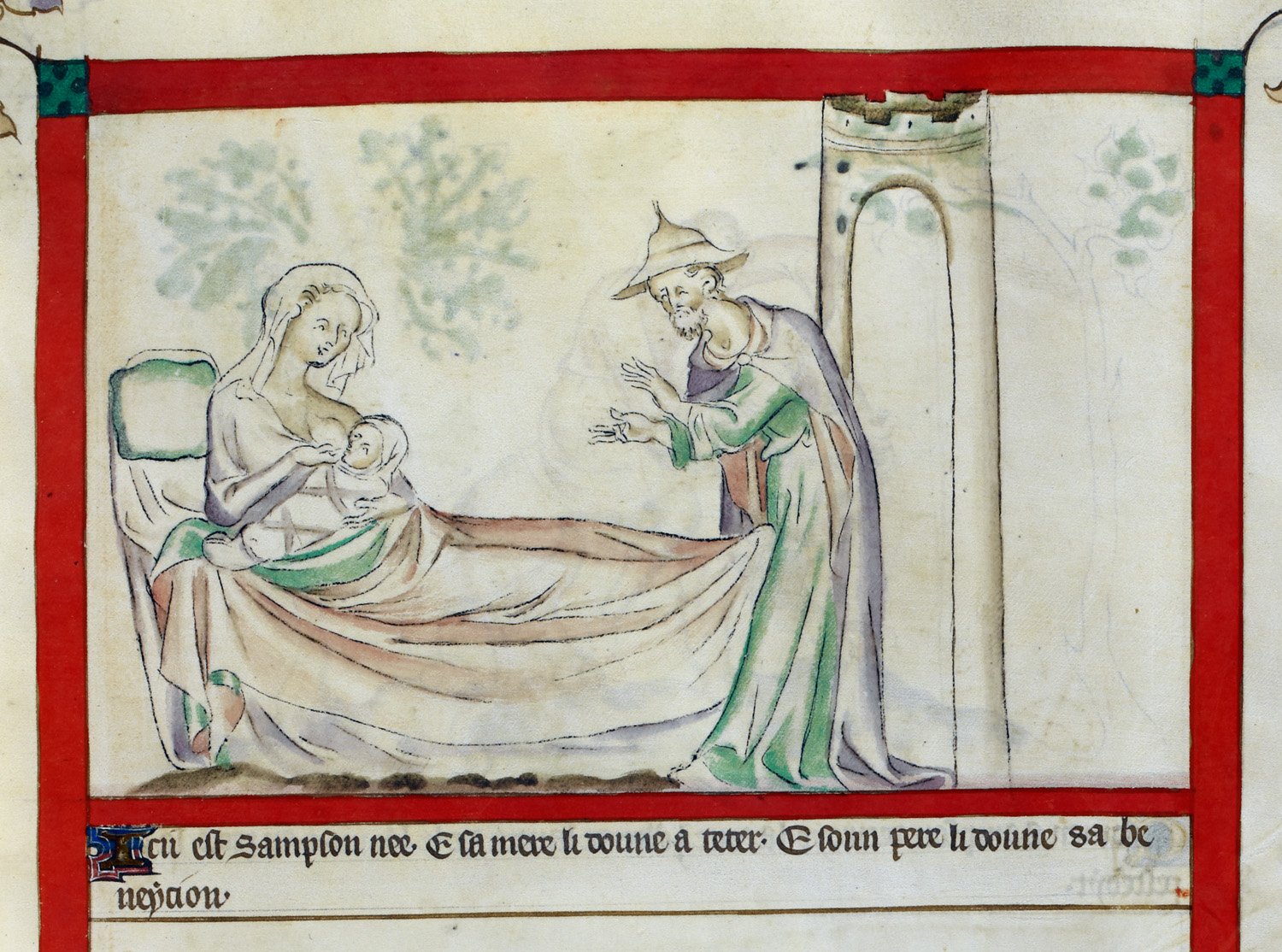
Queen Mary Psalter, BL MS Royal 2 B VII f. 43r
Eleanor of Castile, the wife of Edward I, also gave birth to her first child when she was thirteen. Although she went on to have many more children, she also seems to have found the experience a troubling one - for when it came to the marriage of her own royal daughters, she was extremely reluctant to let them leave the safety of their father’s court until they were past their early teens. She probably knew from experience that royal brides could be put under intense pressure to start producing the all-important royal heir.
In the first of a three-part series on 'Marriage at Court', researcher Laura Slater explains how aristocratic marriages were brokered, and how love was mostly for the lower orders of society.
Henry and Catherine -
Vasari, 1550 fresco in the ‘Sala di Clemente VII’, Palazzo Vecchio
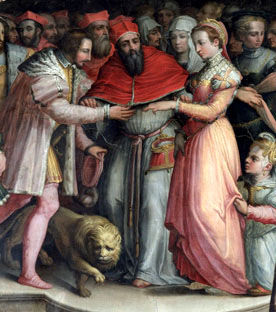
The medieval court was a great marriage market. Royal and aristocratic marriages were not about love and affection, but politics and power.
Noble unions were strategic alliances, carefully calculated to maximise wealth and power, to preserve particular territories or enhance a family’s social and political position. Royal marriages might be intended to make peace between warring nations, bolster the shaky position of a new dynasty on the throne, or renew a longstanding diplomatic alliance.
Dynasties liked to glory in their noble ancestry- many European aristocrats boasted of a descent from Charlemagne, for example. Marriage to a social inferior (known as disparagement) was thought to permanently taint an aristocratic bloodline. When the future Henry II of France married Catherine de Medici in 1533, many sneered at the union of the ancient royal house of Valois with the daughter of an upstart ducal dynasty of rich Florentine merchants and bankers.
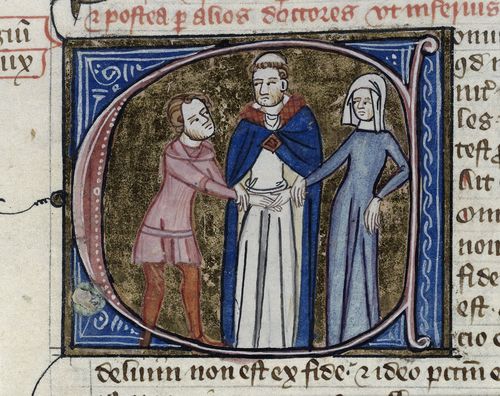
BL MS Royal 6 E VI, f. 375r.
One of the slogans of the 1381 Peasants’ Revolt directly attacked the noble obsession with lineage, pointing out humanity’s common ancestry: ‘When Adam delved and Eve span/ Who was then the gentleman?’
The English king held legal rights of marriage over widows and wards (children who inherited their lands when still underage), which he could use, sell or give away as favours as he pleased. A widow who wanted to avoid marrying again would have to buy the right to do so from the king. But if she was a great heiress, and her marriage rights had been granted to a courtly favourite in need of a grand estate, it might be very difficult to avoid marrying him. Similarly, young children whose estates were in the keeping of a guardian might also be obliged to marry their guardian’s son or daughter.
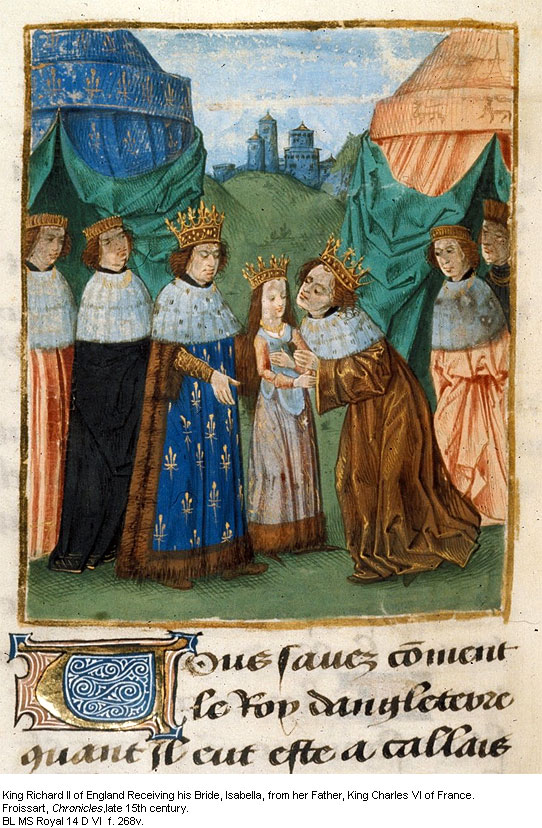
Richard II and his young wife Isabella (BL MS Royal 14 D VI, f.268v)
In theory, a medieval marriage wasn’t valid unless both parties had freely consented to it. But in the world of the court, where marriage was a matter of public business rather than private affection, few expected to have a completely free choice over their future spouse. St Augustine defined marriage not by its consummation, but by ‘affections of the mind’. This ‘sacramental’ view of marriage saw mutual love between the couple as both sign and substance of God’s grace. It became increasingly popular in late medieval Europe.
But love was for the little people…at court, marriages could be brokered at such a young age, ideas of mutual support and affection would have seemed extremely remote. Margaret Beaufort, mother of the future Henry VII of England, was betrothed to her first husband when she was between the ages of one and three. In 1397, Isabella of Valois married Richard II and became queen of England at the age of just seven. Richard’s wedding presents to his wife included a set of dolls.
In our next post, find out about the dangerous business of medieval childbirth, and just when you were expected to pay your 'marital debt'. . .