

Blogs 01 2018 - 08 2018
In my last post I looked at artworks from the castle at Runkelstein in what is now northern Italy inspired by popular courtly romances and epics. In this piece, I turn to murals from around the same period in Vienna inspired by the rather different court poet, Neidhart von Riuwental, and in rather less grand surroundings…
A visit to Vienna in the autumn provided an opportunity to make the personal acquaintance of a work of art I first came into contact with as a finalist, now an increasingly long time ago. The Neidhart murals are the earliest secular wall paintings in Austria, and remarkable for their size (there are extensive remains of about 30 metres of paintings), and for the vividness with which they give life to figures made famous by literature. They are based on the songs of the thirteenth-century poet Neidhart von Riuwental (a stage-name roughly translating as Deeply Envious of the Vale of Sorrows—surely a distant relative of that prolific letter-writer Disgruntled of Tunbridge Wells..). Neidhart also became the object of narrative texts that grew up after his death. The most famous, Neidhart Fuchs, was first published in 1491, and again in the sixteenth century—evidence of a remarkably long-lasting affection among audiences.
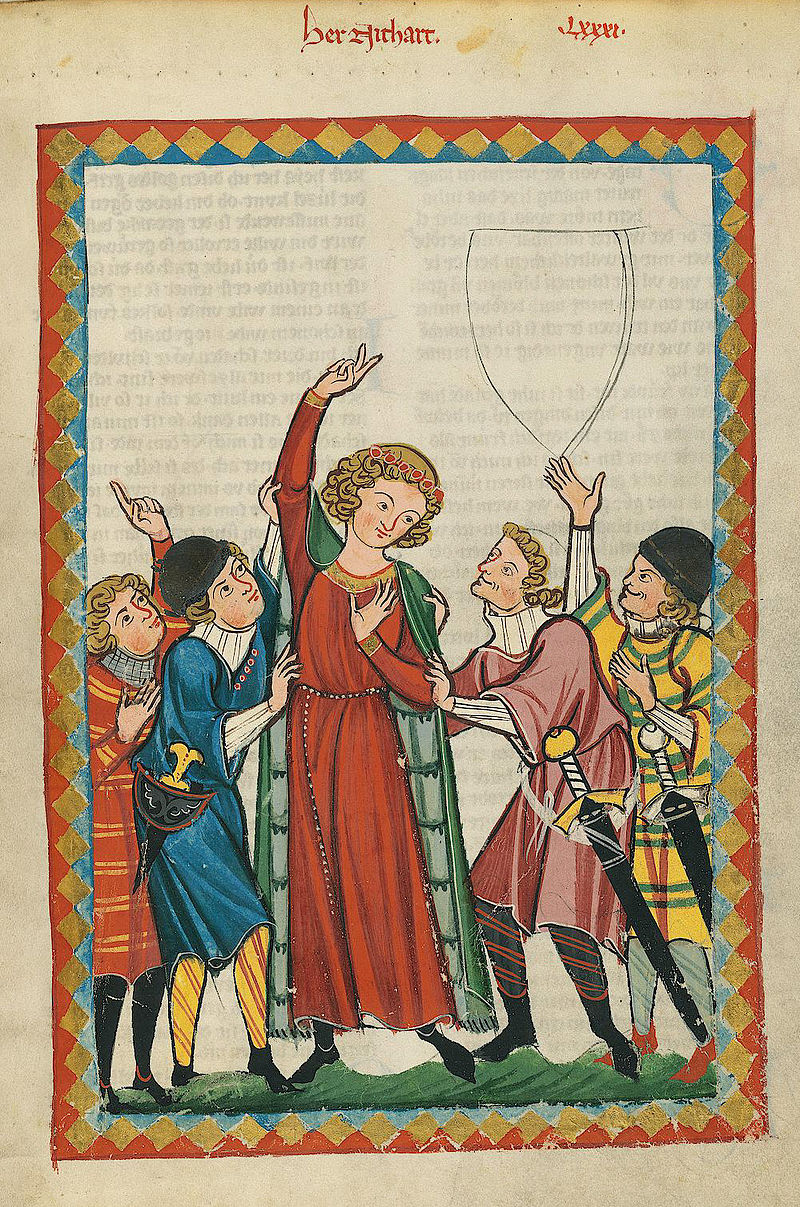
Manesse Codex, Heidelberg, Universitätsbibliothek, cod. pal. germ. 848, c. 1300-1340, Zurich, f. 273r
Neidhart’s poems play out the topoi of courtly love (the male love-servant who gains his lady’s favour after completion of difficult tasks, and by suppressing the expectation of fulfilment or reward, while both parties exhibit the most refined manners and behaviour) among the village world of farmers and peasants. They are, of course, not ‘proper’ courtiers, and so things do not go the way they should. Part of the anti-Ruritanian feel of the poetry is the strange choice of the word dörper (‘villagers’) to name the peasants. Rather Low German in colour (that is, the family of dialects spoken in the Netherlands and the north of modern Germany), it places these non-courtly events at a safe remove from Neidhart’s audiences in Vienna, where he was in the service of Duke Frederick II in the 1230s and 40s.
Interpreting the songs has proven somewhat difficult; some read them as an expression of snobbery, the court making fun of those striving to climb the greasy pole. This reading is certainly not without its merits, for instance Neidhart makes fun of the dörper’s affected dress, remarking in Winterlied 24:
Enge röcke tragent sî und smale schaperûne,
Rôte hüete, rinkelohte schuohe, swarze hosen.
Engelmâr getet mir nie sô leide an Vriderûne,
Sam die zwêne tuont, ich nîde ir phellerîne phosen,
Die si tragent:
They wear tight-fitting skirts and narrow hoods
Red hats, buckled shoes and black breeches.
Engelmar never did anything to Vriderun to hurt me so much
As those two do; I envy the purple purses
That they carry at their belt.
At the same time, though, we could also think about them as criticism of the skin-deep courtliness of certain courtiers. In Ursula Peters’ reading, this is particularly targeted at those members of the lower nobility whose drive to break through the glass ceiling in the thirteenth century was putting pressure on the Establishment ministeriales. That is to say that the dörper recall the alarming decay of old social structures. (Compare the image of the farmers putting on armour and playing at knights, an idea also sent up in Werner der Gartnære’s short story Helmbrecht. In that text, aspirations to courtliness are also mocked by the family of the title figure when he returns home spouting random fragments of foreign languages. Think Del Boy Trotter in Only Fools and Horses saying things like ‘Mange tout, Rodney...’)
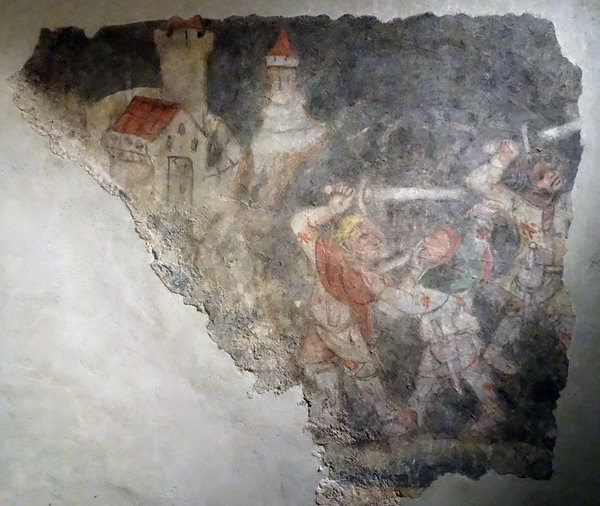
Mein Bezirk, https://www.meinbezirk.at/donaustadt/lokales/die-neidhart-fresken-d74043... 20th Nov 2017
The origins of the murals in Vienna also shed some light on the cultural capital of this literary material, even at quite some remove from its first ‘publication’ and from a non-courtly quarter. Commissioned by the merchant Michel Menschein possibly around 1398, they were rediscovered during building works in 1979 in a house in the street called Tuchlauben, named after the cloth merchants who lived and sold their wares there. The murals offer an exciting insight to some of the people who listened to Neidhart’s songs, as well as what happens to the works of court poets after their time. By this point Neidhart was a major folk hero, and a rather magnificent grave had been built for him on the south side of St. Stephan’s Cathedral in Vienna, although it is at best unclear that he was actually buried there.
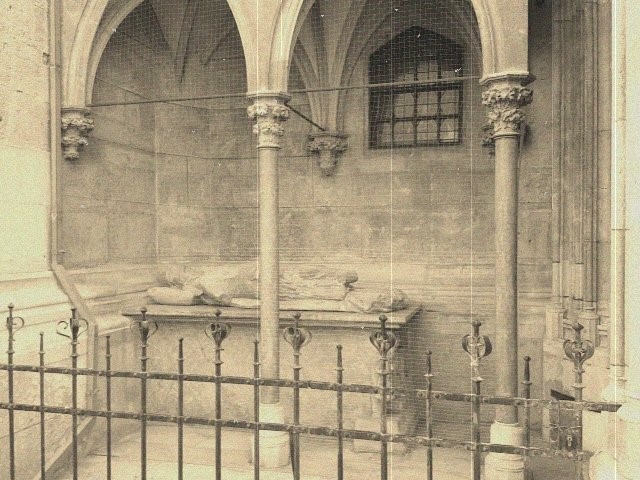
Credit: Wiener Geschichte(n), http://wiener-geschichten.at/2017/08/01/neidhart-von-reuenthal/ 10th Nov 2017
What, then, was it that attracted this merchant to decorate his house with these rather lascivious misbehaving villagers? It seems reasonable to suppose that there is a certain amount of snobbery to be read here: Menschein was one of the city council, and a major international business man dealing with traders from Cologne and the Low Countries. Also, since silk was not produced in Vienna until the eighteenth century, he would have traded with Venetian merchants, whom he may well have entertained in this room. The choice of subject seems to tread a line between showing himself to be a man of the people on the one hand, and showing how comparatively refined he was.
After all, no-one could possibly think Menschein and his family capable of the unpleasant practical joke in the Violet scene. Based on the song ‘Urlaub hab der winter’ [‘Let winter take its leave’], this scene is also portrayed on an exterior wall at Runkelstein castle in Südtirol, discussed in my last post. In it, the ruler has decreed that the first person to see a violet each year must tell him about it, so that the community could celebrate the advent of Spring. Neidhart finds it this year, and places his hat over it, so that the duchess can pick it. He runs off to find her, and meanwhile a dörper picks up the hat, and applies what might be described as home-made fertilizer to the violet. The duchess, as one might imagine, is rather upset when she lifts up the hat. Sadly, in the Vienna murals, one can only see a section of the duchess’s party walking out from the city, on the left, raising their arms in shock at the dörper’s dirty trick. Poor old Neidhart.
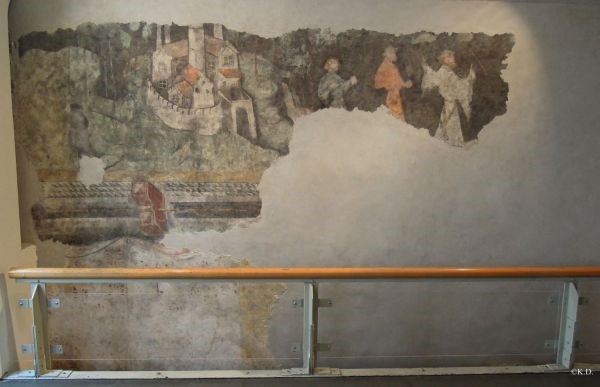
Sagen.at, http://www.sagen.at/fotos/showphoto.php/photo/30298 accessed 20th Nov 2017
What would pass these days as fairly broad humour was evidently perfectly acceptable for the Viennese bourgeoisie at the end of the fourteenth century. Just as much as proving one’s propriety, it seems that the choice of what one puts on one’s walls was about showing yourself to be a good sport. So take note on your next trip to B&Q…
What is it like to be a second son in a late medieval princely family? In this post, Christophe takes us through the example of James of Coimbra (1433 - 1459), who harnessed the political influence of his allies to aid his rapid rise to power.
(Much of this entry is based on Christophe's study in 'Évêques et cardinaux princiers et curiaux (XIVe-début XVIe siècle)'. Find out more about the book here)
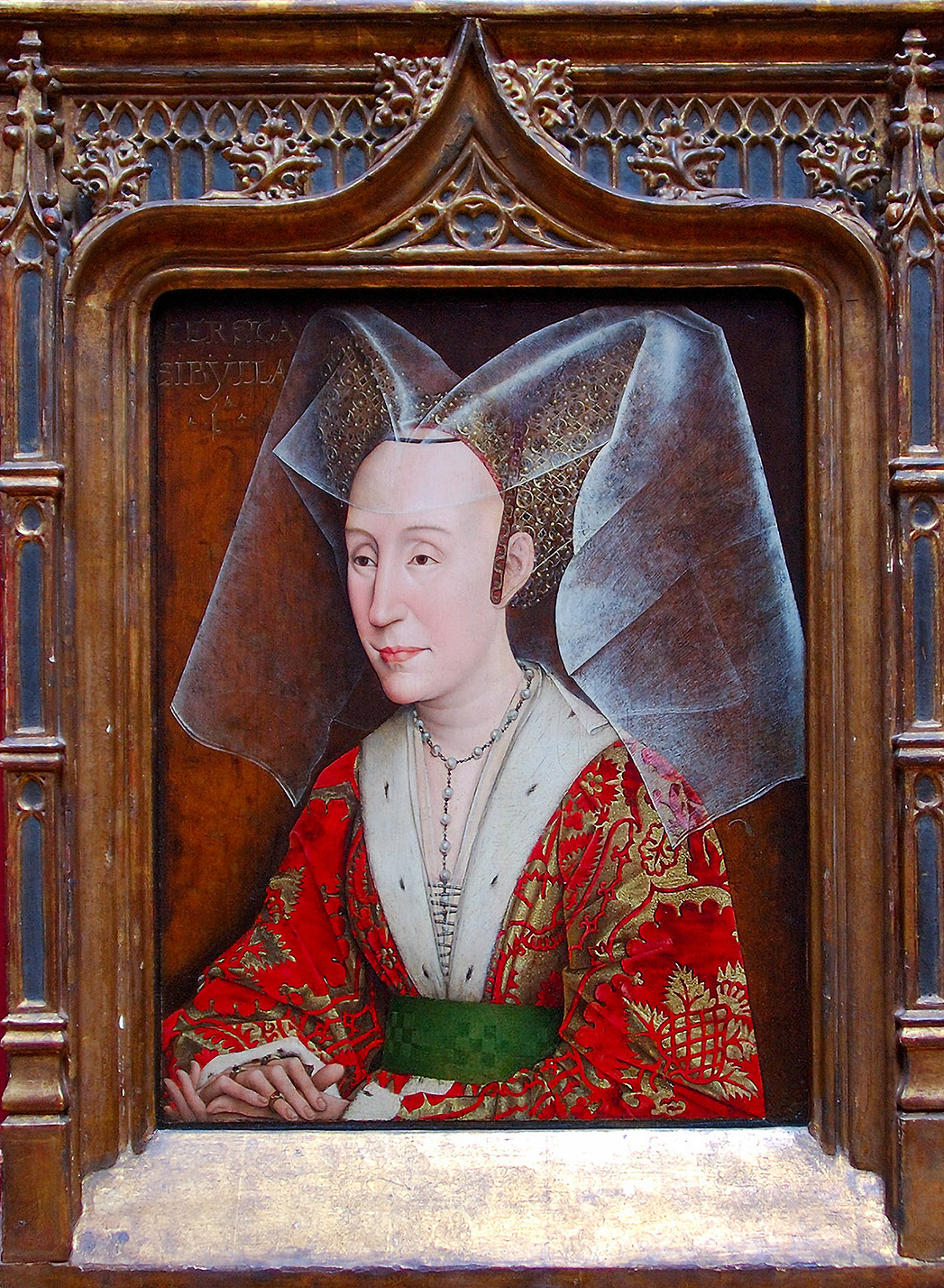
Rogier van der Weyden’s workshop, Portrait of Isabella of Portugal, (Los Angeles, J. Paul Getty Museum)
Born in 1433, James of Coimbra was a son of Peter, regent of the kingdom of Portugal from 1442 to 1448, and was raised as a noble in a cultivated milieu. As such, he fought the battle of Alfarrobeira (20th May 1449) where his father died, and he was taken prisoner aged 15. He remained a captive until the end of the year, when his aunt, Duchess Isabella of Burgundy, managed to have him, his brother John, and his sister Béatrice freed and ultimately taken to the Low Countries.
The three of them benefited from the protection of Isabella and her husband, Duke Philip the Good. Béatrice was betrothed to and married an important Burgundian courtier, Adolf of Clèves, Lord of Ravenstein, (the duke’s nephew), whilst James’ brother John became a diplomat, a soldier and a counsellor for Philip of Burgundy. He then left for Cyprus to marry the 12 year old Charlotte of Lusignan, heir to the island kingdom, where he died a year later, possibly poisoned on the orders of his new mother-in-law…
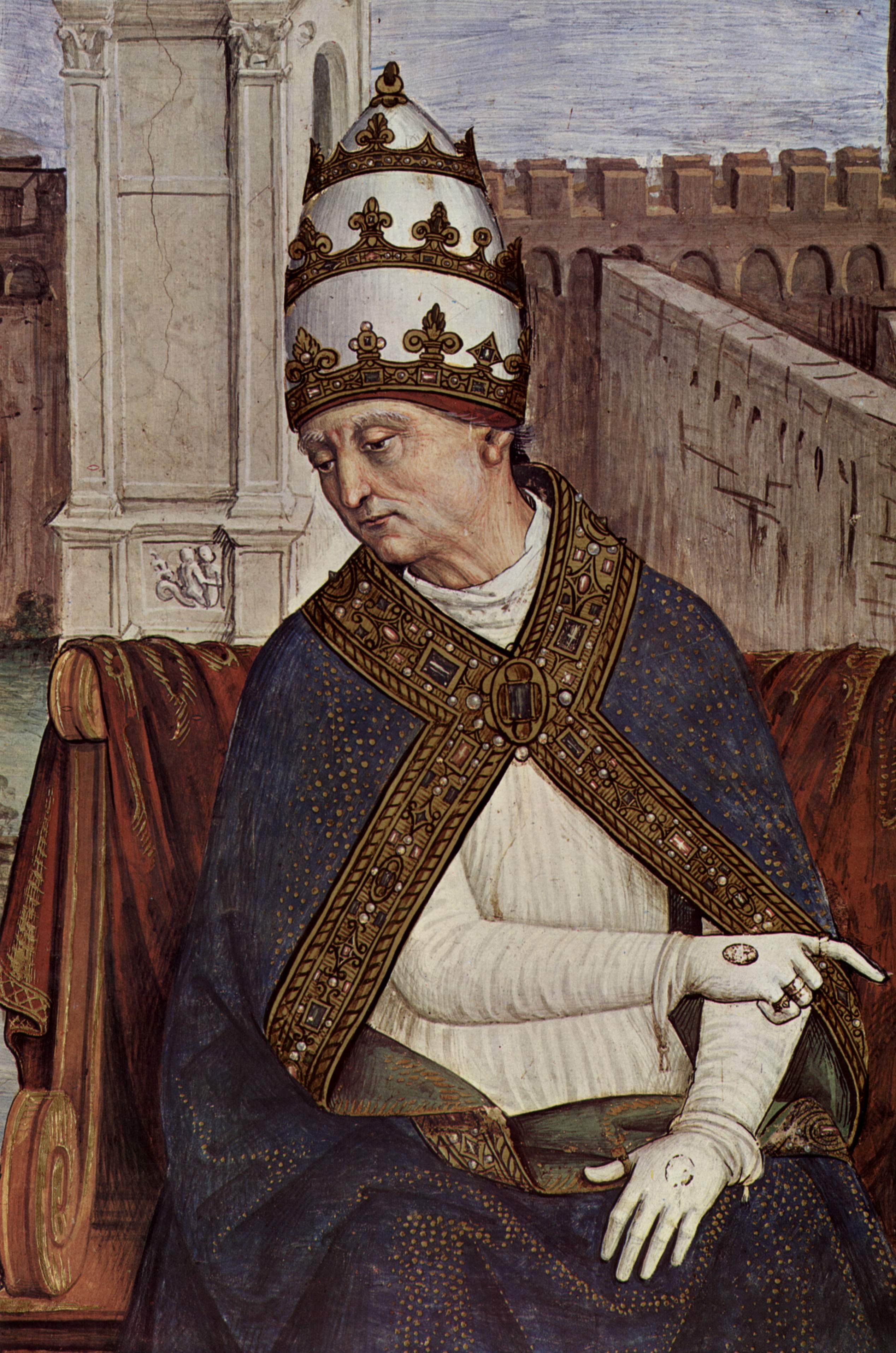
Pius II (Pinturicchio, The Arrival at Ancona (detail), Siena, Duomo, Libreria Piccolomini, (cc) The Yorck Project)
After having spent a little more than a year at the Burgundian court, where he was highly regarded and well-treated, James was sent to Rome to pursue an ecclesiastical career. This complimented the choices made for his brother, who lived as a secular lord, and for his sister, who had made a prestigious marriage alliance.
As well as being financially supported by the personal income of the Duchess Isabella, James’ career was aided by the political influence of the ducal couple. His list of appointments is extensive – he was made protonotary apostolic by the pope in 1451, elected provost of the collegiate church Saint-Pierre of Lille (in Burgundian Flanders) and made bishop of Arras “by the command of the duke of Burgundy” in 1452, bishop of Paphos in 1457, and archbishop of Lisbon in 1459. Despite receiving revenues from all of his positions, he never went to Portugal, the Low Countries, or Cyprus! He was still in his early twenties when Pope Calixtus III made him a cardinal in 1456, and he was ambitious enough to try to get himself chosen as pope at the next election of 1458, afterwards occasionally challenging the authority of the successful Pius II…
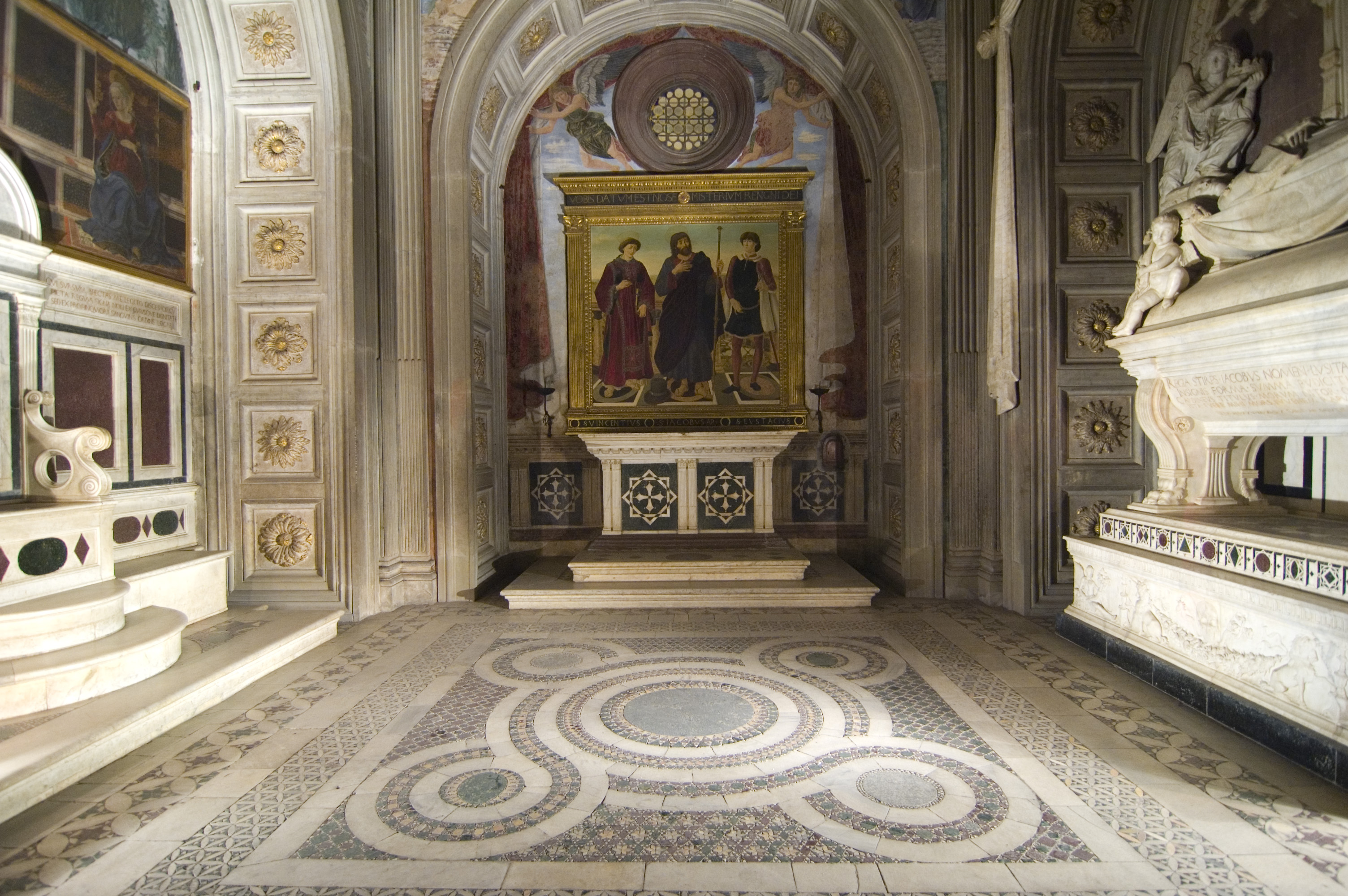
Funeral chapel of James of Portugal (Francesco Gasparetti)
Instead of travelling, James stayed in Rome, where he acted almost as a permanent ambassador for the duke of Burgundy and proved to be especially interested in Portuguese matters. He died on the 27th August 1459 in Florence, aged just 25, before being able to join the pope preparing his crusade in Mantova.
In 1466, thanks once again to the support of Isabella of Burgundy, his funeral chapel was finally erected in San Miniato al Monte, in Florence. Lucca della Robbia produced the tin-glazed terracotta of the ceiling, Antonio Rossellino built the funeral monument, Bartolomeo Platina composed the epitaph and the Pollaiuolo Brothers and Alesso Baldovinetti were responsible for the paintings.
James had thus been a perfect example of what the Burgundian rulers wanted him to be: an ambassador in the very heart of the Christendom, able to support their policy and their claims. Unfortunately for them—and for him—he died too young to be able to fulfil all of their wishes…
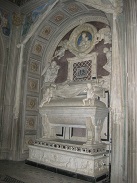
Funeral Monument of James of Portugal (Christophe Masson)
In the first of two blogs on courtly display, David Murray looks at aspirational living in the Middle Ages, how murals are useful for historians, and why you should always visit the castle privy....
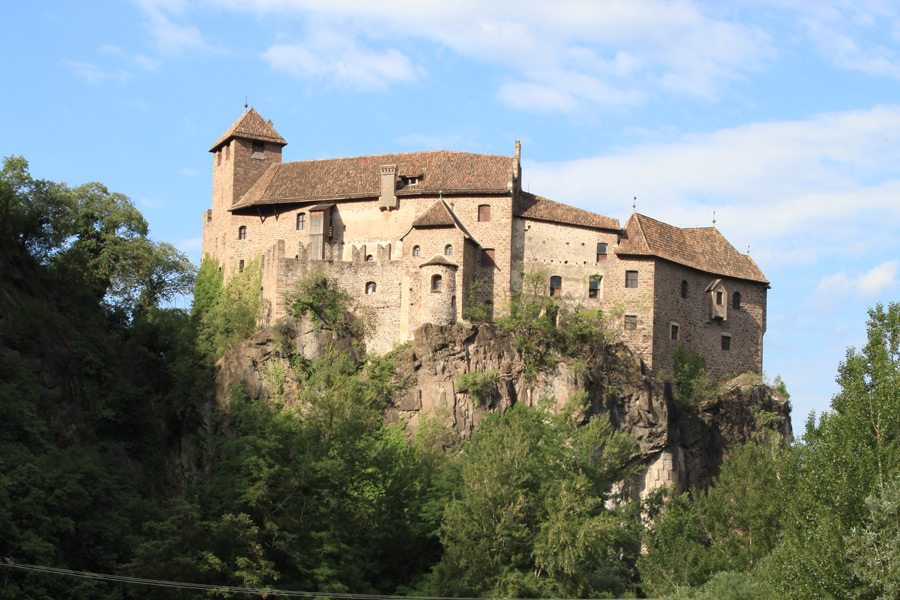
Schloss Runkelstein - Fränzl Foto BZ
One of the most valuable things you can have as a historian of any kind is a sense of what is was like to be in the place you are studying. Happily, for the student of the European Middle Ages, this is not a particularly difficult thing to acquire. There are castles, cathedrals and so on. But given the ‘Take up thy bed and walk’ approach to home furnishing favoured by rulers in the Middle Ages (and indeed long after—just think of Elizabeth I’s extraordinary summer Progresses), some of the more ephemeral elements have gone amiss in the intervening centuries. And it is of course exactly these trappings of daily life that make the past a bit more real. (For instance, I cannot be the only person whose first action on visiting a castle is to find the privy…)
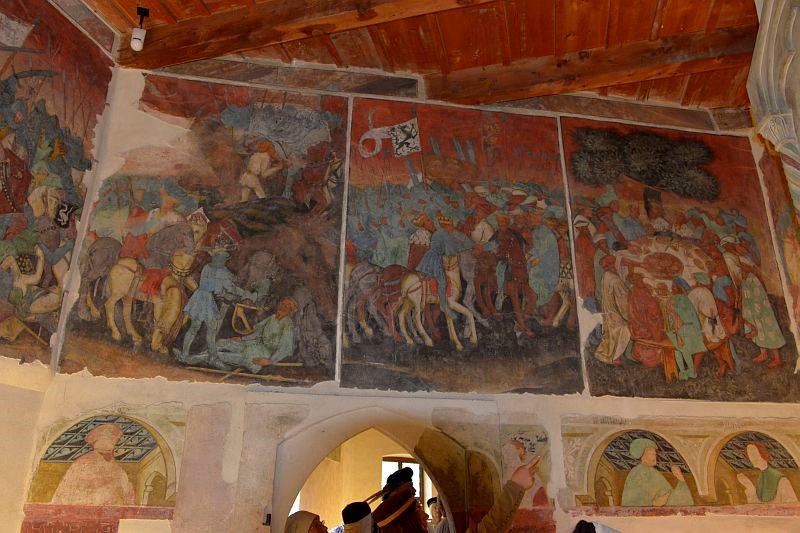
Frescos at Schloss Runkelstein - DKrieger
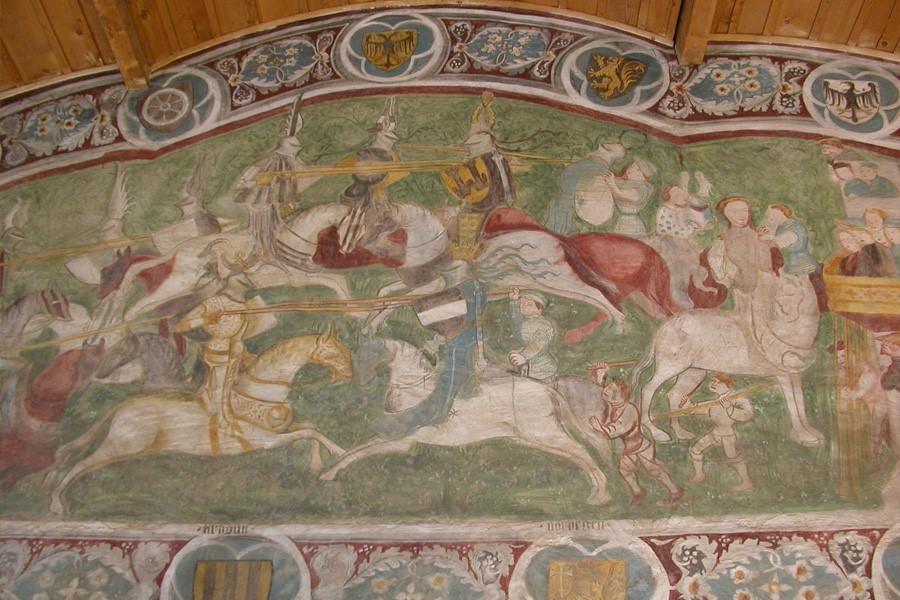
As such, the extraordinary series of wall paintings in the rather romantic castle of Runkelstein, (now northern Italy), discovered from the middle of the nineteenth century, offers a vivid idea of what a self-respecting man of means liked to have on his walls around at the end of the fourteenth century. They are certainly an antidote to any lingering suspicions anyone might have about the dreary Middle Ages. Quite the riot of activity and colour, the paintings combine pictures of favourite characters from courtly romance like Tristan, Wiglaois and the now less-well known Garel, with what seem to be scenes of everyday courtly folk in their natural habitat.
What is most remarkable about Runkelstein is the extent of the paintings: for a relatively small castle, there is an astonishingly large area of preserved mural, inside and out. For instance, on the gallery of the so-called summer house are triads of the greatest heroes of the Christians, Jews and heathens—as they would probably have labelled them. For instance in this picture, you can see on the far left of the gallery a sliver of King Arthur, Charlemagne and Geoffrey of Bouillon.
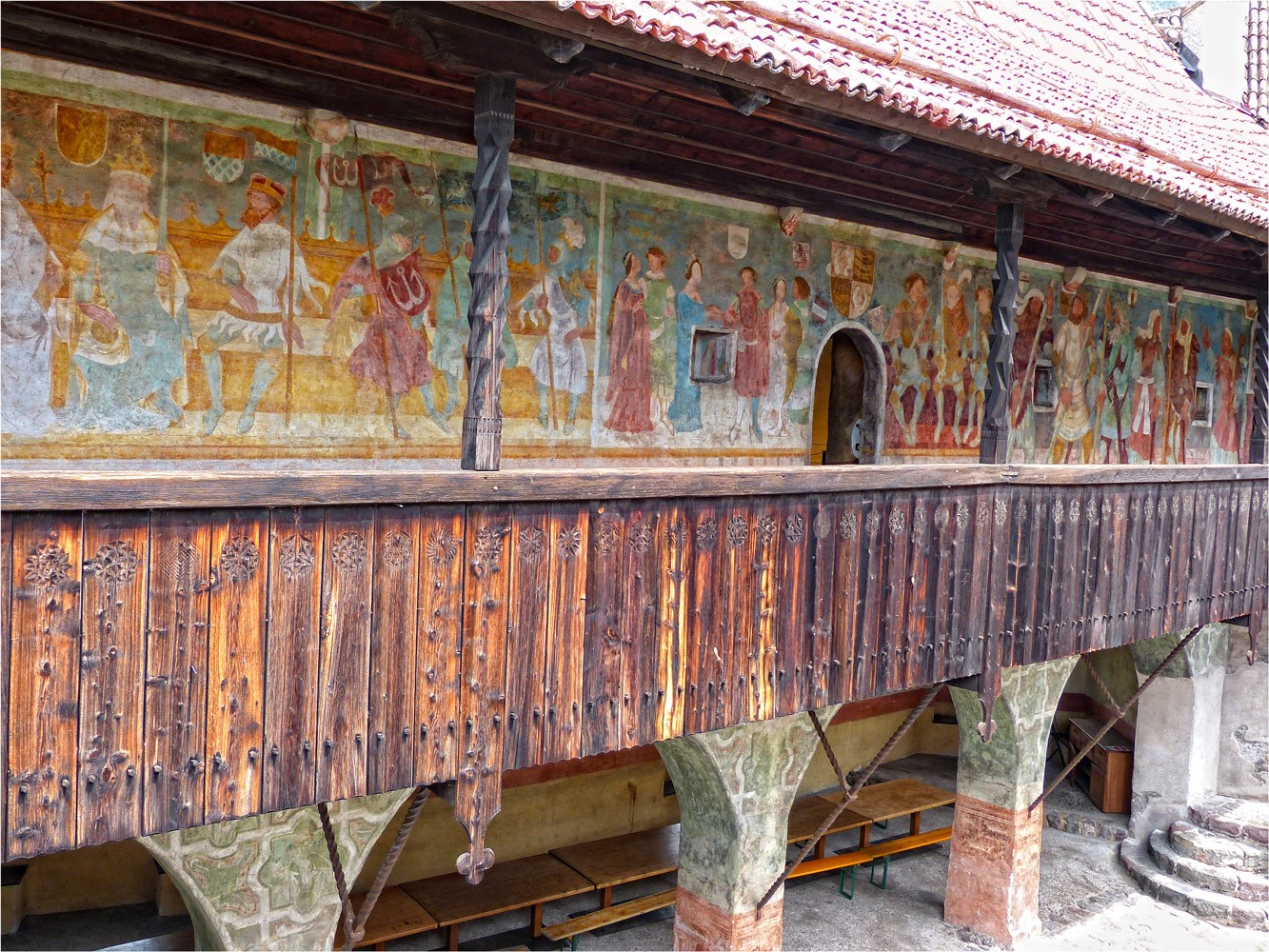
The summer house gallery - Eduard Kleitsch
Inside, an idea of the sheer scale of the decoration from the room devoted to the story of Garel vom blühenden Tal, a romance by the Salzburg poet of the mid-thirteenth century Der Pleier (currently the object of renewed interest in medieval German studies). Left to right, we see Garel, a knight of the Round Table defeat the forces of Ekunavers of Kanadic who had had Guinevere abducted at the beginning of the romance. Garel takes the captured enemy knights to King Arthur—the meeting with the king is the middle scene. Finally, the right-most scene, all Arthur’s knights gather around the Round Table.
Particularly striking, and much-celebrated, are the terraverde cycle of images dated to around 1410, telling the story of Tristan and Isolde. Here is the death of the hero, the copious blood alarmingly bright against the muted colours. The frescos are of particular value to historians of costume, as they give a detailed overview of fashions over a number of decades. For instance, where the sleeves of the ladies tending to Tristan are gathered at the wrist, those of the ladies playing ball in the West Palace are fitted along the arm, a style thought to be more fashionable in the decades between 1360 and 1390.
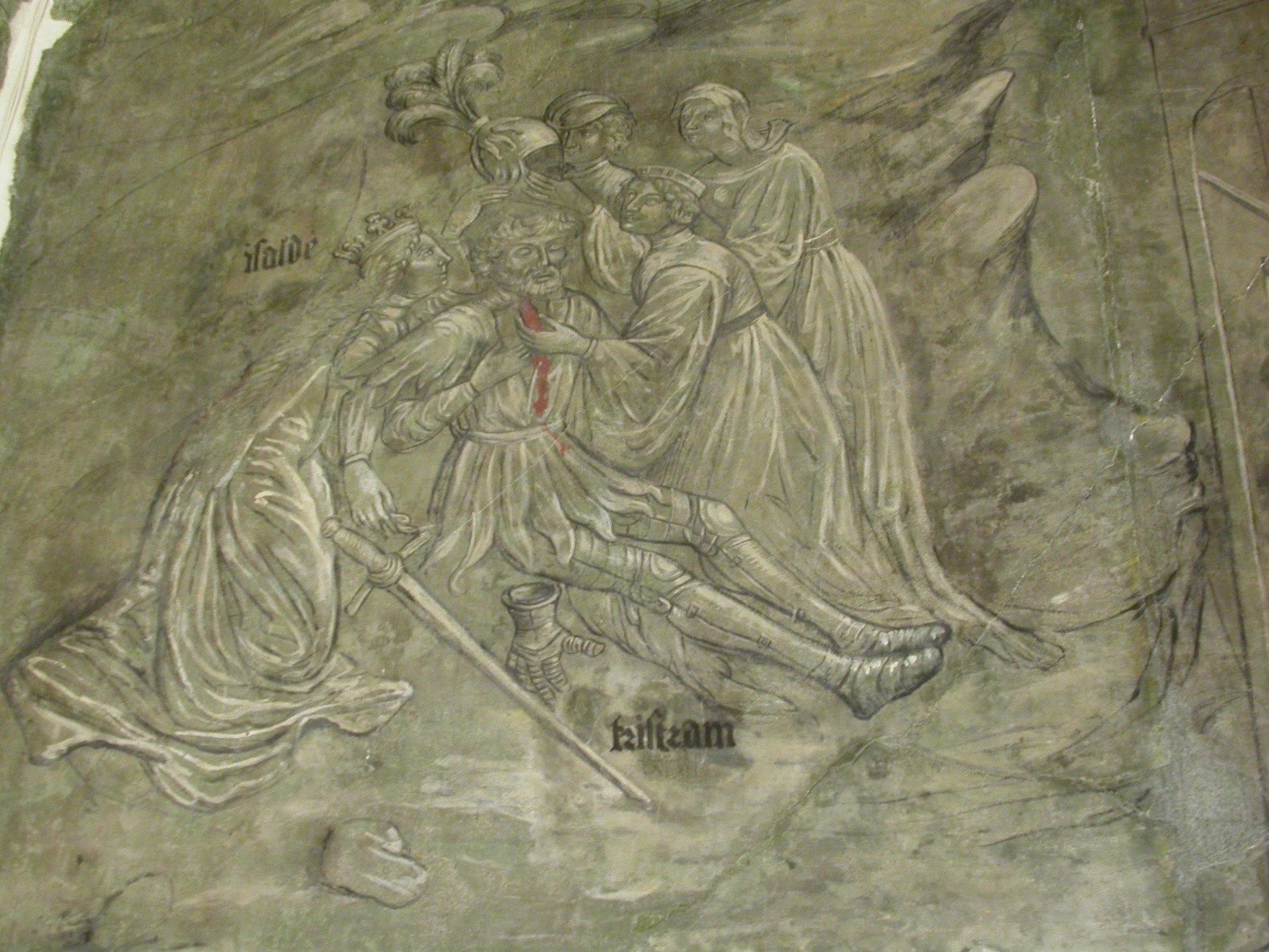
Ladies tend to Tristan in the terraverde mural
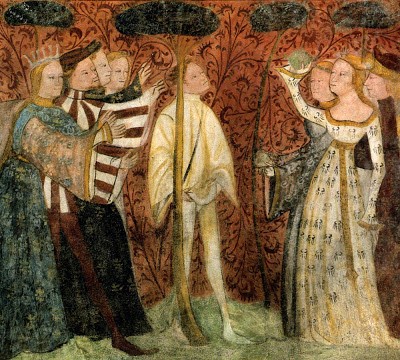
A group of ladies play ball in the West Palace - Needleprint
At any rate, the murals give a certain image of how courtly life was imagined to be. Imagination, after all, was always central to the idea of the court, and is famously sent up in the beginning of Hartmann’s Iwein, a translation-plus of Chrétien de Troyes’ Chevalier au lion. Hartmann, his eyebrow gently raised, opens by describing King Arthur’s Whitsuntide court as:
ein alsô schœne hôchzît
daz er vordes noch sît
deheine schœner nie gewan
…sich gesament ûf erde
bî niemens zîten anderswâ
sô manec guot ritter alsô dâ.
ouch wart in dâ ze hove gegeben
in allen wîs ein wunschleben
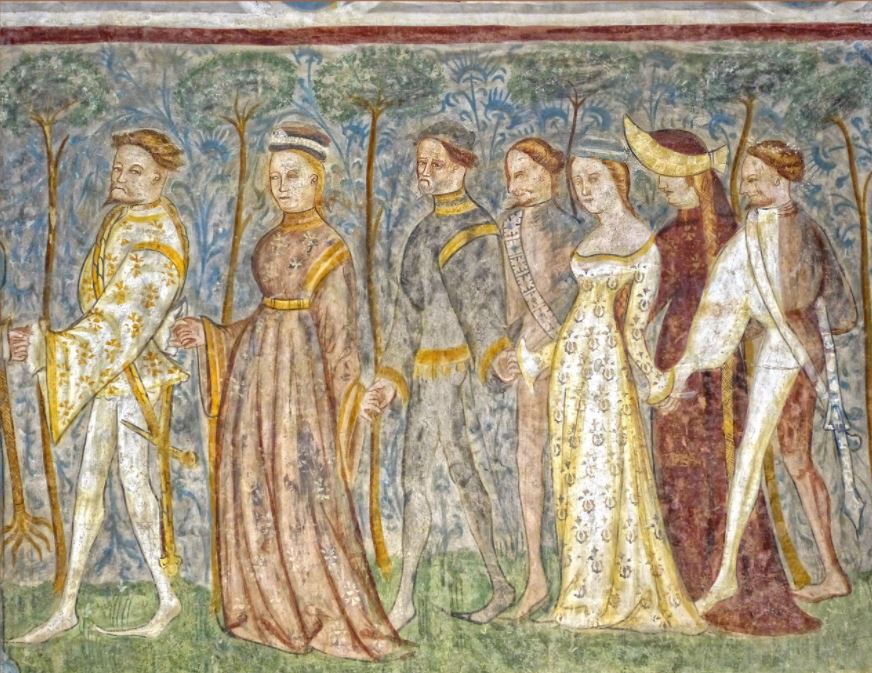
Court Life
Fresco at Schloss Runkelstein - Eduard Kleitsch
[‘Such an amazing festival, that neither before nor after did he have a better…at no time elsewhere had there been a collection on Earth of so many great knights as there was there. At court they had a dream life.’ (my trans. from ed. Cramer)]
While this topos is normally called laudatio temporis acti or praise of times past, Hartmann makes it quite clear that these are times that never happened. Indeed, he goes on to say that he would rather not have lived in those times, preferring to live in the present and to enjoy the stories about them.
In fact, this idea of a ‘wunschleben’ rings true in the story behind the paintings at Runkelstein. The man who commissioned the paintings, Nicklaus Vintler, was himself not noble, coming from a major mercantile family from Bozen. He was a counsellor to Leopold III, the Habsburg duke of Carinthia, as well as acting as his castellan at the important castle of Reinegg, ten miles south of Runkelstein; nonetheless, he did not have his own coat of arms (but made one up), and had bought the castle. The beautifully ornamented castle he bought with his brother was thus very much the Vintelers’ dream, a fact made all the more real when the family was dispossessed in 1409 by Friedrich mit den leeren Taschen, [‘with the empty pockets’], duke of Tyrol. Ruined by the impecunious prince—who resented the close relationship the Vintlers had had with another branch of the Habsburgs—Nicklaus’ brother Franz had to sell the property definitively after Nicklaus’ death.
So next time you see a mock-Tudor house, spare a thought for the brothers who went one better with their mock-Arthurian palace. Now that’s aspiration.
On 5-7th April 2018, project member Laura Slater attended the ‘Association for Art History’ annual conference in London, held at the Strand campus of King’s College London and The Courtauld Institute of Art. She gave a research presentation on ‘Devotional Soundscapes in the Psalter of Queen Philippa’ as part a thematic strand organised by Margit Thøfner and Tim Shephard. More excitingly, she contributed to a live musical event held at The Courtauld Gallery, organised by Dr Charlotte de Mille, founder and curator of the music programme at The Courtauld Gallery.
The programme began in the inspiring surroundings of the Medieval and Renaissance gallery, surrounded by Italian paintings by Bernardo Daddi and Fra Angelico. The singers sang directly below Lorenzo Monaco’s stunning c. 1370-1425 Coronation of the Virgin. Laura introduced the music from ‘Queen Philippa’s Psalter’.
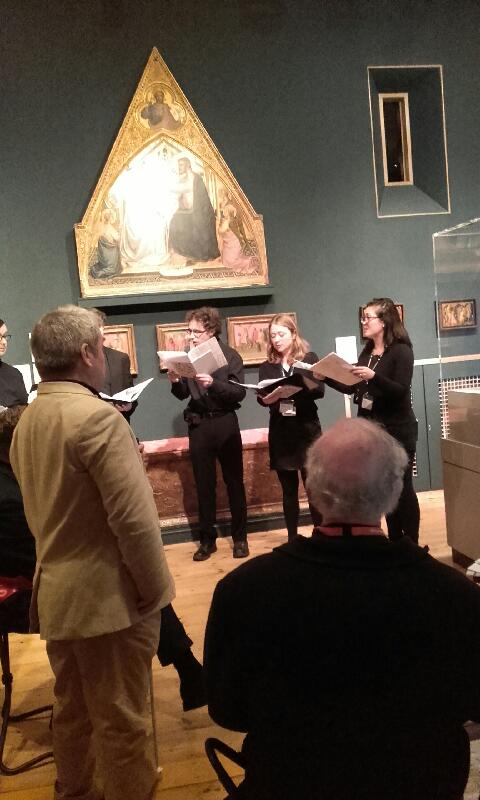
The singers performed choral plainchant and psalms taken directly from the music found in the manuscript that she is researching for the MALMECC project, and that would have been heard by Philippa of Hainault when she attended services of the Divine Office.
This was followed by other research-informed performance pieces. Laura Stefanescu, a member of the ‘Music in the Art of Renaissance Italy’ project, introduced music that might have been familiar to the ducal court of Urbino.
After the dramatic plainchant from Queen Philippa’s Psalter, the audience enjoyed further examples of early Renaissance polyphony, with the performance of work by Francesco d’Aiolle, an important Florentine composer. He was one of the first to combine northern European sacred polyphony with distinctive Italian tones and harmonies.
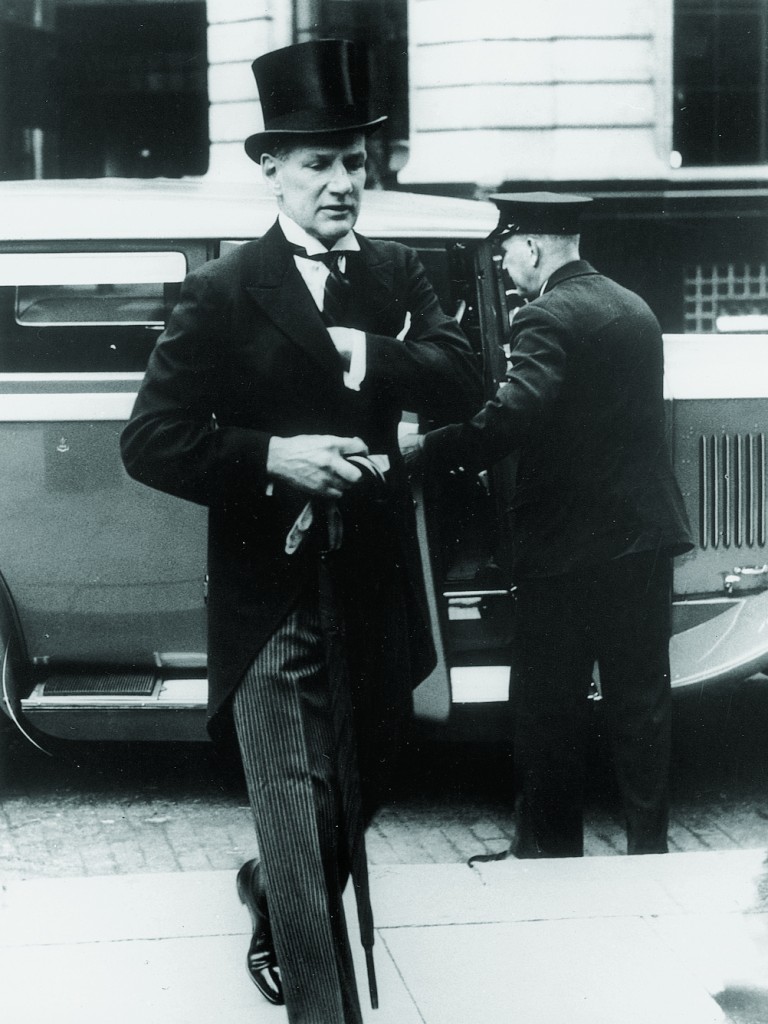
Samuel Courtauld
The Courtauld Gallery is a wonderful collection of art, first built up by the textile magnate Samuel Courtauld and his wife Elizabeth.
In the later 1920s, Samuel and his wife were some of the first collectors of French Impressionists and Post-Impressionists, at a time when this art was still controversial and often ridiculed. Advised by the art critic Roger Fry, he bought numerous works by Cezanne, Renoir, Manet and Van Gogh, including masterpieces such as Manet’s A Bar at the Folies-Bergère and Déjeuner sur l’herbe, as well as a female nude by Modigliani.
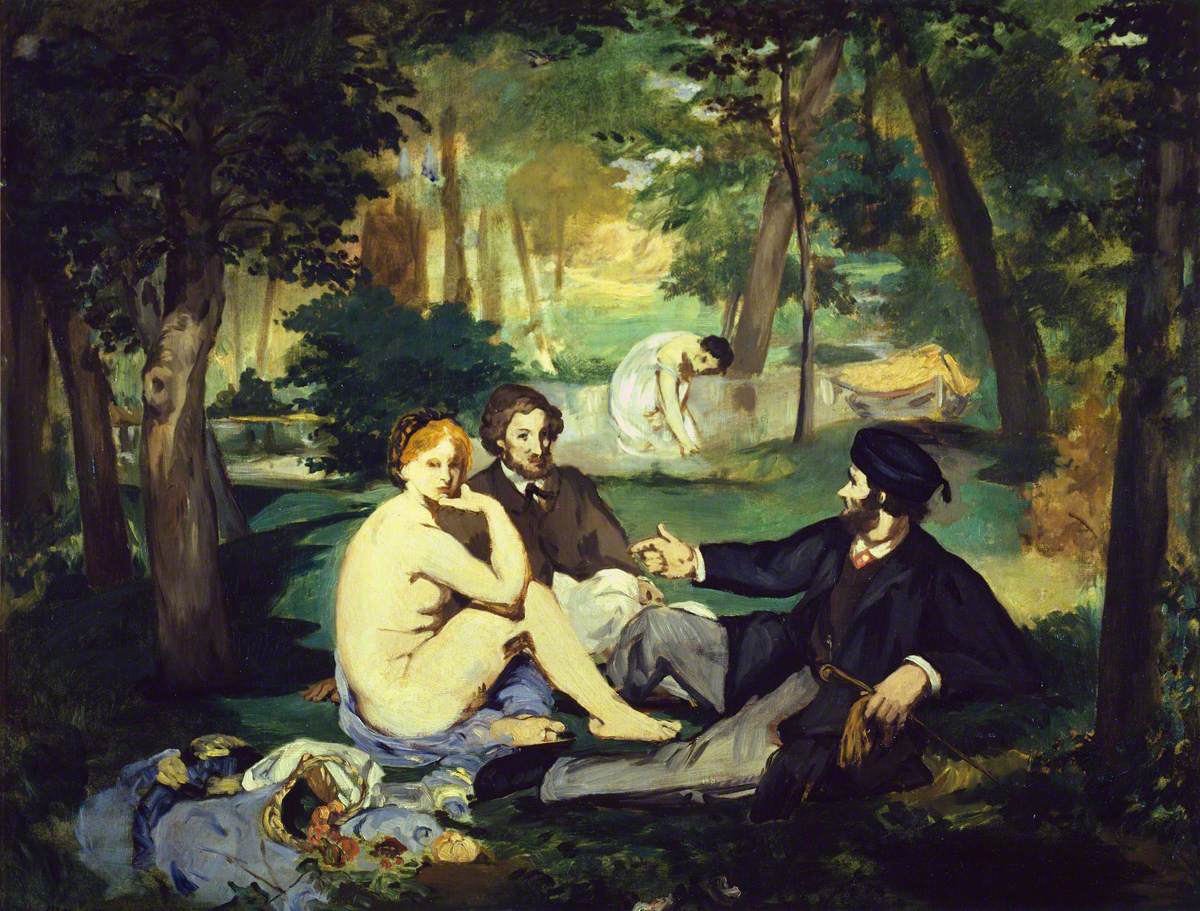
Manet, Edouard; Dejeuner sur l'herbe; The Courtauld Gallery; http://www.artuk.org/artworks/dejeuner-sur-lherbe-207294
Although its collection of twentieth-century paintings includes major works by Impressionists and Post-Impressionists, German Expressionists, the French Fauves, the Camden Town Group and the Bloomsbury Group, there is much more to see from earlier periods at The Courtauld Gallery, with major works by Cranach, Rubens, Gainsborough, Claude, Van Dyck, Goya and Tiepolo. Paintings, prints and drawings, sculptures and other decorative arts, such as an impressive collection of ivories and Islamic metalwork, are all on display.
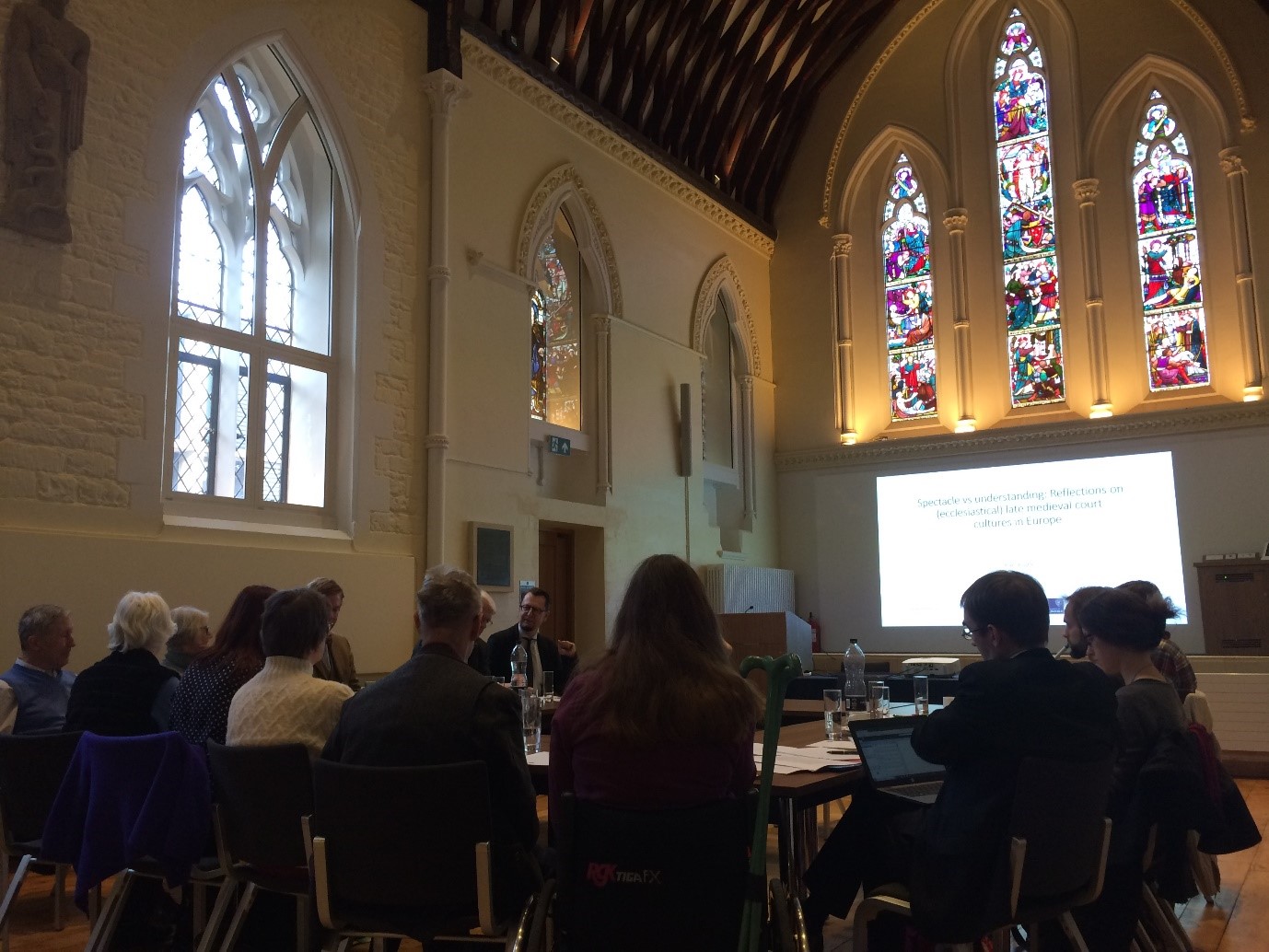
On the 16th and 17th February the MALMECC team welcomed an international gathering of medievalists to Oxford for a workshop focused on ecclesiastical courts as places of cultural production, performance, reception and dissemination. The team hoped that assembling scholars of many different disciplines (including historians, musicologists, art historians and literary scholars) would both illuminate this important but understudied social milieu or setting, and facilitate future theorization.
Proceedings began in the suitably magnificent St Luke’s Chapel—sadly only neo-Gothic—with words of welcome from Prof. Karl Kügle, in which he laid out some of the questions that had been asked of invited participants and which were open for discussion: how should we define the ecclesiastical court? Beyond the households of (prince-) bishops and cardinals, could one perhaps include cathedral or collegiate church chapters? What about noble monastic houses such as the royal abbey of Las Huelgas or the Frauenstift at Essen? What, if anything, distinguished the ecclesiastical court from a secular one?
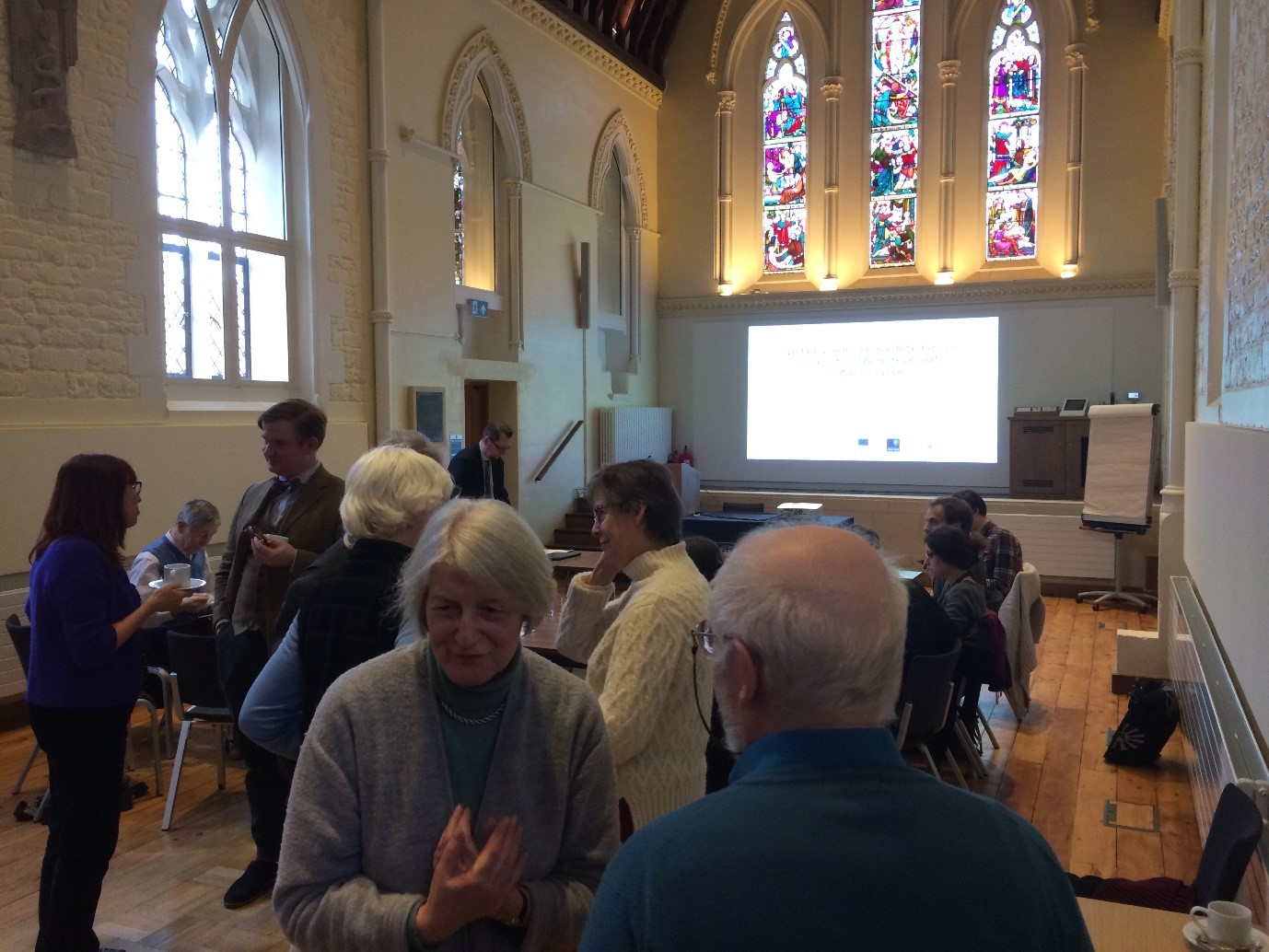
The first paper was given by Prof. Dr. Werner Paravicini. Taking as his subject matter the Teutonic Order, Herr Paravicini traced the developing differentiation between the knights and the Grand Master of the Order, the increasingly blatant retention of aristocratic practices that knights had supposedly given up on entry, with secular titles mentioned in the administrative documents of the order from the 1370s, and worldly rank becoming increasingly important for one’s treatment in the order. A far cry, then, from the ‘background-blind’ beginnings of the knighthood where officers were elected and personal property anathema. There was also a clear falling-off in religious observance, or, if knights were in chapel, there are accounts of brothers sitting in the stalls with hawks on their wrist. Next, Prof. Kügle read a paper on the court as heaven, and heaven as a kind of court, examining parallels in the importance of performance and proximity between religious and secular hierarchies. The generation of distinction, to use Bourdieu’s phrase, became a central goal of courtly life, often taking the form of the invention of new traditions (think of the knightly orders founded by so many dynasties in imitation of the Garter), while the overwhelming important of closeness to the source of power was common to both types of court.
The second day of the workshop, when the participants met in the Margaret Thatcher Centre at Somerville College, began with a paper by Prof. Dr. Andreas Bihrer. Regrettably, Prof. Bihrer was unable to join us in person, but had very kindly allowed his paper to be circulated and discussed in his absence. Taking as his point of departure the Oxonian Walter Map and his De nugis curialium, his contribution was a stimulating and wide-ranging discussion of the episcopal court. Proposing a wide-ranging approach to the court as the ‘bishop’s milieu in its entirety’, including even the cathedral chapter, Bihrer suggested that ecclesiastical courts were more stable and office holders rather more independent than their secular homologues. This discussion was continued among the participants in Oxford, who wondered how the differentiation between entourage or familia and institution could be negotiated. Paired with Prof. Bihrer—whose PhD was a study of the court of the Bishops of Konstanz in the early fourteenth century—was Dr David Murray, whose paper looked at the court of Pilgrim II of Salzburg. Focusing on the adoption of influences from Prague (the Schöne Madonnen statues) and from France (in the shape of the melody of a three-part canon re-used by the Monk of Salzburg), he asked how cultural pursuits could be used in the elaboration of a shared identity among courtiers and, indeed, in the bishopric at large.
After coffee, Dr Laura Slater offered a paper which opened up discussion of the place of women at ecclesiastical courts, not only as visitors (including the example of Philippa of Hainault’s chilly reception on a visit to her husband at Durham), but also as valuable connections to secular power structures, for example as abbesses of reichsunmittelbare abbeys. Similarly, in secular courts, women (especially queens) were often responsible for the fostering of relationships to religious houses and, in cases such as that of St. Margaret of Scotland or St. Elizabeth of Thuringia, introducing an air of holiness to the court.
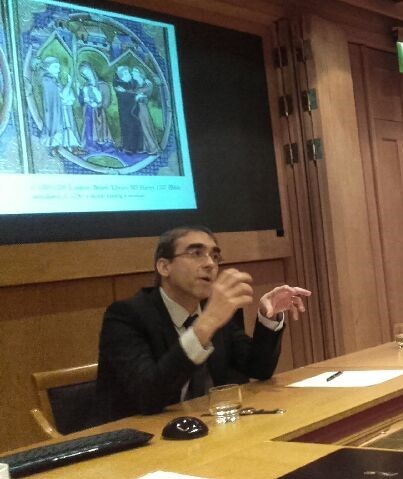
In the afternoon, attention was turned to Avignon as Prof. Étienne Anheim and Dr Christophe Masson drew the spotlight respectively to the Papal court and the cardinals’ livrées. First Prof. Anheim gave an illuminating account of the curia as a polycentric court which ‘produced’ government and the place from which the representation of power was done. It was, he suggested, the hieratic environment that encouraged and facilitated the development of the courtly model later exported around Europe. Dr Masson’s paper investigated the practical, methodological and also conceptual problems of studying the cardinals at Avignon, offering a view of the popes as super-cardinals, not cardinals as mini-popes as is more common in scholarship. The participants also discussed the problems of identifying in the records those responsible for liturgical singing, and the differentiation of cappellani from cappellani cappellae, as well as the evidence for competition between cardinals to host the most sumptuous entertainments.
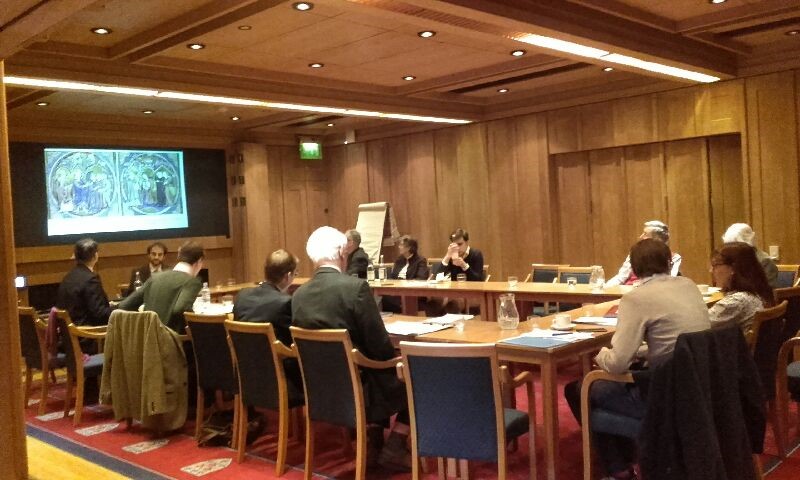
In the final discussions, participants returned to the question of the relationship between household and court, seeing the one as the centre of the other, larger organism. It was also suggested that an administrative or judicial approach could be fruitful as a means of identifying courtiers as those subject to legal protections or exemptions from taxations. Rich food for thought, indeed. The workshop was undoubtedly a great success, and laid the foundations for important future conversations among the participants, opening up new lines of enquiry for all involved.
We were particularly grateful to our international visitors, Prof. Dr. Paravicini and Prof. Anheim, for their valuable contributions and participation. Special thanks are also due to both the project administrator Martha Buckley for all her organizational and logistical help, and to John Merrington of Somerville who assured the smooth running of proceedings on Saturday.
In her last post, Laura introduced us to the elaborate tombs of the Hastings family at St Mary’s priory Abergavenny, and showed what they can reveal about attitudes towards memorial and self-image amongst late-medieval nobles. This time, Laura turns her attention to other tombs at St Mary’s, and the difficulties of studying medieval art in Britain.
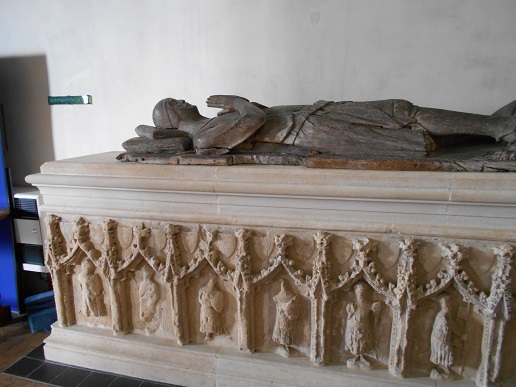
Weeper figures with heraldic shields
The Hastings tombs at Abergavenny, and the impressive fifteenth-century alabaster tombs of the Herbert family, that also now lie in St Mary’s Priory, contain spaces for weeper figures on their tomb chests. Sometimes, they were shown carrying heraldic shields, as in the angelic mourners seen on the tomb of Sir Richard Herbert and his wife Margaret. Or they might be secular figures, usually family members and ancestors. Such ‘kinship tombs’ formed a powerful display of aristocratic lineage.
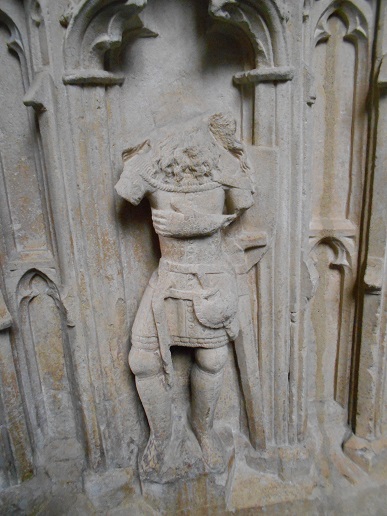
Weeper figure from the tomb of Laurence de Hastings
Studying medieval art in Britain means looking at rare fragments and chance survivals. During the Reformation, from 1535 onwards, monastic houses, holy sites, and the images, sculptures and wall paintings inside them were destroyed, whitewashed over, or removed from the landscape altogether. The Civil War and the Commonwealth in the seventeenth century caused further damage and destruction, especially to ‘royalist’ or aristocratic monuments. It is impossible to know how much was lost. Professor Colin Morris estimates that with the exception of English alabasters, ‘there is more late medieval art at Cologne than in the whole of England.’ This weeper figure from the tomb of Laurence de Hastings, probably intended to depict one of his family members, has been a victim of later iconoclasm.
Yet St Mary’s also contains extremely rare and valuable surviving artefacts. These images of saints and Biblical scenes, found on the alabaster tomb chest of William ap Thomas (d.1446) and his wife Gwladys, was barely touched by iconoclasts bent on removing ‘idolatrous images’. We can clearly see St Margaret standing in triumph over the dragon, and the Virgin seated with the Christ Child. We can also make out the scene of the Annunciation to the Virgin, flanked by angels. In the centre is the lily flower, symbolising Mary’s virginity.
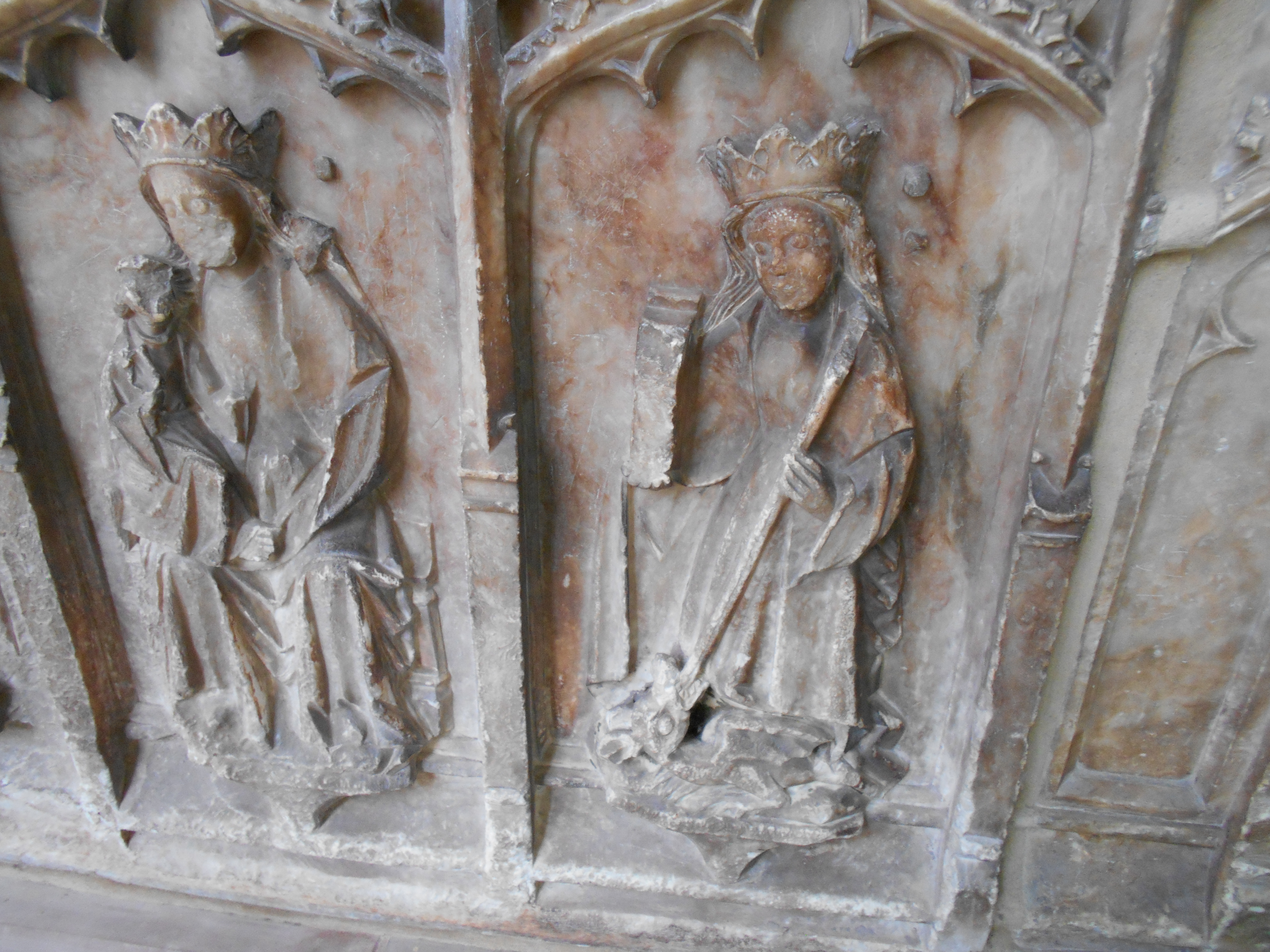
The Virgin Mary and infant Christ (left) and St Margaret and the dragon (right)
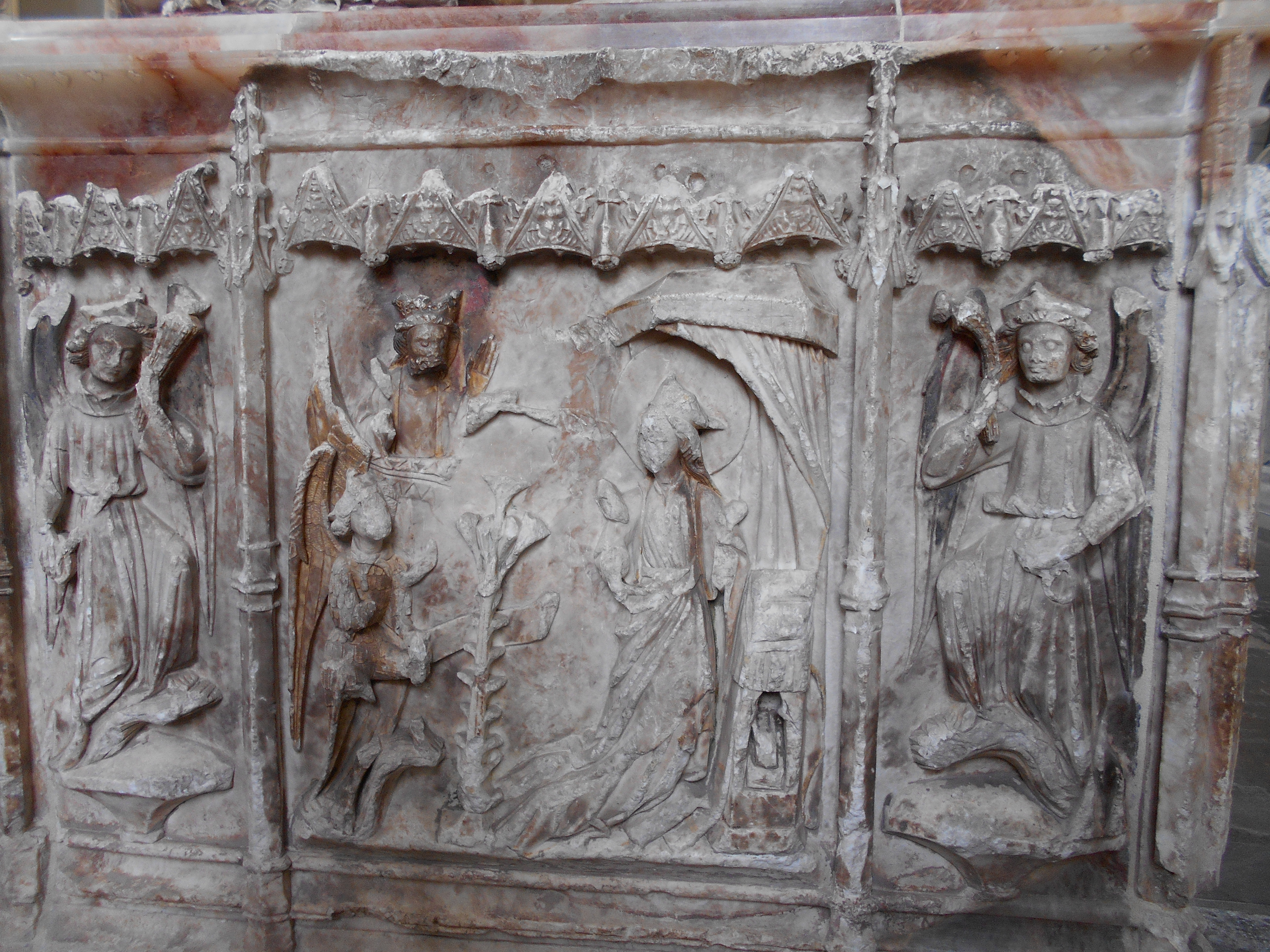
The Annunciation
The tomb still contains much of its original polychromy. It has been suggested that the region’s close ties to the House of Tudor, or simply the local power of the Herberts themselves, stopped reformers from getting too busy with their hammers and chisels.
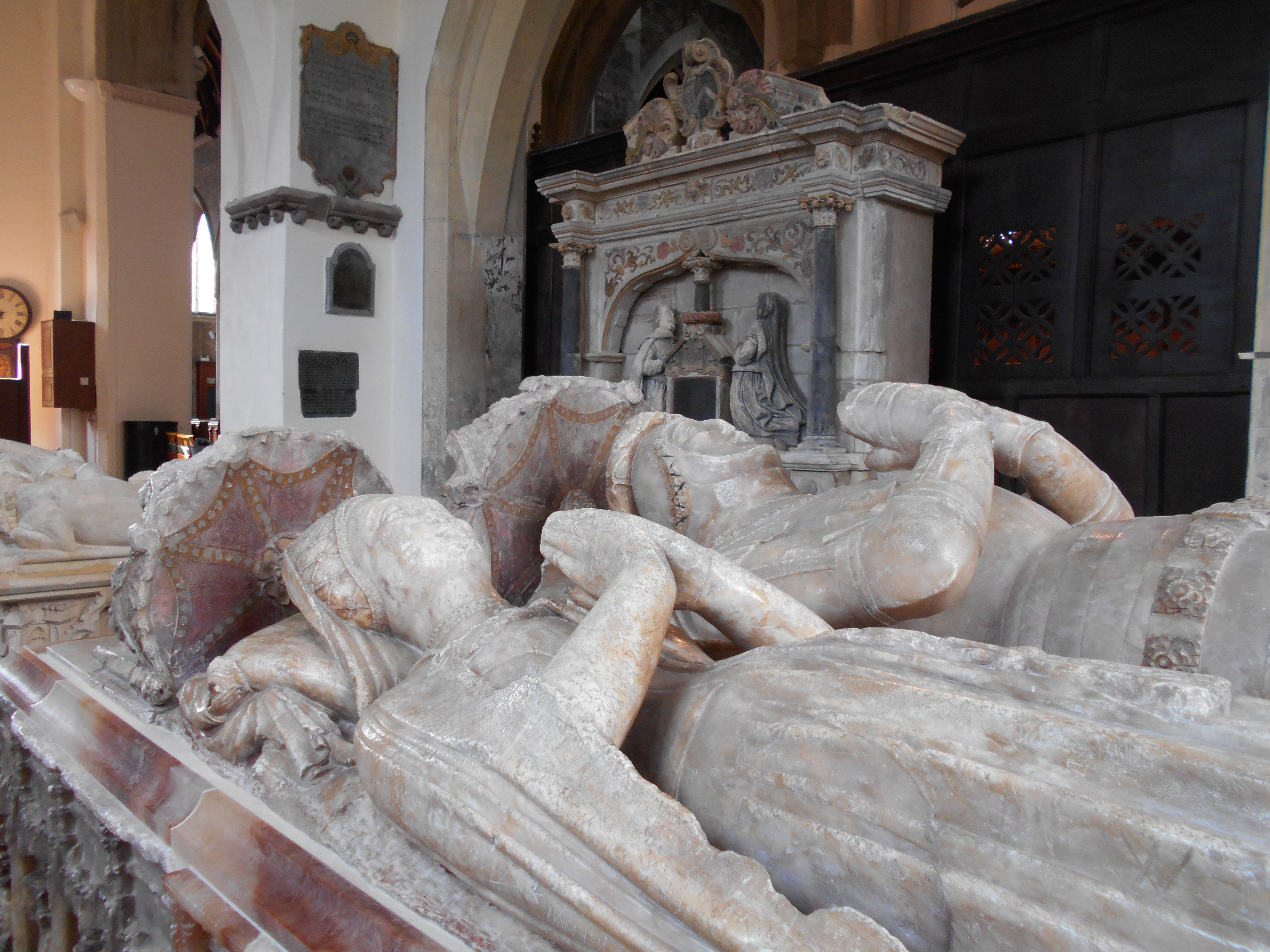
Tomb of Sir Richard and Margaret Herbert
In the second of her posts on commemoration, Laura shows the role that effigies could play in creating dynastic identity.
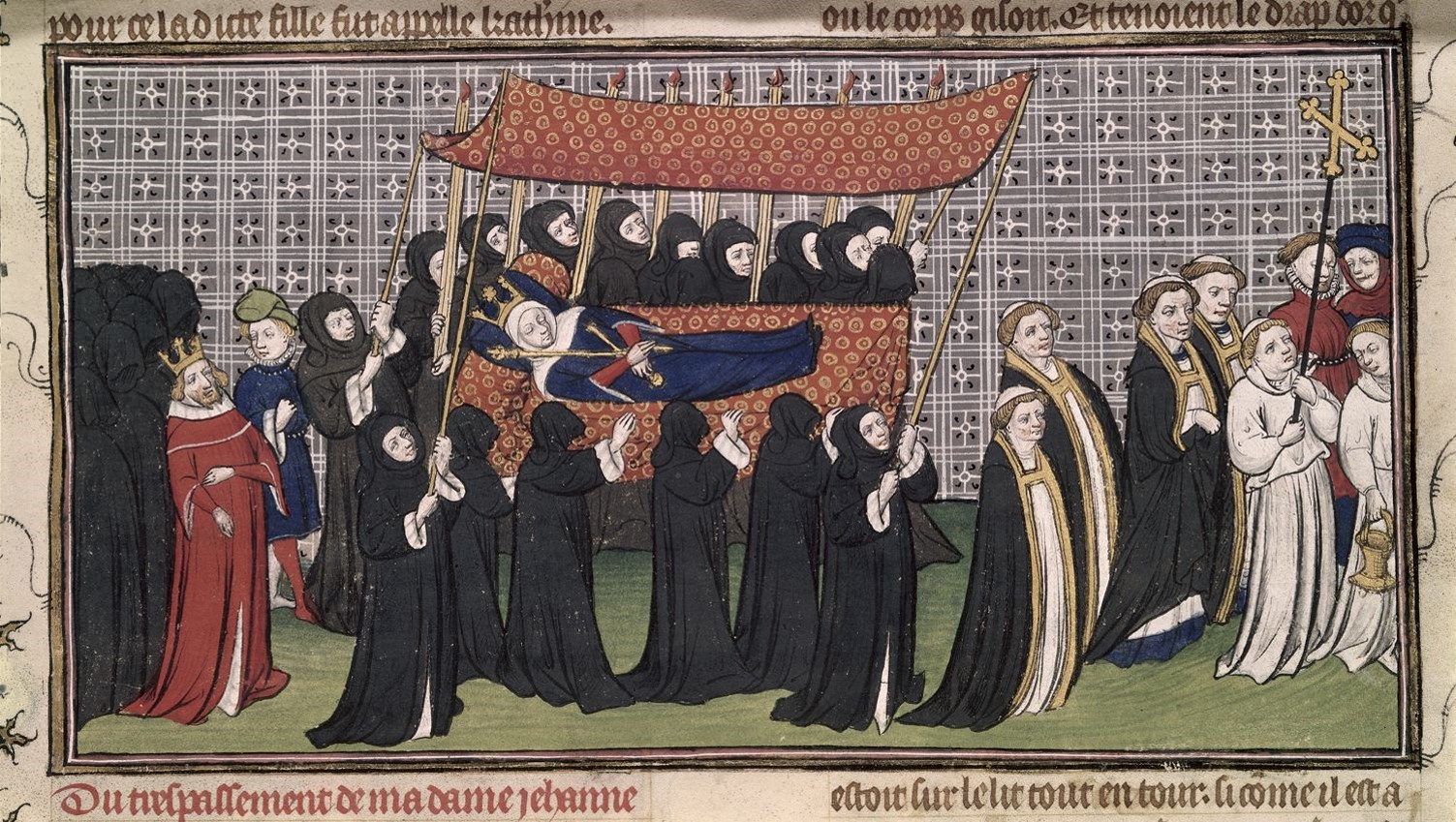
London, British Library MS Royal 20 C VII, f.40v: funeral service
Most aristocrats did not set up public crosses in memory of their deceased loved ones. But it was seen as very important for the salvation of your soul to be laid to rest properly, with all the right prayers and rituals. Funeral services were usually meticulously planned and could last for many days. Vigils were kept over the corpse and Requiem Masses would be said for the deceased. After the burial itself, funeral feasts could also be held on successive days, alongside lots of alms-giving. A month after the death, more feasts, masses and alms-giving followed on what was known as the ‘month’s mind’.
The elite of medieval Europe commissioned elaborate tombs, with a sculpted effigy on top depicting an idealised form of their living selves. Like the Eleanor Crosses, these not only kept the memory of the deceased alive, but would prompt- and sometimes explicitly request- the prayers of passers-by.
By the later middle ages, most aristocrats also had traditional dynastic burial places: religious houses that might have been founded by their ancestors, and remained supported by the family. The church of St Mary’s Priory in Abergavenny, in the scenic Brecon Beacons area of Wales, preserves many tombs of the Hastings family.
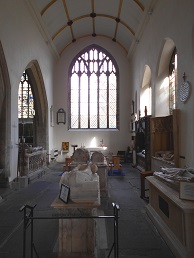
St Mary's Priory Abergavenny
The priory was originally founded in 1087 by a Norman knight, Hamelin de Ballon, and was staffed by monks from the abbey of St Vincent, in Le Mans. But in the early 1320s, John de Hastings was given control of Glamorgan by Edward II. A nephew and retainer of the staunch royalist Aymer de Valence, earl of Pembroke, these lands in Wales formed a rich reward for John’s service at court. As the new lord of Abergavenny, John de Hastings made his mark on the local priory. He arranged that the French monks of St Mary’s be replaced with Englishmen (resulting in prolonged legal disputes and appeals from the evicted monks) and completely rebuilt the priory church, including its tower. He died in 1325 and his beautiful wooden tomb effigy rests in the north transept. Originally, it would have been painted and gilded.
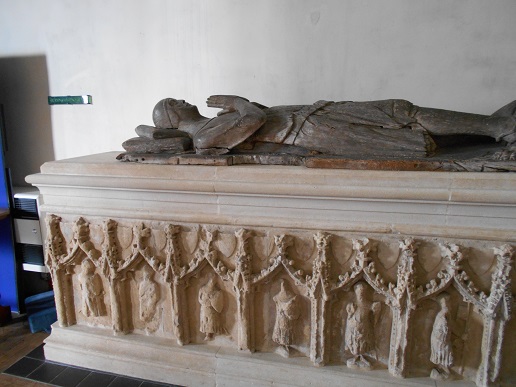
John de Hastings d.1325
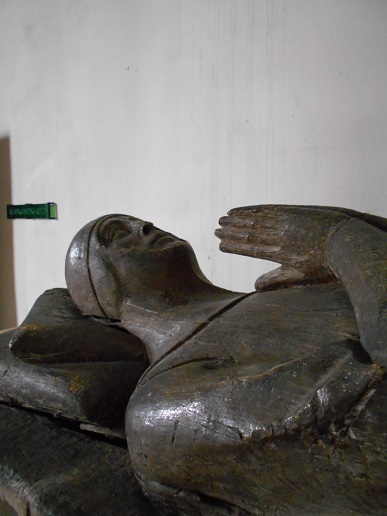
Detail of John de Hastings' effigy
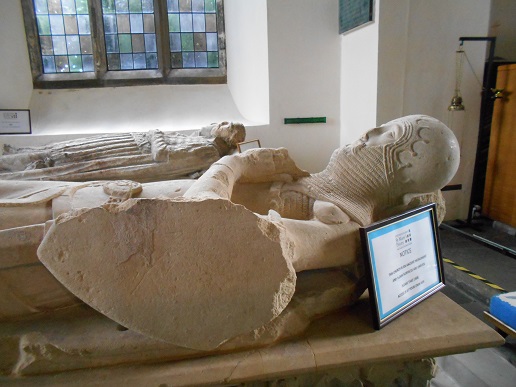
Laurence de Hastings, d.1348/9
His son, Laurence de Hastings, was only four when John de Hastings died in 1325 and wardship of his lands passed between numerous courtiers, including Edward II’s notorious favourite, Hugh Despenser the Younger. In 1328, at the age of just seven, he was married to the third daughter of Roger Mortimer. Mortimer was another controversial courtly favourite, this time of Queen Isabella of France, de facto regent of England until 1330. Mortimer, supposed by many to be the queen’s lover and blamed for all the evils of the regency government of Edward III, was clearly using his position at court to enrich himself and his family, exploiting his connections to make excellent marriages for his daughters.
In 1332, Hastings is recorded as an esquire in the household of Queen Philippa of Hainault and went on to make his career in royal service, fighting regularly in Edward III’s wars. He died in August 1348 or 1349 at Abergavenny and was again buried in the priory church.
Shown in armour, sword by his side and wearing an elaborate jewelled belt, the tombs of Laurence and his half-brother William, who also died in 1348, tells us how the Hastings family wanted to be remembered- as wealthy and powerful warriors.
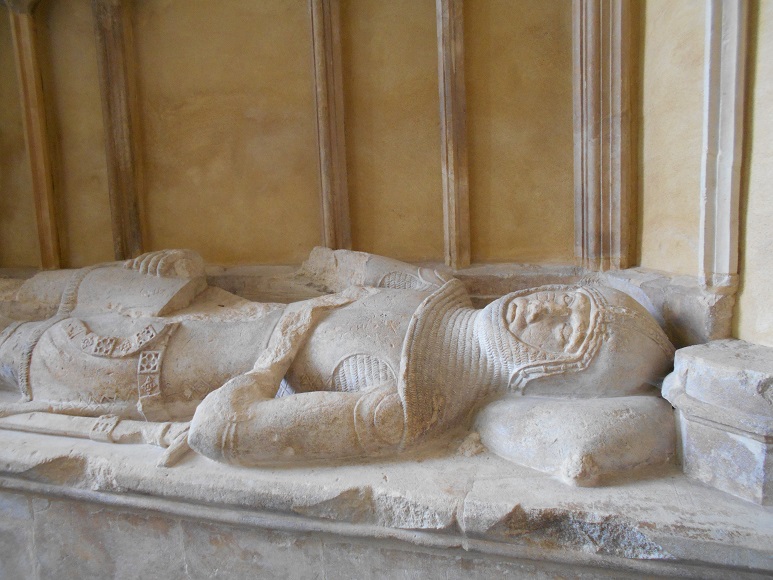
William de Hastings, d.1348
But neither died in battle. It is even possible that the brothers died of the bubonic plague, better known as the Black Death. The disease first reached England in summer 1348, and the first recorded instances of plague in Wales came in April 1349. As royal courtiers, who will have regularly travelled around southern England, including coastal towns such as Dover and the disease-ridden capital of London, it is perfectly possible that these members of the Hastings dynasty were some of the earliest casualties of the plague.
In the first of a series of posts on commemoration, MALMECC's art historian Laura Slater looks at the phenomenon of the 'Eleanor Crosses' - a very visible memorial to Eleanor of Castile.
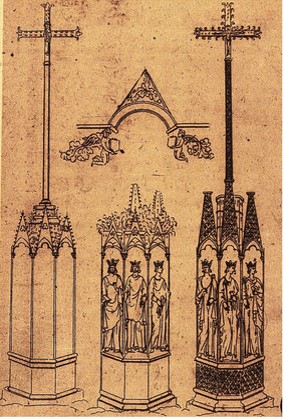
Commemoration 1
Montjoies, sketched in the 17th century
One example of a happy royal marriage was the union between Edward I of England and Eleanor of Castile. Eleanor accompanied her husband on crusade in 1270, and gave birth to her fifth child while staying in Acre, a daughter named Joan. In 1272 in Acre, Edward was attacked by an assassin with a poisoned knife. Surgery was required to remove it- a drastic step in a world without anaesthetics and with little means of preventing infection. The contemporary chronicler Walter of Guisborough records that Eleanor was led from Edward’s bedside before the operation, weeping and lamenting. Later legends suggested that Eleanor herself sucked the poison from her husband’s wound. Even in an age of pragmatic aristocratic alliances, people still liked the idea of a fairy-tale royal romance, followed by a loving and happy marriage.
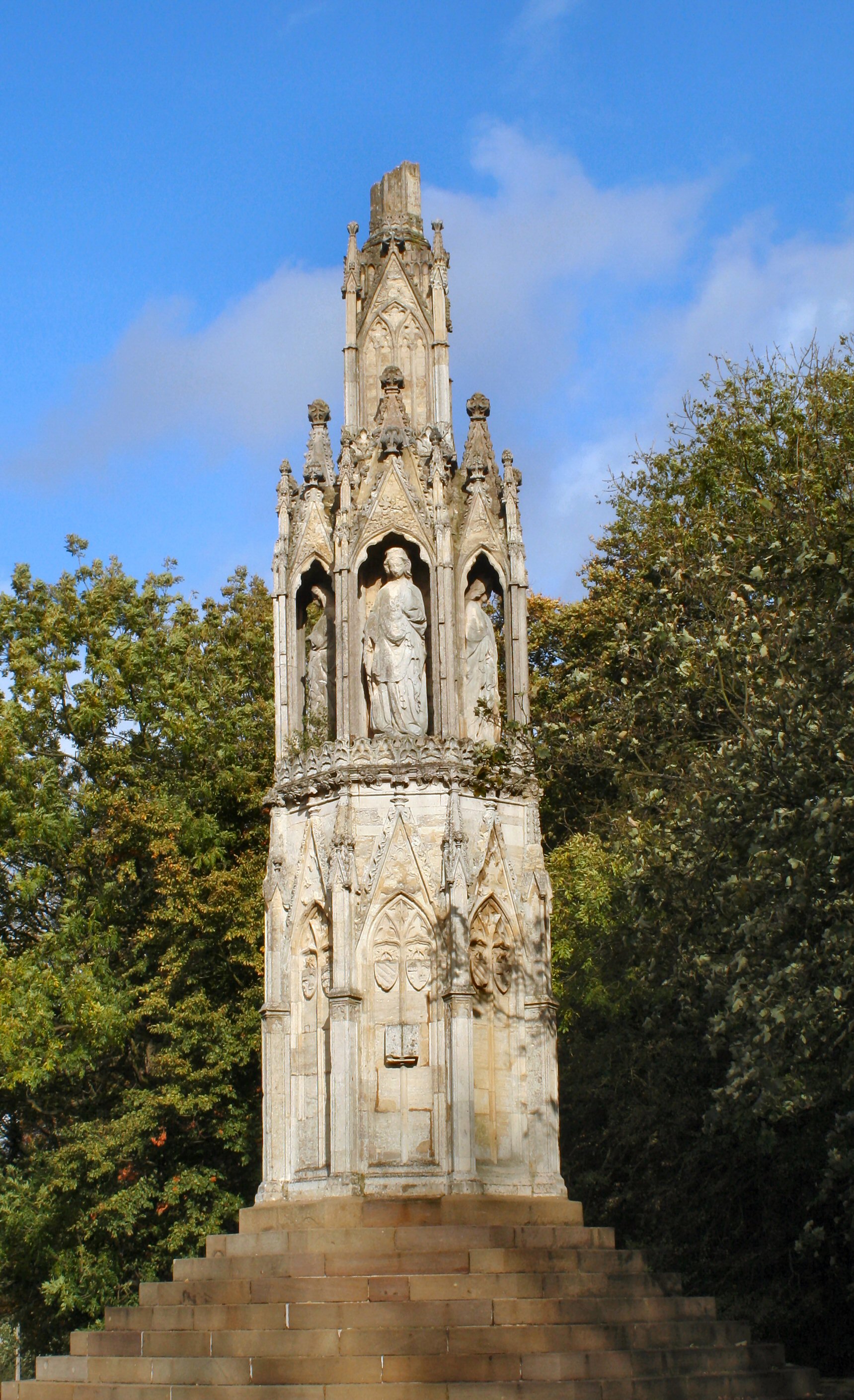
Northampton Cross
The Eleanor Cross at Northampton
When Eleanor died in 1290, a grief-stricken Edward I ordered that twelve monumental crosses mark the places where her funeral cortege rested each night, as it travelled down from the village of Harby in Nottinghamshire, where Eleanor died on the 28th November, to her final resting place at Westminster. In another reminder of the internationalism of late medieval courtly culture, the crosses echoed the royal ‘montjoies’ of France: a series of sculpted crosses set up between Paris and the abbey of St Denis to mark the route of King Louis IX’s funerary procession. All French monarchs were laid to rest at St Denis, and by the later thirteenth century, Westminster Abbey was becoming a similar royal mausoleum for the Plantagenets.
The surviving Eleanor crosses display numerous statues of the queen, shown in idealised and youthful form. Her hair is loose, just as it would have appeared at Eleanor’s coronation. The statues of the queen strongly resemble contemporary images of the Virgin Mary, deliberately drawing parallels between the dead queen and the tender, beloved mother of Christ. In contrast to vengeful saints like St Cuthbert of Durham, the Virgin Mary was venerated as a loving and forgiving intercessor- a caring mother whose spiritual grace could always be relied upon, no matter what your sins.
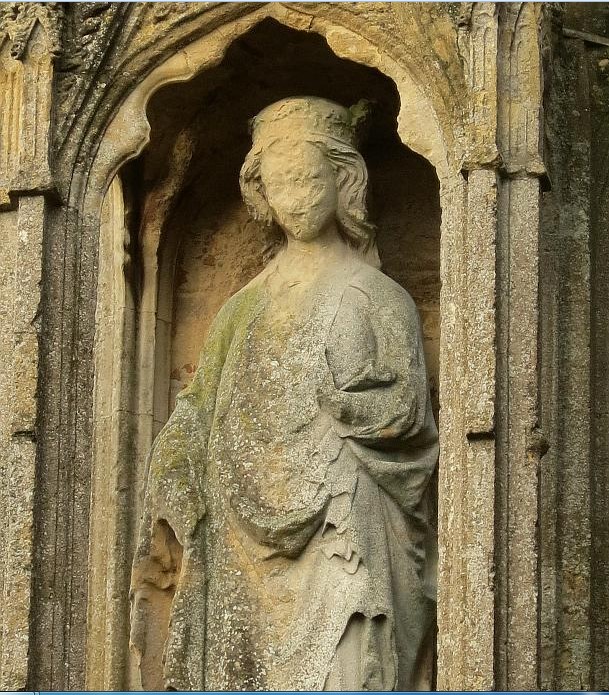
The 'Hardingstone Cross'
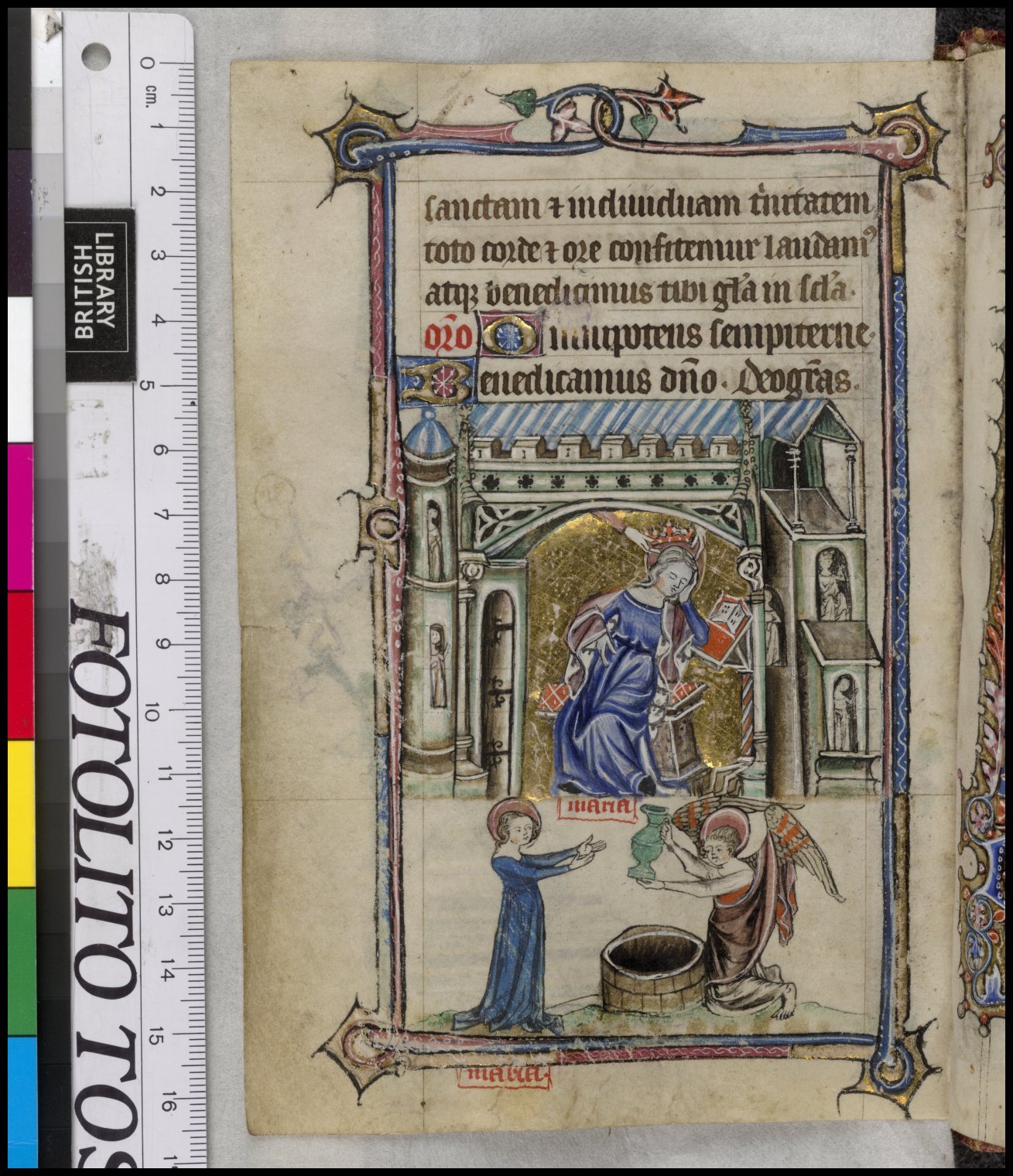
(BL MS Yates Thompson 13 (Taymouth Hours), f.59v- Virgin Mary)
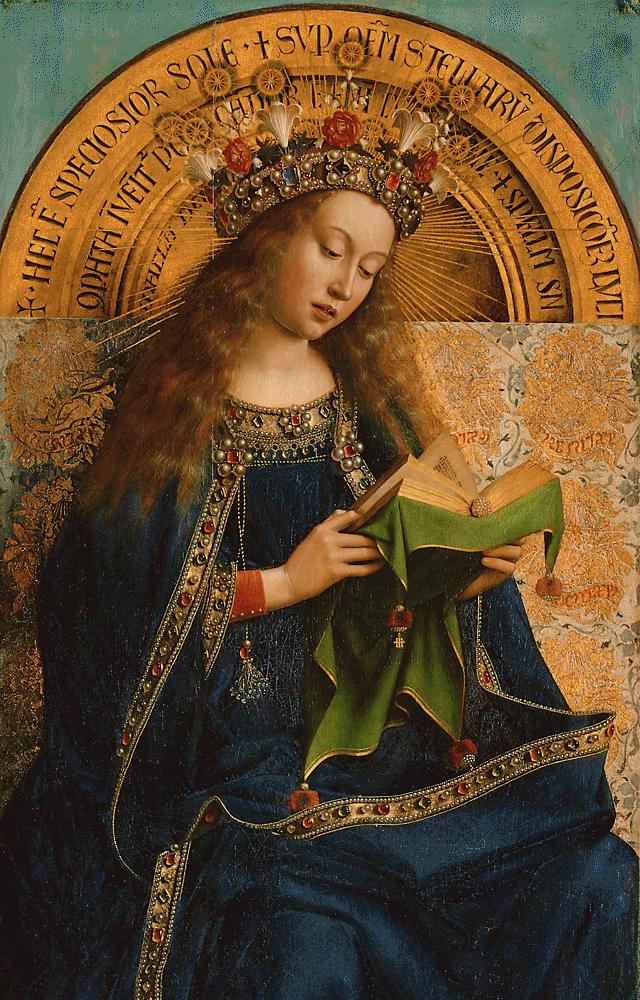
The Virgin Mary from 'The Ghent Altarpiece' by Jan Van Eyck
Decorated with an array of royal heraldry, the crosses form a lavish display of royal splendour. They also had a devotional function. Open books can be seen on some of the crosses. Originally, they were probably painted with requests for prayers. People passing the cross would have been encouraged to look up, see the beautiful figure of the English queen (who looked just like the Queen of Heaven) and then pray for her soul.
But would your medieval man or woman on the street have actually been willing to do this? In her lifetime, Eleanor was widely disliked by the common people. Four years before her death, John Peckham, the archbishop of Canterbury, wrote to one of Eleanor's officials that:
‘It is said that day by day the said lady [Eleanor] continues to acquire plunder and possessions of others…There is public outcry and gossip about this in every part of England.’
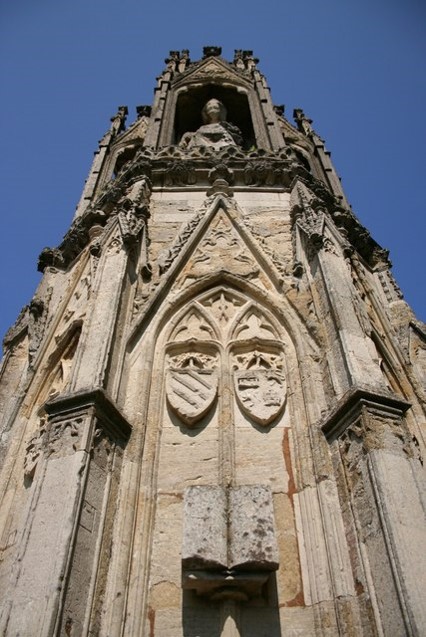
Commemoration 1
Detail of the books on the Hardingstone Cross
Eleanor encouraged her officials to be as grasping as possible, and took over the collection of debts to Jewish moneylenders, gaining the lands pledged as security for these debts. She was also blamed for the ‘oppressive’ aspects of Edward I’s government, as he raised taxes to fight his wars with Scotland, Wales and France. As a popular contemporary song had it: ‘The king would like to get our gold. The queen, our manors fair to hold.’
As well as a token of Edward I’s deep and genuine grief, the Eleanor Crosses may also have become part of (a perhaps unwitting?) royal PR effort - for as the later legends of Eleanor’s heroics in Acre show, she was ultimately remembered as a loving queen.
For a medieval French knight, being a courtier was just as important as being a tactician and military leader. Here, Christophe investigates the many facets of knighthood, inspired by his recent article in a special edition of Revue du Nord.
King Henry V: What prisoners of good sort are taken, uncle?
Exeter: Charles Duke of Orleans, nephew to the king, John Duke of Bourbon, and Lord Bouciqualt.
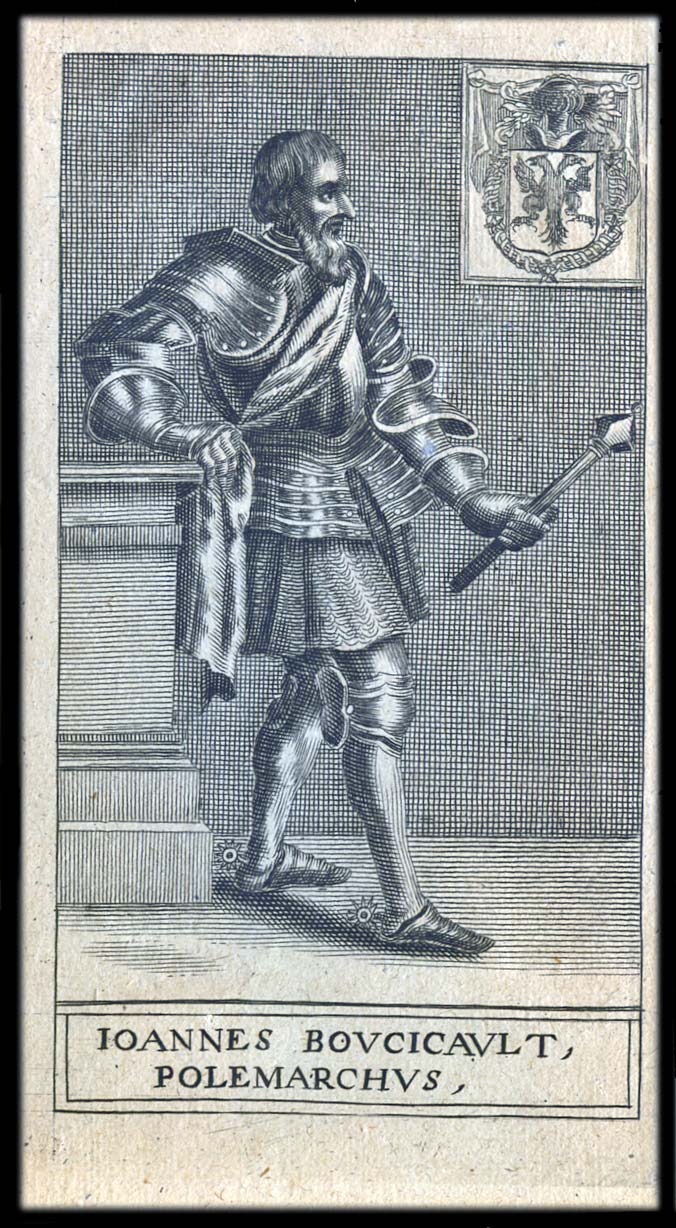
William Shakespeare, Henry V, Act 4, Scene. 8 Marshall Boucicaut
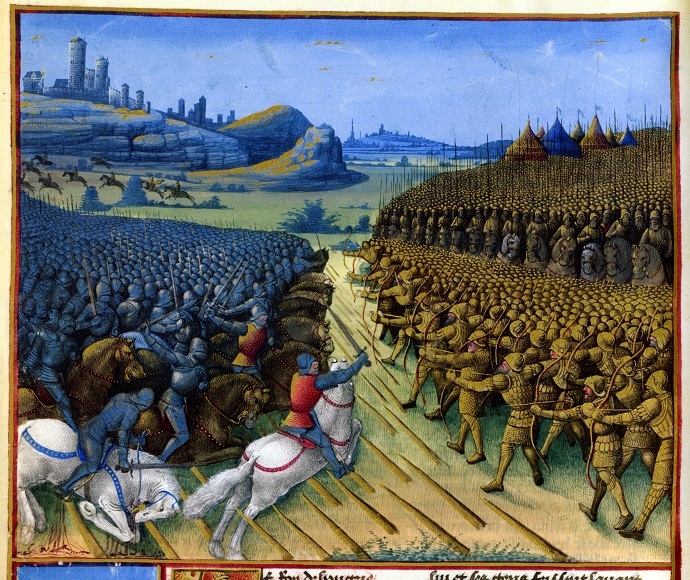
‘Battle of Nicopolis’ (1396), f. 263v. Sébastien Mamerot, Les Passages d’Outremer, Fr. 5594, BnF
In the early fifteenth-century, one of the most prominent French knights and captains was Jean II Le Meingre, commonly known by the nickname Boucicaut.
He was an accomplished jouster who took part in prestigious military campaigns: he joined the Prussian reise, took part in the infamous Nicopolis Crusade (1396), fought in Constantinople against the Turks (1399), ruled the Republic of Genoa for the king of France Charles VI (1401-1409), and of course, waged war against routiers and British troops during the Hundred Years War. It was only to be expected that he would join the French contingent sent against Henry V’s army in Normandy in 1415.
As a Marshall of France—the second most important function in the military hierarchy—, he led an impressive army to cut off the retreat of Henry V towards Calais. He even issued a battle plan, found in the 1980s, that would probably have changed the course of the battle if it had been followed, although it was unlikely to change French and English history. In the end, the French fought differently and were crushed by the English. Kept prisoner, Boucicaut remained a captive until his death in 1421.
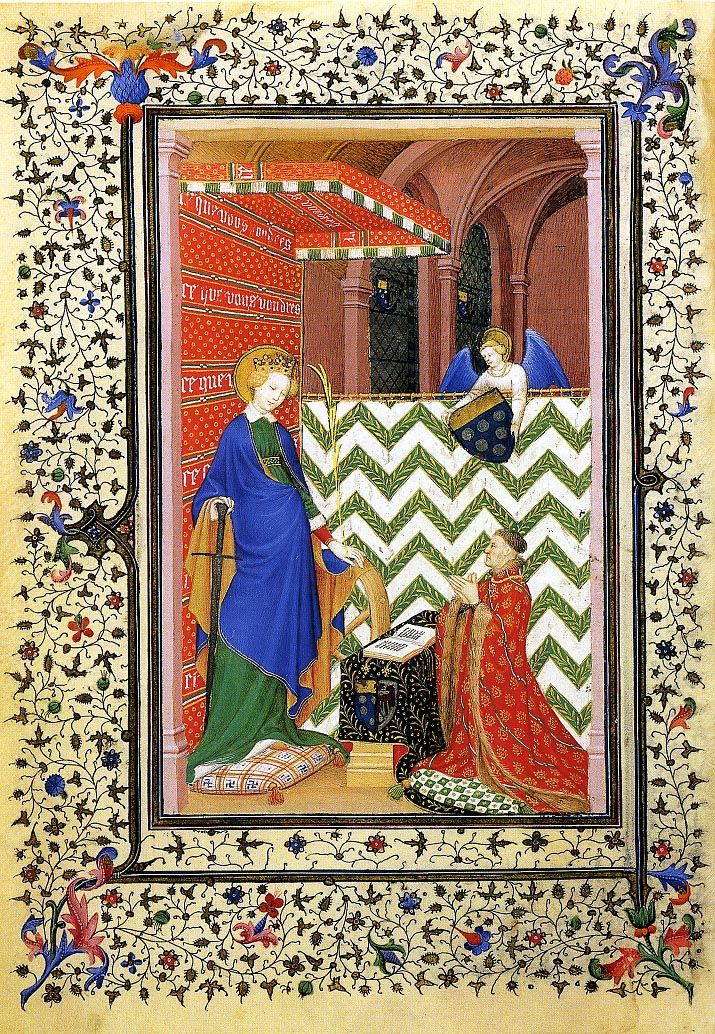
'Marshall Boucicaut Praying before Catherine of Alexandria’, Musée Jacquemart-André, Ms. 2, Livre d’heures du maréchal Boucicaut
Despite this eventful life, Boucicaut was more than a knight loyal to his king. A well-known courtier, he gathered around him several knights and squires who served him in his wars, some of them for years. One of these was Guillaume de Montrevel, who fought the Flemish rebels with Boucicaut in 1382, joined him for his adventures in Constantinople, Cyprus and the Middle East (1403) and who served him again in Italy. We can also mention Louis de Boisredont, serving in Genoa and who, in the Agincourt battle plan, was to attack the English forces from the rear.
In his role as a courtier, Boucicaut even founded his own knightly order, the Ordre de l’Ecu vert à la dame blanche (the order of the green shield with the white lady). Designed to protect oppressed ladies, it was composed of twelve knights, all Boucicaut’s companions, not least of whom was Charles d’Albret, the Constable of France and leader of the army during the Agincourt campaign.
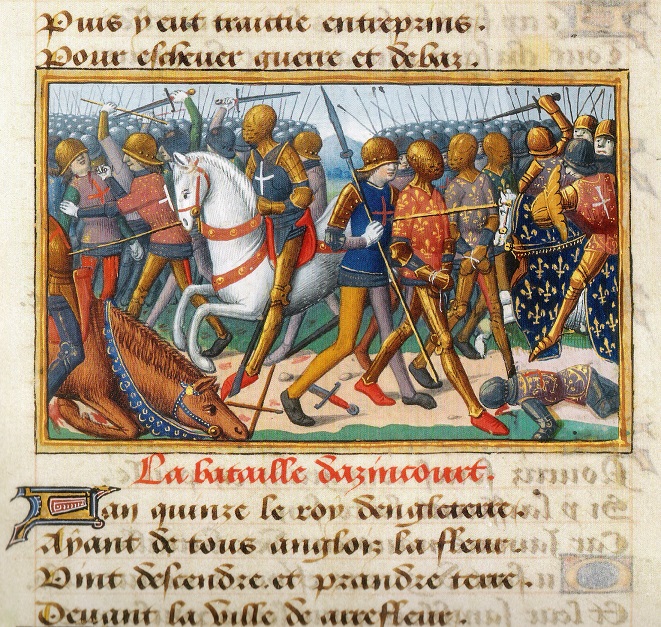
‘La Bataille d’Azincourt’, Martial d'Auvergne, Les Vigiles de Charles VII, Français 5054, BnF
The career of Boucicaut makes it clear that late medieval knights cannot be characterised simply as either brutal and short-sighted soldiers or lazy and fearful courtiers. Many were military leaders, able to conceive battle plans and strategy. Between campaigns, they would enjoy a more peaceful life, composing poems, jousting, and celebrating the service of ladies. These courtly interludes were not mere breaks in their main activities, but instead the perfect moment to create or strengthen political and martial relationships. It was these relationships which made them able to bring together a strong and numerous company of men-at-arms to fight the enemy, be it English, Turk or Italian.
In this post, Christophe discusses how authors wrote about military defeat in 15th Century Burgundy. Was the victor the captain who remained on the battlefield, or the one who captured the largest amount of prisoners and goods? In an era of knightly ideals, the most important thing was how you framed it....
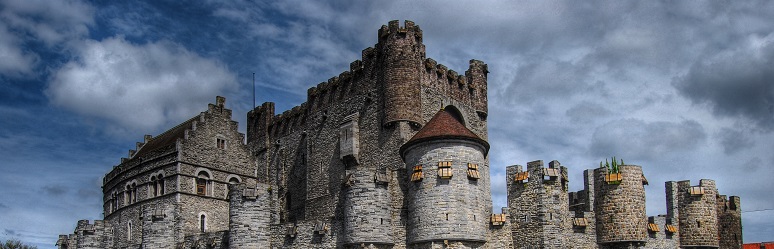
Gravensteen, Ghent
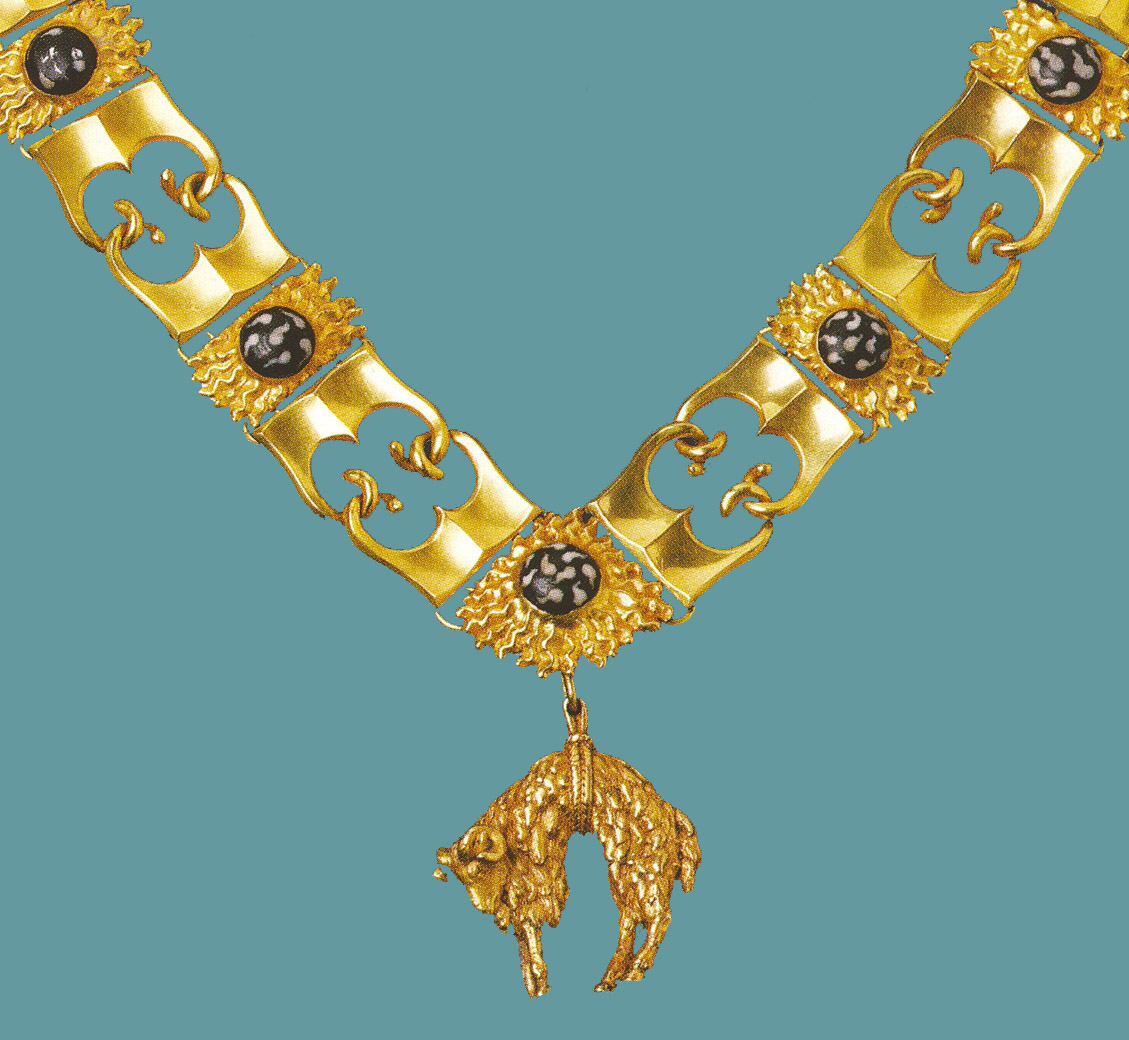
Fifteenth century Burgundy is known to be one of the most brilliant polities of the late Middle Ages. The Order of the Golden Fleece, the Flemish Primitives, the illuminated manuscripts or the beautiful palaces of Dijon, Brussels and Ghent are just some examples of its legacy. Yet Burgundian dukes were also warriors who led important campaigns against, alternately, England, the Holy Roman Empire, France, Switzerland, and the Low Countries, not to mention their crusading enterprises.
Two authors, Olivier de La Marche and Jean de Haynin, respectively from Burgundy and Hainault (currently in Belgium), recorded part of their martial deeds in their Mémoires. These texts help us to understand the day-to-day life and feelings of 15th century men-at-arms. Obviously, large parts of these writings were meant to idealize their dukes, to emphasize their qualities, and to celebrate their success and prowess.
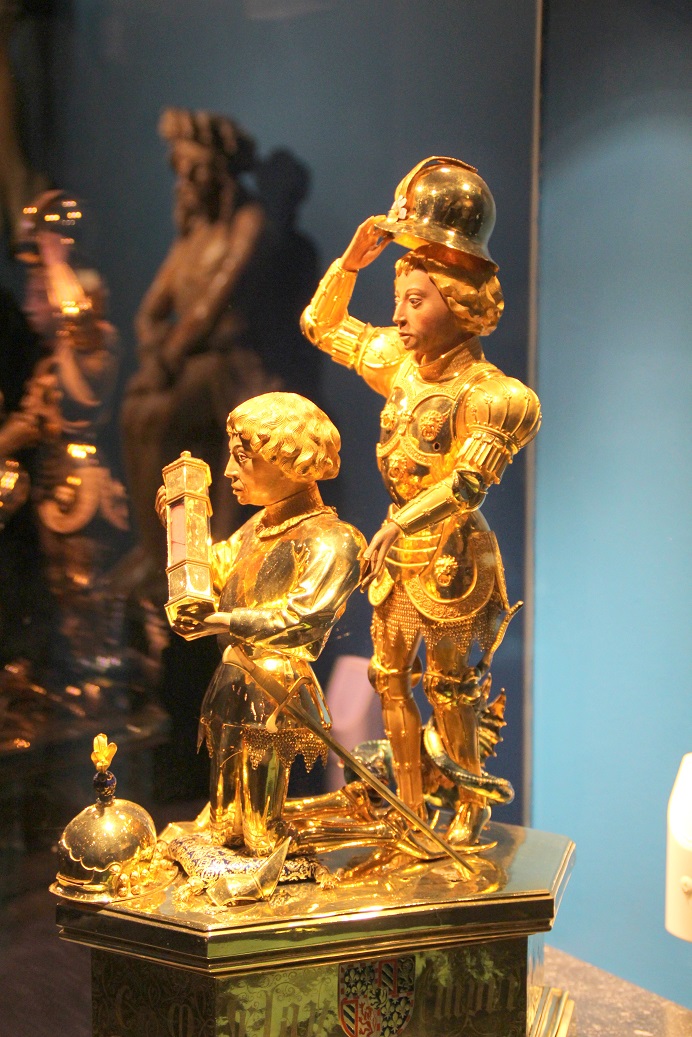
Charles the Bold, Cathedral of St Paul, Liège
Yet, the last duke of Burgundy born from the royal French house of Valois—Charles the Bold—faced several, and increasingly dramatic, defeats. In this context, one could wonder if and how La Marche and Haynin tried to “hide the truth” of his military failures. But it would be a methodological error to think that we can so easily part the so-called “historical truth” from the “historical lies.” Veterans of both successful and catastrophic campaigns, these two writers experienced what it was like to wage war in hostile regions. This is probably what they mostly wanted their readers—Burgundian dukes and aristocrats, members of the court—to understand. Each of the events they described was thus the occasion to, more or less clearly, give their ideas about warfare and how it was meant to be. In this context, defeat was not something to be met with shame alone. Of course, it was to be prevented. But when faced with defeat, there were solutions and attitudes to adopt.
In a martial prospective, the ideal captain was the one who never abandoned his troops, the one who was a kind of “father” to them.
The point most regularly made was that defeat encompasses a wide range of situations, from total annihilation to the situation where no one exactly knew who won, at the end. Was it the captain who remained on the battlefield or the one who captured the largest amount of prisoners and goods?
Order of the Golden Fleece, Kunsthistorisches Museum, Vienna
The answer of Haynin and La Marche was that what really mattered was the way in which captains acted to save as many of their men as they could, and to act as bravely and effectively as was humanly possible. In a martial prospective, the ideal captain was the one who never abandoned his troops, the one who was a kind of “father” to them. If these writers apparently minimized some defeats, it may have been less to hide the truth—that in any case would be known through other channels—than to give a model to emulate to their readers.
Last but not least, this portrait of the warrior great in defeat as well as in triumph was also used to describe the late medieval knight, no matter what his level in the military hierarchy. As this portrait began to be applied to the ordinary members of the army, it opened the way for the implicit dubbing of the entire army, commoners included. It was probably this movement that helped the knightly ideology to regenerate and survive in the Early Modern Period, not to say in Modern times…
This post is inspired by Christophe's recent chapter in P. Delsalle, G. Docquier, A. Marchandisse, B. Schnerb (eds.), Pour la singuliere affection qu’avons a luy Études bourguignonnes offertes à Jean-Marie Cauchies (Brepols 2017). You can read it by clicking here.