
THE TEAM
The project was led by Principal Investigator, Prof. Karl Kügle.
Over the course of the project, six post-doctoral researchers and two project support coordinators have been active.
Project Members 2021 - 2022
From October 2021 to the end of 2022, the project team included the Principal Investigator, Karl Kügle, and two Research Fellows, David Catalunya and Uri Smilansky. More information about their work for the project and their current positions at other eminent institutions can be found in links from their RESEARCH AREAS.
Claire Selby was project support coordinator.
Project Members 2019 - 2021
From October 2019 to the end of the academic year 2021, the project team included the Principal Investigator, Karl Kügle, and three Research Fellows: David Catalunya, Grantley McDonald and Uri Smilansky. More information about their work for the project and their current positions at other eminent institutions can be found in links from their RESEARCH AREAS.
Claire Selby joined the team as project support coordinator.
Project Members 2016 - 2019
From the start of the project in 2016 to the end of the academic year 2019, the Principal Investigator, Karl Kügle, and three Research Fellows were active on the project: Christophe Masson, David Murray, and Laura Slater. More information about their work for the project and their current positions at other eminent institutions can be found in links from their RESEARCH AREAS.
Martha Buckley was project support coordinator.
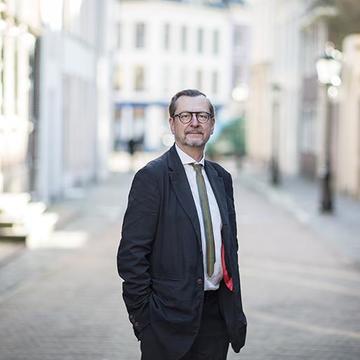
Karl studied piano at the Hochschule für Musik, Munich (1975-81), the Hochschule für Musik, Würzburg (1981-82) and the Juilliard School (1982-83), as well as musicology, theatre studies and Japanese at Ludwig Maximilian University, Munich (1976-82). He continued his studies at New York University, where he earned his Ph.D. in 1993 with a study of the fourteenth-century manuscript Ivrea, Biblioteca capitolare 115 and its music. He subsequently held research positions at the University of Maryland, College Park, the Katholieke Universiteit Leuven, and Johannes Gutenberg-Universität Mainz. In 1998, he joined the Department of Music at the University of Hong Kong where he taught until 2004. In autumn 2004, he was appointed Professor of Musicology at Utrecht University where he held the Chair in the History of Music prior to 1800 until his retirement in 2023. He joined the University of Oxford in 2016, where he was Senior Researcher in the Faculty of Music and a Senior Research Fellow of Wadham College. From 2016 to 2019, he also led the HERA-financed international research project Sound Memories. From 2021 to 2024, he served as Director of Research in the Faculty of Music at Oxford. From October 2022 to March 2023, he was a Visiting Professor in Musicology at Heidelberg University, and from August 2023 to January 2025, he directed the ERC-funded Proof-of-Concept project VALSOUNDS at KU Leuven, a 'brainchild' of the MALMECC project. He currently is Professor emeritus in the Faculty of Music at Oxford University and in the Faculty of Humanities at Utrecht University, and an Eremitus Fellow of Wadham College.
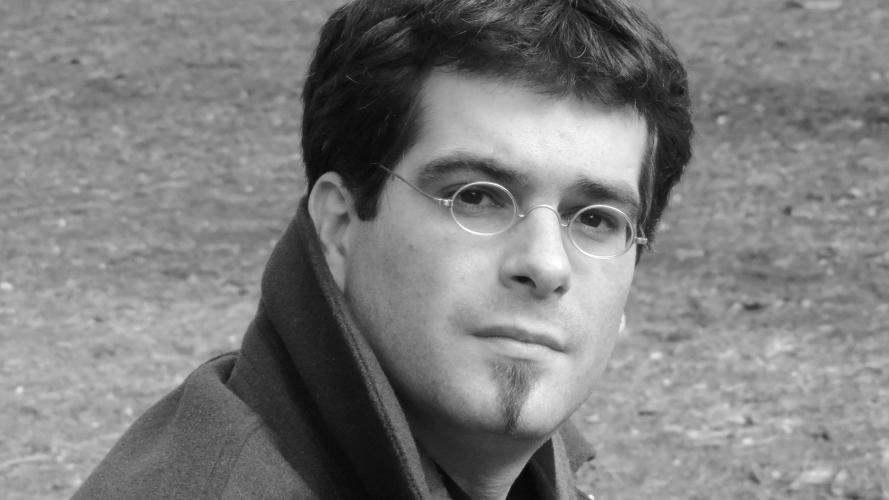
David researched court culture at the Royal Abbey of Las Huelgas, Burgos (Spain) in the period 1200-1360. His studies shed new light on the permeable boundaries between monastic and court culture in this royal foundation and elucidated the staging of royal, public ceremonies – such as coronations, conferment of knighthoods, funerals and the commemoration of battles – within the architectural space of Las Huelgas.
For more information on David's current work, see https://bethlehemorgan.org/.
Uri focused on the function of music as a cultural artefact within fourteenth-century courtly cultures, be it physically manifested in luxury books, experienced as sound in performance, or used for displays of economic or intellectual power. In particular, he was interested in the (re-)presentation of musical identities as expressed through their interactions with a wide range of stakeholders, from scribes and performers to primary and secondary patrons. In this, he concentrated on the figure of Guillaume de Machaut as he was perceived throughout Europe, as well as composers now usually placed under the umbrella term Ars Subtilior.
For more information on Uri's current work at the Basel Academy of Music / Schola Cantorum Basiliensis, see https://www.fhnw.ch/en/music/about/portrait-organisation/people/uri-smilansky.
Grantley joined the project with a keen interest in the cross-cultural aspect of the project's work and aims. His focus was the court and chapel of Holy Roman Emperor Frederick III (1415-1493), with a particular interest on the Imperial chapel.
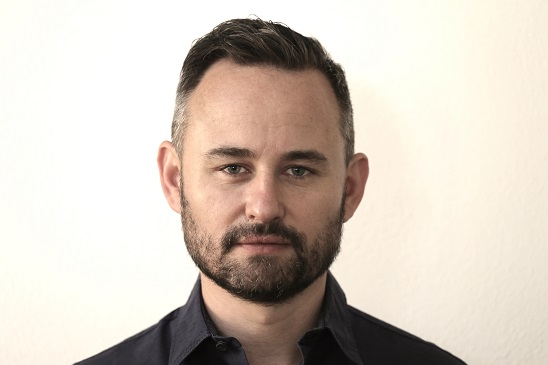
For more information on Grantley's current work, see https://ufind.univie.ac.at/en/person.html?id=61588.
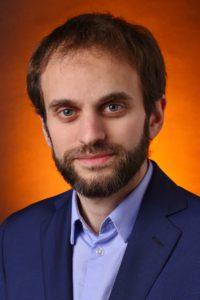
Christophe explored the identity and organization of the courts held by cardinals who lived in Avignon during the first period of the Great Western Schism (1378-1403) when two popes competed, one living in Rome, the other in Avignon.
For more information on Christophe's current work, see https://www.uliege.be/cms/c_9054334/fr/repertoire?uid=u193646.
Please also see his blog post in our series 'Meet the Researchers' for further information about this team member.
David investigated the archiepiscopal court of Salzburg where the anonymous ‘Mönch von Salzburg' (‘Monk of Salzburg')—among other courtiers—composed one of the most important collections of songs in German in the fourteenth century. Including both spiritual and secular material, these songs offer a fascinating insight into the cultural activity surrounding Pilgrim II von Puchheim, Archbishop of Salzburg between 1365 and 1396.
For more information on David's current work, see https://multilingualdynamics.sites.uu.nl/project-description/.
Please also see his blog post in our series 'Meet the Researchers' for further information about this team member.
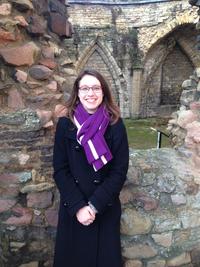
Laura researched the cultural patronage of Philippa of Hainault, wife of Edward III of England. Originating from a region that now cuts across northern France, Belgium and the Netherlands, Philippa's importance as a transnational cultural patron is well-known but has never been explored in detail. Laura focused on the manuscripts associated with Philippa's ownership and personal devotional use.
For more information on Laura's current work, see https://www.hoart.cam.ac.uk/people/laura-slater and https://www.pet.cam.ac.uk/person/slater.
Please also see her blog post in our series 'Meet the Researchers' for further information about this team member.
Claire worked on the MALMECC project providing administrative and finance support to the team from 2019 to 2022. Her interest in music, language and cultural education chimed well with her role supporting this project.
Martha Buckley was Project Support Coordinator from 2016 to 2019.
Martha is now project portfolio manager in the Department of Physics at the University of Oxford and a member of the LGBT+ Allies network in Oxford’s Equality and Diversity Unit.